
Regional NATO “Tour”: What Did Rutte Convey to the Western Balkans?
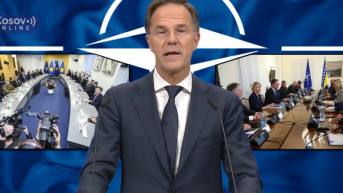
Only two stops on the “tour”: Sarajevo, then Pristina. And a clear message: NATO is the guarantor of peace and stability in the Western Balkans. For analysts speaking to Kosovo Online, the two-day visit of NATO Secretary General Mark Rutte to the region should primarily be interpreted as a response to heightened tensions in Bosnia and Herzegovina, as well as an attempt to revive dialogue on Kosovo.
Written by: Arsenije Vuckovic
Summarizing his visits to Kosovo and Bosnia and Herzegovina, Rutte stated that, as soon as he assumed the position of NATO Secretary General, he intended to visit the Western Balkans due to the significant presence of NATO forces in the region, but that recent developments in Bosnia and Herzegovina made it “even more important” for him to come.
“The discussions went very well, and what I tried to emphasize to all political leaders was to make it clear that I will take an equal approach. When I have requests for one country, I will ask the other two as well. So, if we request something from Bosnia and Herzegovina, we will also request it from Kosovo and Serbia. I also had a phone conversation last week with Serbian President Aleksandar Vucic, who will visit me in Brussels. This way, I will maintain an equal approach,” Rutte said.
At a press conference with Kosovo’s President Vjosa Osmani, he stated that regional stability depends on all parties “choosing diplomacy over violence” and that NATO fully supports the EU-facilitated normalization process “because it is the only guarantee of security.”
“All sides must show flexibility and engage in talks to advance the dialogue. Normalization contributes to the stability and security of the region and all its inhabitants. It is clear that this process requires difficult decisions, but we must look at the bigger picture. Normalization brings greater security, increased investment, and more stability for the entire region and all communities. That is my message to everyone,” Rutte emphasized.
Earlier, in Sarajevo, he stressed that what happened in Bosnia and Herzegovina in the 1990s and in Kosovo in 1999 “must never be repeated.”
“This region has great potential,” Rutte stated.
The Region and Its Turbulence
Senior fellow at the Center for International and Security Affairs (ISAC Fund), Igor Novakovic, pointed out that the primary reason for Rutte’s “Balkan tour” was the situation in Bosnia and Herzegovina, while the visit to Kosovo should be viewed as “protocolary.”
“I believe this was primarily prompted by the recent turbulent events in Bosnia and Herzegovina, specifically everything that has happened following the verdict of the Court of Bosnia and Herzegovina against Milorad Dodik. Consequently, since NATO is responsible for security under Bosnia’s constitution, as well as in Kosovo, the Secretary General of the Alliance visited the two currently most volatile points in the Balkans. That, I believe, is the essence of his visit. In the case of Bosnia and Herzegovina, the message was clear that the Alliance remains in charge of security and will not allow violations of the Dayton Agreement. As for Kosovo, it seems more like a protocolary visit rather than a substantial one,” Novakovic told Kosovo Online.
Commenting on the message that Pristina and Belgrade must resume Dialogue and normalize relations as soon as possible, Novakovic says this is NATO’s well-known position.
“This message does not go beyond what has been stated in the past two or three years and the overall narrative around normalization,” Novakovic emphasizes.
He explains that the position of NATO’s Secretary General does not allow for the delivery of “clear political messages.”
“Very clear political messages are the responsibility of member states and their representatives, particularly the larger ones. Rutte essentially operates at the level of the highest official, conveying messages that align with previously agreed positions and the official narrative,” Novakovic explains.
He clarifies that security challenges in Bosnia and Herzegovina are far more complex compared to those in Kosovo.
“In Kosovo, escalations have largely been limited to the north, which is a relatively small area. The main security threat there has been the potential involvement of Serbia. In Bosnia and Herzegovina, the situation is much more complicated because there are three constituent peoples, internal relations are not great, and a potential flashpoint could escalate into a broader conflict,” the researcher points out.
He adds that this is why NATO found it important to send the message that “violent scenarios will not be tolerated.”
“On the other hand, a political message was also sent that the people of Bosnia and Herzegovina and their political structures must resolve these issues among themselves,” Novakovic concluded.
Geostrategic Situation
Political analyst Shkelzen Maliqi states that, with his visit to the region, NATO Secretary General Mark Rutte clearly conveyed that the Alliance is ready to intervene in the event of escalation or “adventurous actions.”
Tensions in the Western Balkans remain high, but the security challenges are currently much more serious in Bosnia and Herzegovina than in Kosovo, Maliqi says.
“NATO is certainly interested in delivering the message to stakeholders in the Balkans, in Bosnia and Herzegovina, Serbia, and Kosovo, that they are ready and capable of intervening if something happens or if any adventurous actions are planned, given the current geostrategic situation,” Maliqi told Kosovo Online.
He assessed that the Balkans have “relatively peacefully” weathered the effects of the Ukrainian crisis, while the Alliance itself is undergoing a process of “restructuring.”
“NATO itself is restructuring. It is unclear whether it will continue with the U.S. or not. No one can predict that, but a continental defense strategy is still necessary,” Maliqi stated.
He believes that security challenges remain in the Western Balkans, particularly in Bosnia and Herzegovina and Kosovo.
“There are still major tensions in the region. Bosnia and Herzegovina is experiencing significant tensions, and the situation in Kosovo remains uncertain as it is yet to be seen whether and how the dialogue will continue. There are many unknowns. A few months ago, the head of the CIA was in Kosovo, and now the NATO Secretary General is visiting. I believe this is moving towards stabilization, but there will always be groups or forces that seek to exploit the situation for their own gain,” Maliqi specified.
He added that additional concerns arise from the “unpredictability” of the new U.S. president, Donald Trump, as well as the question of how long Europe will remain united.
He also believes that security challenges are currently much greater in Bosnia and Herzegovina than in Kosovo.
“This issue regarding the status of the Dayton Agreement and the ongoing condemnation of Dodik, whom some wish to completely remove from the equation, persists. The question is whether he has the strength to initiate anything and how much support he receives from Serbia for any secessionist moves by The Republic of Srpska. We will have to wait and see, but it is not as risky as it sometimes appears,” Maliqi concluded.
Key Messages
On the other hand, security studies researcher Nikola Vujinovic believes that the primary reason for Rutte’s visit to the Western Balkans was to reaffirm NATO’s legitimacy in this part of Europe.
“Rutte’s visit is an attempt to reaffirm NATO’s legitimacy in the Western Balkans. He visited not only the governments in Sarajevo and Pristina but also the EUFOR and KFOR commands. This demonstrates that NATO is the entity that brought peace and stability and that NATO is the guarantor of peace and stability and will fight against any attempts to alter this,” Vujinovic told Kosovo Online.
He highlights that the primary message in Pristina was the importance of the dialogue process.
“The primary message to Kosovo and the region is that dialogue is paramount. That is the value that must be upheld—dialogue—while NATO stands as the guarantor of security and political stability in the Balkans. What I expected to hear but did not was support for the formation of the Association of Serb Municipalities. I had anticipated this, but it was evidently not part of Rutte’s agenda. I also expected some statement regarding the formation of the new Kosovo government,” Vujinovic noted.
He emphasized that, by visiting Sarajevo and Pristina, Rutte sought to reaffirm NATO and the EU’s security significance.
“In the current international circumstances, NATO as an organization, and especially the EU as a significant part of that organization, have been sidelined. The U.S., Russia, and China are discussing major global issues, and the EU, and by extension NATO, needs a topic in which they can play a dominant role. Unfortunately, that topic is the Balkans. I say ‘unfortunately’ because, when it comes to Balkan issues and problems, the EU does not seem to be on Serbia’s side,” Vujinovic argues.
Analyzing Rutte’s visit to Bosnia and Herzegovina, he said he was surprised by the “conciliatory tone” towards The Republic of Srpska and its president, Milorad Dodik.
“Given all the current events affecting The Republic of Srpska and Bosnia and Herzegovina, I expected him to be much harsher towards Dodik,” Vujinovic stated.
He emphasizes that NATO currently faces much greater security challenges in Bosnia and Herzegovina than in Kosovo.
"At this moment, the security challenges are greater there, and that explains why NATO has strengthened its capacities in Bosnia and Herzegovina. Meanwhile, regarding Kosovo, issues surrounding the formation of a new government could generate problems, but not to the same extent. This is primarily because, for local political elites, NATO’s presence and the importance of Western allies are far greater than in Bosnia and Herzegovina," Vujinovic concludes.

0 comments