
Second term of the most powerful woman in the world – is the Belgrade-Pristina dialogue on her radar?
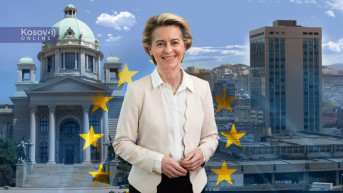
"We want the Western Balkans to join the EU," "The Growth Plan for the Western Balkans is a very clear message for the enlargement process," "We call on Kosovo to initiate the procedure for accepting the Community of Serb Municipalities while Serbia needs to de facto recognize Kosovo." These are some of the messages from Ursula von der Leyen in the last year of her first term as President of the European Commission. As she awaits the formalization of her proposal to lead the EC for another five years, the region is also waiting to see how many of her words will come true during that period.
Written by: Dusica Radeka Djordjevic
If both processes – the integration of the Western Balkans into the EU and the Belgrade-Pristina dialogue – did not last several times longer than von der Leyen's first term, one might even say that these issues are easily solvable for the politician whom the American magazine "Forbes" declared the most powerful woman in the world for two consecutive years (2022 and 2023).
The mosaic of the new European Commission has yet to be completed, and what is seen from the perspective of Belgrade and Pristina as an advantage of von der Leyen remaining at its helm is her familiarity with the Brussels dialogue and her alliance with the EU enlargement policy.
Serbian President Aleksandar Vucic said it was good news for Serbia if von der Leyen got a second term.
"We worked well with her, and I believe we can do even better and more," Vucic said last week.
Political scientist Ognjen Gogic says for Kosovo Online that in von der Leyen's first term, the issue of the Belgrade-Pristina dialogue was not at the top of her agenda and that she had other priorities, but that she also addressed this issue, among other things, because it is connected with the EU enlargement policy, which she has been very interested in.
Considering that von der Leyen last autumn called on Serbia to de facto recognize Kosovo, Gogic says she did so only after EU member states had defined the European plan for Serbia and Kosovo regarding the path to normalization. He also emphasizes that the European Union's approach to the dialogue is not defined by the European Commission and commissioners, nor by the President of the Commission or the High Representative, but they are the implementers of decisions made by the member states.
"This plan was primarily defined by Scholz and Macron, and then Italian Prime Minister Giorgia Meloni joined them. The three of them first called on Serbia and Kosovo to implement the obligations from that agreement in a letter in October last year, which, as they themselves explained, for Serbia actually means de facto recognition of Kosovo. They were the first to say that the implementation of the Brussels and Ohrid agreements means de facto recognition, and then Ursula von der Leyen repeated it. So, she did not present a new idea, concept, or demand, but repeated what the heads of states and governments themselves had defined," Gogic states.
He points out that the future approach and demands of the European Union will not depend on her, but that she will implement the policy of the most powerful member states.
"As things stand now, as Borrell said, people change, but the policy remains the same. So, for now, the European Union's policy towards the dialogue essentially means further implementation of the obligations from Brussels and Ohrid, which actually means, according to their interpretation, de facto recognition of Kosovo. The role of von der Leyen and Kaja Kallas will be to implement that policy until it changes, but it should be noted that this agreement has failed, that this policy has crashed, and that the EU will very likely have to somehow redefine the entire approach once the new European Commission is elected because this one has reached a dead end and it is not expected that new progress in the implementation of these obligations can be made," Gogic believes.
Commenting on Serbian President Aleksandar Vucic's statement that it is good news for Serbia if Ursula von der Leyen gets a second term as President of the European Commission, Gogic says that President Vucic welcomed her reappointment partly because she made significant steps towards EU enlargement during her mandate.
"During her mandate, two very significant initiatives for our region were launched: one is the formation of a common regional market, and the other is the recently initiated Growth Plan for the Western Balkans. These are all results of her work, and she will continue to support the integration of the Western Balkans into the EU as President of the European Commission. What connects von der Leyen and President Vucic is political affiliation, as President Vucic comes from the Serbian Progressive Party, which is part of the European People's Party family, to which Ursula von der Leyen's Christian Democratic Union also belongs. There are much better relations between the authorities in Serbia and European Christian Democrats and conservatives than with Social Democrats, greens, and others. So, there is a kind of political closeness between them," Gogic states.
Political analyst Arton Demhasaj says for Kosovo Online that von der Leyen is familiar with the Serbia-Kosovo dialogue process and that she can achieve its completion in her second term.
"For Kosovo, this would mean no longer needing to spend energy on dialogue with Serbia but instead focusing on internal problems related to education, healthcare, and similar issues. I believe this will be the last chance for the EU to show that the dialogue between Kosovo and Serbia must be concluded as soon as possible so that both countries can move toward the EU," Demhasaj says.
In his assessment, the dialogue will have to end with mutual recognition, and for Serbia and Kosovo to become EU members, they must meet the conditions defined in their agreements with the EU.
"If Kosovo and Serbia are not in the EU, neither the Balkans nor the EU will be at peace. The EU is currently in a phase where it refuses to expand due to an internal crisis, and I think that the new appointees in the European Commission should be clear toward the Western Balkans in terms of foreign policy, emphasizing that it should become part of the EU, but certainly only after meeting the conditions set by the EU for membership," Demhasaj states.
Nemanja Todorovic Stiplija, Director of the Center for Contemporary Politics and editor of the European Western Balkans portal, believes that von der Leyen will most likely insist on the implementation of last year's dialogue agreements in her second term.
"I do not believe that her appointment will change anything. Her policies and how she worked in the previous period will remain the same. For us, it is important that she will most likely insist on the implementation of the Brussels and Ohrid agreements, or, as she called it, de facto recognition of Kosovo. I think she will not abandon this, nor will the next European Commission. Regarding Vucic's relationship with von der Leyen, she has, on several occasions during her visits to Belgrade, somehow tried to downplay the problems of democracy and the rule of law in our country, which suited him on the domestic level, and I believe that von der Leyen's policy will, unfortunately, continue," Todorovic Stiplija says.
The re-election of von der Leyen, according to Aleksandra Kolakovic, a senior research associate at the Institute for Political Studies, will mean continuity with her first term, and when it comes to the Belgrade-Pristina dialogue, she notes that it is always better to have continuity.
"In the sense that if you have started communication with certain individuals, to continue that communication in the next phase. If there were significant changes, it would always require time for all those people to get better acquainted with the situation on the ground. Here, it is evident that there is already a process ongoing with, I would say, more setbacks and a few advancements," Kolakovic says for our portal.
Speaking about the EU enlargement to the Western Balkans, she says that there is a framework of a rounded, homogeneous Europe, European states that are all in one geopolitical space.
"We see that there is talk about the countries aspiring to become full members of the EU from the Western Balkans receiving certain financial aid, or funds, and entering a space where they can experience all the benefits of the European Union and understand why becoming an EU member is advantageous. This leads to some form of integration before the final integration. We have been waiting for this for quite a long time, the years keep shifting, and there is a certain fatigue and growing euroskepticism. This euroskepticism also grows with the rise of right-wing parties, making the integration process more difficult from both sides, but it is something that will undoubtedly be worked on, as we see in the context of Hungary's presidency of the EU Council, which has just begun," Kolakovic says.
She believes that the future leadership of the EU will work on the homogenization of Europe itself and ensure that the decisions made are consistent.
"Now we have an economically stronger Europe and a Europe of new technologies and innovations, but on the other hand, it is a Europe that firmly stands by the stance that Ukraine needs to be protected and that the issue of European security is essentially the issue of Ukraine," Kolakovic concludes.
EU leaders proposed Ursula von der Leyen as a candidate for a new term as President of the European Commission last week, and this proposal must also be confirmed by the European Parliament.

0 comments