
Small Families – a big problem for modern society: How the declining birth rate trend threatens the future of the region?
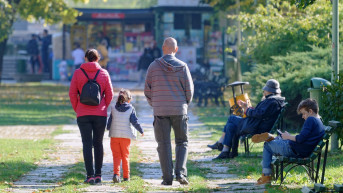
The decline in birth rates is causing concern worldwide, and this problem of 'modern society' has not bypassed our region either. There are numerous theories explaining the population decline, but there is no systematic answer on how to combat it. Experts explain to Kosovo Online that demographic issues are extremely complex and warn that the functioning of the state depends on them.
Many countries are facing a population decline and aging. Fewer births have serious consequences for the functioning of the family and society, the economy, and even security. An aging society means fewer workers in key industries and fewer people paying for programs like social security.
On the other hand, among the major obstacles to parenthood are rising living costs, the expenses of childcare, and the inability to buy a home.
For this reason, the Government of the Republic of Serbia adopted a Regulation on the Determination of the Program to Support the Implementation of Population Policy Measures and Support in the Field of Family and Children in the Republic of Serbia for 2024 at yesterday's session, allocating 400 million dinars for this purpose.
"The goal of adopting this document is to support measures of pro-natal policy in local self-governments, given the general objective of sustainable demographic development, which is a stable population, i.e., a population in which the next generations will be the same size as the existing ones", the Government's statement said.
These measures were recently announced by President Aleksandar Vucic. On that occasion, he stated that we must increase the fertility rate if we wanted Serbia to survive.
"As for children, we must look at how to reward mothers with four or more children. We have identified our weaknesses; the biggest problem is the first and second child, but we must solve that. We are very poor in terms of natural population growth, but slightly less poor than others in the region for the first time in history. We must continue that trend and raise the fertility rate to 1.75; that is the next goal. We had 1.48 ten or eleven years ago; today it is 1.63. We must raise it to 1.75 if we want Serbia to survive.
I don't know why we are building all this; there will be no one to inherit it. The world doesn't end when we leave this world. We must think about our country and our children. That is my plea to all people. In addition to helping themselves, making their lives better, people help their country, their state a lot", Vucic said.
The decade-long trend of declining birth rates in Serbia has been confirmed by Dr. Danica Santic, a Professor at the Faculty of Geography in Belgrade, confirmed to Kosovo Online. She points out that demographic issues are extremely complex and affect the functioning of the state, as they not only influence social aspects but also economic conditions.
"When we talk about the number of live births in Serbia, the trend has been consistently declining over the decades, indicating a continual decrease in the number of live births. According to some recent data published by the Statistical Office, the decline in the number of live births continued in 2023. There were 56,001 births, which is about 860 fewer than in 2022. If we compare this with the beginning of the 21st century, there has been a two-thirds reduction in live births over the past 20 years", Santic said for Kosovo Online.
Such a trend, she explains, is a process happening in all countries worldwide, primarily related to the demographic transition, i.e., the shift from higher birth and death rates to lower ones. She adds that it is a historical process that began about 200 years ago in developed countries in Western Europe.
“The reasons are numerous. This is primarily due to lifestyle changes, the transition from an agricultural society to what we now call a modern society, moving from rural areas to urban environments", Santic says.
She adds that there is now a trend of small families. Previously, these were families with two children, and now, especially in developed parts of the world, these are families with one child.
The consequences of this are also visible in the labor market. Santic notes that in the immediate vicinity, or some EU countries, there are examples where low birth rates are already manifesting as a labor shortage. The closest example, she says, is Germany.
According to her, a similar situation exists in Serbia, so last year, the law on the employment of foreigners and the law on residence were modified, given that, due to a low birth rate, our market required certain job positions to be filled by foreigners. In the previous year, she adds, according to some estimates, as many as 80,000 work permits were issued to foreigners, precisely for those in-demand occupations that there was no one to perform in Serbia.
In response to the question of how to promote an increase in birth rates, Santic states that, until now, no one has devised a systematic answer. Countries are attempting to address the needs of both families and children through various material incentives, aligning work and parenthood, and paying attention to the psychological costs of parenthood. However, significant demographic results require years.
"Primarily, I mean birth rates because any strategy to improve childbirth, all measures aimed at increasing the number of children in families, will show its effects only in 10 or 20 years. Thus, things move very slowly in demography in terms of positive or desired effects, and demography is undoubtedly the most important issue for any country, and soon we will become aware that it is also crucial for the planet as a whole", Santic says.
In recent years, the birth rate has sharply declined in Kosovo, and sociologist and political analyst from Pristina, Artan Muhaxhiri, attributes this primarily to changes in lifestyle, migration, and the government's poor population policy. As he stated for Kosovo Online, in the past, there had been different criteria, especially compared to today.
“The quality of life has changed, the level of education has changed, the way people plan families..., so it is impossible today, for example, to have ten children, as was the case in the past. This is because there is increasing pressure on people for their children to have a quality life, which is not feasible with the current level of wages and expenses, so people choose to have fewer children to provide them with better conditions," Muhaxhiri says.
As our interlocutor explains, the decline in population has numerous social, economic, and cultural consequences. This primarily affects the lack of a workforce, which also raises security concerns.
"A smaller population requires immigration to fill the empty space in the labor market. This is a big problem because Kosovo does not have good enough security measures to filter foreign labor, i.e., migrants who would replace domestic workers. Also, we should not forget that migrations are a big problem for Kosovo, and they are the number one cause for the population decline in recent years," the sociologist from Pristina explains.
Muhaxhiri explains that there is a significant difference between whether the number of children a family plans to have is a personal choice or imposed due to poor population policies.
"If it is a choice, as it is in the West, states have good programs to counter these changes, but here, I don't believe the government has the capacity when it comes to family planning, improving education, and the healthcare system. There are many reports about the closing of schools in small villages in Kosovo because there are not enough students, and unfortunately, I don't see anything meaningful and good in the government's plans, so I think it is not a priority for our government," Muhaxhiri says.
A similar situation is present in Albania. As the main factors contributing to the declining birth rate, Ph.D. Arjana Mucaj, the Head of the Department of Pedagogy and Psychology at the Faculty of Social Sciences in Tirana, a sociology professor, cites the uncertain future for young people and migration. Kosovo Online interlocutor links the decline in birth rates to the strengthening role of women and girls in society, as well as the fact that young people are increasingly focused on professional achievements and careers.
"I am talking about young families, just created, who do not believe that their future in our country will be happy. It should be emphasized that the years of education have increased because each of them aims to advance in their professional career, and only after succeeding in that do they think about starting a family and having children. In Albania, there is another significant cause, and that is population migration, which can be considered 'early society' here. Mass emigration has led to consequences for the economy. So, we have several elements – insecurity and a lack of desire among the youth to quickly form a family. These are the main factors influencing the reduction of the birth rate in our country," Mucaj said.
She notes that there has been a significant drop in births in the last ten years, and before the 1990s, the average Albanian family had five or six children. Today, they have a maximum of two.
"There are statistics on the aging of the population in all European countries, including Albania. In our country, in the next decade or two, it will be a very sensitive problem that will affect health services because the elderly need more healthcare than the young. Also, we will have a problem with social services, but the main concern will be related to contributions to social insurance and pensions. We know very well that the number of contributors should be significantly higher than the number of pensioners," Mucaj explains.
As one of the possible solutions for increasing the birth rate, she suggests creating opportunities for young people to have a better life in Albania and encouraging the return of those who have left the country.



0 comments