
Sorensen's first moves: Will the establishment of the CSM be among the priorities?
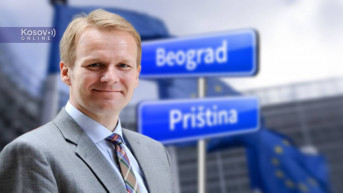
To start, phone conversations with the chief negotiators, Petar Petkovic and Besnik Bislimi, along with courtesy calls to visit Belgrade and Pristina. But that is the easy part. The much harder task lies ahead in the coming months – finding a way to bring both sides back to the dialogue and ensuring they fulfill their commitments. The establishment of the Community of Serb Municipalities will be at the top of that agenda, but it will also depend on the composition of the future Kosovo government, interlocutors of Kosovo Online say.
Written by Arsenije Vuckovic
"I appreciate the very good conversations and welcome their invitations to visit Kosovo and Serbia soon," was posted on the official social media account of the EU envoy for dialogue on platform "X."
Peter Sorensen took over the role from Miroslav Lajcak on February 1.
During his nearly five-year tenure leading the dialogue, 14 meetings were held at the leadership level and 31 at the level of chief negotiators.
Lajcak considers the Ohrid Agreement to be the crowning achievement of his work and is convinced that its implementation will be at the top of his successor’s agenda.
"Without its implementation, it is difficult to see progress in European integration for either side," Lajcak said, reflecting on his tenure, during which he visited Belgrade and Pristina 28 times each.
However, judging by initial promises, unlike Lajcak, the Danish diplomat will not be handling this task alone.
The EU’s High Representative for Foreign Affairs, Kaja Kallas, has announced that she will be directly involved in the negotiations and intends to lead the process.
"There is important work ahead of us. Full normalization of relations is the only way for Kosovo and Serbia to join the EU," Kallas stated.
Mandate and first steps
Dragisa Mijacic, coordinator of the Working Group of the National Convention on the EU for Chapter 35, has no doubt that the new EU Special Envoy has a clear mandate, but he believes his first moves will come only after the formation of Kosovo’s new government.
This includes Pristina’s key obligation – the establishment of the Community of Serb Municipalities.
"Sorensen has arrived with a clear mandate, which is to facilitate the implementation of the Agreement on the Path to Normalization and its Ohrid Annex. Both short-term and long-term steps should be sought within these foundations. His task, after the formation of the Kosovo government, is to bring both sides to the negotiating table and enable the implementation of the agreement, with the first step being the formation of the Community of Serb Municipalities," Mijacic told Kosovo Online.
He emphasizes that establishing the CSM is fundamental to any normalization of relations between Belgrade and Pristina.
"It is also a prerequisite for Kosovo's membership in international organizations such as the Council of Europe. Sorensen will have a major and difficult task in initiating the implementation of these activities," he specified.
Commenting on Kosovo Prime Minister Albin Kurti’s claim that if he secures a new mandate, he will not establish the CSM, Mijacic warnes that such a stance would return the dialogue to a "vicious cycle."
"This means that if Kurti remains at the helm of the government, we will once again enter a vicious cycle of activities that will not lead to normalization but rather to the deterioration of interethnic relations and overall relations between Kosovo and Serbia," Mijacic stressed.
The Belgrade-Pristina dialogue under Peter Sorensen’s leadership will largely depend on the "wavelengths" between Washington and Brussels, as he says.
"A key question here is how Washington will position itself regarding these negotiations led by Sorensen, whether it will support him in this process, whether Washington and Brussels remain on the same wavelength, or if each will pursue its own policy. At this moment, no one can say for sure," Mijacic noted.
However, he adds that Brussels and Washington agree on one thing.
"They have expressed dissatisfaction with Albin Kurti’s unilateral actions, and there is an expectation that such actions will not occur in the coming period. That is the key to further activities and success: coordinated actions agreed upon by both sides, along with Brussels and Washington. Otherwise, the process will lead to sanctions and punitive measures, which no one from this region wants," Mijacic emphasized.
He points out that lifting the EU measures against Kosovo is a complex issue because "it was easy to impose them, but difficult to remove them" due to the required consensus of all member states.
He believes that local elections, expected in the fall, will be a determining factor.
"There will likely be no consensus on lifting sanctions until new local elections are organized, expected around October this year. This means that sanctions will likely remain in place throughout the year. If the Kosovo government does not take decisive steps toward forming the CSM, I believe these sanctions will continue," Mijacic stressed.
He notes that beyond punitive measures, the European Union also has "other mechanisms" to pressure Pristina into fulfilling its obligations.
"Rather than directly targeting the Kosovo government, they will primarily marginalize Kosovo in relation to the other six Western Balkan countries and certain integration processes," Mijacic explained.
He is convinced that many uncertainties will be clarified on February 9 with the results of Kosovo’s parliamentary elections.
"I’m not saying that February 9 will provide all the answers, but it will provide many. We will see how things unfold if Albin Kurti’s government remains in power – whether he will maintain the same discourse or change his narrative. Knowing Mr. Kurti, no one expects him to soften his stance in the negotiation process, which means new difficulties, primarily for the Albanian society in Kosovo, but also for all citizens of Kosovo due to his unilateral actions," Mijacic said.
He emphasizes that an additional challenge for the new government, if led by Kurti, will be its relationship with the new US administration.
"We have seen Richard Grenell’s statements, and he will certainly play a role in the US administration regarding Kosovo-Serbia relations. His stance on Kurti's statements has been extremely negative. This presents a limiting factor for Kurti – whether he will pursue self-isolation, for which he will be solely responsible, or whether he will engage in integration, regional, and European processes, which are expected not only in Pristina and Belgrade but also in Brussels and beyond Europe," Mijacic concluded.
Electoral calculations
Analyst Afrim Kasolli believes that Sorensen’s initial moves in the dialogue process will depend on many factors, including who will form the next Kosovo government.
"The EU has made it clear that Kosovo's first step in this direction should be to send the draft Statute to the Constitutional Court for review of its constitutionality, as a fundamental step toward establishing the Community of Serb Municipalities. This will also depend on who will lead the Kosovo government. Prime Minister Kurti has recently neglected this obligation," Kasolli told Kosovo Online.
He specifies that most Albanian parties avoided taking a stance on the formation of the CSM during the campaign. The exceptions were the leader of the Self-Determination Movement, Albin Kurti, who stated that it is not within the government's jurisdiction, and the Alliance for the Future of Kosovo (AAK) candidate for prime minister, Ramush Haradinaj, who declared that he would send the draft Statute of the CSM to the Constitutional Court immediately upon assuming office.
"Since this issue does not bring electoral benefits, the Democratic League of Kosovo (LDK) and the Democratic Party of Kosovo (PDK) did not express their positions on it, stating that they would not implement any of the obligations Kurti accepted during the negotiations in Brussels and Ohrid," Kasolli said.
He emphasizes that the success of the new European envoy in the dialogue, Peter Sorensen, will depend on many factors, including conditionality with the integration agenda and Euro-Atlantic integration.
"Progress in the dialogue will also depend on what leverage the EU decides to use. Either it will apply more pressure, or it will offer incentives that can be gained if obligations are fulfilled," Kasolli stressed.
He also warns that the new European negotiator will be influenced by internal EU issues and the future relationship between Brussels and Washington.
"It seems that the EU will be more focused on handling this newly emerging situation and on how Trump will manage his new administration rather than dealing with other sensitive geopolitical issues, such as the Western Balkans," the analyst believes.
Another serious issue, according to Kasolli, is the potential "trade war" between the US and the EU, as well as political crises in the most powerful European countries, which played a key role in reaching the agreements in Brussels and Ohrid.
"France and Germany have their own internal political and electoral challenges. Institutional formations are pending, who will head the government, who will be the chancellor. These are the two main drivers of the project that is binding for both Kosovo and Serbia, and they are expected to be active in pressuring both sides to implement the agreed obligations," Kasolli pointed out.
Therefore, he predicts that much in the further negotiations between Belgrade and Pristina will not depend on the will of the new EU mediator.
"All these factors, regardless of his personal willingness, could obstruct his success. Ultimately, this issue will also depend on the consensus of EU countries. Before the departure of the previous representative, Miroslav Lajcak, who announced after the September 24 attack that the EU sanctions on Kosovo would be lifted, nothing of the sort happened because EU member states failed to reach a consensus. In that sense, the EU itself is in an unclear position, it is not unified in its promises to these two countries in the integration process," Kasolli stated.
An additional issue, he notes, is the intention of the new US administration to have "exclusivity" in resolving global conflicts.
"We have seen that the EU was excluded from attempts to establish contact between President Putin and Trump regarding the resolution of the Ukraine crisis. The plan to resolve the conflict is exclusively American, putting the EU in an unfavorable position and, consequently, the EU negotiator for the Kosovo-Serbia dialogue as well," Kasolli concluded.
Revitalizing the dialogue
Stefan Vladisavljev, Program Coordinator at the BFPE Foundation for a Responsible Society, believes that at the start of his mandate, Peter Sorensen will have to find a way to revitalize the Belgrade-Pristina dialogue and ensure the implementation of agreements signed so far. However, he says that Sorensen also faces uncertainty regarding who the actors in this process will be.
"After making the usual welcome phone calls, he will have to reassure everyone that he is dedicated to the dialogue process, which is his sole task in this mandate. Unlike Lajcak, his focus is not the entire Western Balkans, but solely the dialogue process. I expect that he will sit in his office and carefully consider how to revitalize the dialogue process, given that it has been stagnant for a long time and has not yielded any concrete results," Vladisavljev told Kosovo Online.
He believes that the starting point should be the agreements already reached.
"There is quite a bit that has already been written down on paper. The question is how feasible it is to implement such things," Vladisavljev noted.
He is convinced that the topics of Sorensen’s first discussions with relevant actors from Belgrade and Pristina will involve returning to the initial negotiation points: the Ohrid Agreement, the Implementation Agreement, and the formation of the Community of Serb Municipalities.
"These are prerequisites for any further progress, both in the dialogue process and in the broader process of normalization," Vladisavljev emphasized.
He warns that a key issue for continuing the dialogue is determining who will actually lead it.
"There are many unknowns regarding the actors currently involved in the dialogue process. We are waiting for the election results in Pristina to see who will actually be the interlocutor from that side. Will the same political faction remain in charge, or will someone new potentially take over? On the other hand, in Belgrade, societal issues are currently in focus, along with political tensions caused by protests following the collapse of a canopy and the tragic deaths of 15 people in November," Vladisavljev explained.
Because of this, he believes, neither Pristina nor Belgrade currently have the dialogue as a priority.
"One of Sorensen’s tasks will be to bring the dialogue back into focus, to assess the level of political will on both sides to implement these agreements. And if the political will is insufficient, he must find certain mechanisms, not coercive ones, but mechanisms that will motivate the actors to constructively engage in implementing the agreements and advancing the normalization process," Vladisavljev stressed.
So far, conditioning progress with European integration has been, as he emphasizes, the "main lever of power."
"For a long time, the main lever of power was the prospect of EU membership. What will now be a task not just for Sorensen, but for the entire EU infrastructure, is to convince the actors that this remains a relevant leverage point and to clearly outline the goals that need to be achieved, both short-term and long-term. These should then be seamlessly integrated into the normalization process, as history has shown that progress is most successful when there is a 'light at the end of the tunnel' to strive for. Moreover, it is crucial to have clear and concrete measures for both sides in the implementation process. Defining and clearly presenting these measures will be his priority," Vladisavljev concluded.

0 comments