
Storm in Albania over the Serbian consulate in Shkoder
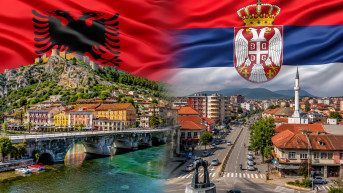
Amid a heated summer marked by daily anti-government protests on Tirana's main boulevard, Albania has found itself facing another issue that has sparked fierce debate in the media and on social networks. A few days ago, Serbian Foreign Minister Marko Djuric announced that Serbia and Albania had reached a preliminary agreement to open consular offices in Bujanovac and Shkoder. Meanwhile, Albania's Minister for Europe and Foreign Affairs Ferit Hoxha stated that the matter is still under consideration, while assuring the public that a Serbian consulate in Shkoder would not undermine Albania's sovereignty and that Albania's presence in Bujanovac serves the country's national interest.
Written by: Bledar Kuka
Former Foreign Minister Ditmir Bushati, independent MP Marjana Koceku, political analysts, and other public figures have spoken out against the initiative of Prime Minister Edi Rama's government, and, at least for now, the voices opposing the proposal appear to be louder than those supporting it.
On Sunday, a group of citizens in Shkoder protested against the announcement that a Serbian consulate would be opened in the city.
They argued that Shkoder has no historical, economic, or diplomatic ties that would justify the presence of a Serbian consulate and described such a move as unacceptable, particularly "because of the crimes committed by Serbian forces during the Kosovo war." They therefore called on the Albanian authorities to reconsider the decision.
The announcement has also drawn reactions in Kosovo. Constitutional law professor Mazlum Baraliju argued that there is no need for Serbia to open a consulate in Shkoder, while former Kosovo Foreign Minister Meliza Haradinaj described the proposed consulate as "a Greater Serbian political project" and said it would be "shameful and anti-national if Albania allowed itself to become an instrument of Serbia's diplomatic strategy."
For the Serbian community in Shkoder, however, the announcement has been welcomed.
Brajovic: We will no longer have to travel to Belgrade or Podgorica for documents
One of the representatives of the Serbian community in Shkoder, Milojka Brajovic (Vaso), believes that the move will significantly improve the daily lives of Serbs living in Albania.
"This is something very positive because we will no longer have to travel to Podgorica or Belgrade to obtain documents, seek clarifications, or deal with any other matters requiring assistance from Serbia. I also believe it is positive because one of our young people may find employment at the consulate. It belongs to them, because they will regard that consulate as theirs more than anyone else's," Brajovic told Kosovo Online.
Andoni: The negative reaction was expected
Political analyst Ben Andoni said the negative reactions were not unexpected.
According to him, this form of nationalism undermines economic cooperation between the two countries.
"For me, the negative reaction in Albania was entirely expected. First of all, because public opinion in Albania is shaped by certain individuals who have access to the media. This narrative has largely been promoted by former Albanian Foreign Minister Ditmir Bushati and by the former Socialist Party MP, now an independent member of parliament from the Shkoder region. If we look closely, the nationalist spirit behind these reactions has been stronger than patriotism and, above all, stronger than the spirit of cooperation and the very significant national interests we have regarding Medvedja, Bujanovac, and Presevo. At this particular moment, Albania's political scene, which currently seems rather poor in ideas, has found a 'flag' around which it can rally in order to become the center of attention," Andoni told Kosovo Online.
He believes that the lack of arguments, information, and, above all, pragmatism regarding the purpose of opening the consulates has made the debate largely unproductive and detached from the country's real challenges.
"Personally, I support the opening of our consulate in Presevo, and I believe it will be more difficult for the Serbian side to achieve its objective than it will be for us to establish our consulate there, while at the same time allowing Serbia to open its consulate in Shkoder. Under the Vienna Convention, there is no requirement for numerical parity in terms of population, but there must be reciprocity of purpose. I should also point out one important fact. Around 1,000 Serbian companies currently operate in Albania, while many Albanian businesses operate in Serbia. Yet on both sides they continue to face obstacles created by this type of false nationalism, which seeks to maintain unnecessarily high tensions between our two countries—tensions that, in my view, are completely absurd," Andoni said.
He stressed that it is particularly important for Albania to open a consulate in Bujanovac in order to protect the rights of Albanians living there, which he described as a constitutional obligation, especially given that Kosovo cannot do so because Serbia does not recognize it.
"The rights of Albanians in Presevo, Medvedja, and Bujanovac should normally be protected by Kosovo, but Serbia does not recognize Kosovo. On the other hand, Albania has a constitutional obligation to protect Albanians living abroad and is therefore obliged to establish a consulate there. I repeat, the obstacle to opening these consulates will not be Albania, but Serbia. Do you know what the current situation is? Albanians from Medvedja, Bujanovac, and Presevo have to travel more than 400 kilometers simply to have their diplomas recognized, to visit the Albanian embassy, file complaints, or express their concerns. A consulate is not merely a liaison office like the arrangements Kosovo has with Serbia—it is much more than that. A consulate represents the authority of the Albanian state within Serbia; it is our country's flag there. Historically, Serbia had a consulate in Albania before it established an embassy. It was opened in Shkoder in 1923, after the creation of the League of Nations, with the purpose of regulating commercial and other bilateral interests shared by Serbia and Albania," Andoni explained.
He added that time will show whether the current objections will subside and whether Albania and Serbia will ultimately proceed with opening the planned consulates.
Rajic: A consulate will help Serbs in Shkoder preserve their identity
Political analyst Predrag Rajic also believes that opening a Serbian diplomatic-consular mission in Shkoder would be highly significant for the Serbian community, particularly for preserving its identity and strengthening economic ties with Serbia.
"Historically, Shkoder has always been home to a considerable number of Serbs. There are still Serbs living there today, as well as people of Serbian origin who have become Albanian over time but who still retain an awareness of their Serbian roots. For that reason, I believe such a diplomatic-consular mission would be important to them—not only for preserving their identity but also for strengthening economic ties with their homeland. These are all important considerations. Every serious state takes care of its people, both those who maintain a clear sense of their identity and those of Serbian origin throughout the region. Serbia is a serious state," Rajic told Kosovo Online.
He added that it is important to recognize that all countries in the region share common interests.
"Through the Open Balkan initiative, we have sought to strengthen cooperation with neighboring countries and create the best possible conditions for economic cooperation. Shkoder is certainly one of Albania's most important economic centers, probably second only to Tirana. I therefore believe there will be significant opportunities for cooperation, not only among large companies but also for small and medium-sized enterprises," Rajic said.
He also expressed hope that the move would contribute to easing regional tensions.
"In recent years, we have succeeded in building relatively constructive relations with official Tirana, as much as that is possible given the situation in Kosovo and Metohija and the profound disagreement between us and Albanians over its status. There are also challenges in our relations with the Albanian political elite, so achieving constructive relations has never been easy. Nevertheless, I believe we have established a relatively sound relationship with official Tirana. It would be beneficial for everyone in the region if we were to receive a similar response to our outstretched hand from the Albanians in Pristina. Unfortunately, that is not the case. The example of the relations we have managed to build with Albanians in Albania could perhaps serve as a model for future relations with Albanians in Kosovo and Metohija, although I fear that at present this remains unrealistic," Rajic explained.
He interprets the negative reactions in Kosovo to the announcement of a Serbian consulate in Shkoder as reflecting the profound political differences between Albin Kurti and Edi Rama.
"Kurti wants to be the leader of all Albanians. He believes a 'Greater Albania' should be created, with its center in Pristina rather than Tirana, and that he should become its principal leader. Rama, on the other hand, is an experienced politician who has managed to remain in power and win election after election under extremely difficult circumstances. Unlike Kurti, who, in my opinion, displays certain psychological issues, Rama is an unconventional but stable leader. That distinction is important. Rama has shown understanding for certain initiatives proposed by our President and by Belgrade with the aim of easing tensions in the region. I believe he views these matters more pragmatically and realistically. That is not to paint an idealized picture or suggest that he and Kurti would disagree on fundamental issues—they certainly would not. They are both Albanians and share objectives they perceive as serving the broader national interest, which is entirely to be expected," Rajic said.
He believes, however, that the two differ in one crucial respect.
"Kurti harbors genuine hostility toward the Serbian people in general, whereas Rama does not. I do not believe Rama has ever held such feelings, regardless of the fact that his position on Kosovo and Metohija is ultimately the same as Kurti's. What he lacks is the constant desire to take revenge on Serbs or inflict harm upon them, something that characterizes Kurti. It is probably because of that, and because of the highly toxic atmosphere Kurti has created in Kosovo and Metohija, that many among the Albanian population have come to regard anyone willing to speak with Serbs, establish contacts, or reach agreements as a traitor. In their view, Serbs should neither be spoken to nor negotiated with. After all, when Self-Determination first emerged as a political movement, its slogan was 'No negotiations.' Given how deeply rooted that message remains among Kurti's supporters, and how consistently he reinforces it, it is hardly surprising that such reactions are now coming from Pristina," Rajic concluded.

0 comments