
Kurti: Kosovo deserves candidate status; Schuebel: Fulfilling Dialogue obligations an integral part of the European path
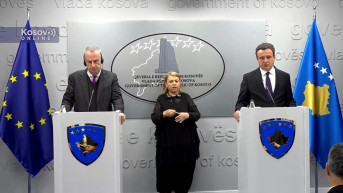
Kosovo Prime Minister Albin Kurti said this evening that the European Commission, in its latest Report on Kosovo, had not identified backsliding in any area and that Kosovo deserved to be granted EU candidate status. Head of the EU Office in Kosovo Dirk Schuebel, for his part, said that rebuilding trust with the Kosovo Serb community and fulfilling all obligations arising from the Dialogue remained an integral part of Kosovo’s European path.
At a joint press conference after presenting the Report to Kurti, Schuebel said that this was a decisive moment for Kosovo, the Western Balkans and the EU, and that accession negotiations were moving at an unprecedented pace, with Montenegro approaching the finish line and Albania not far behind.
“Enlargement is becoming a reality. The EU is also preparing itself. For the EU, enlargement is a strategic imperative—an investment in stability, prosperity and security. This is precisely why, for the first time, this year’s reports contain a dedicated section on resilience, defense and security,” Schuebel explained.
He stressed that the enlargement process was merit-based.
“Countries that implement reforms move forward. Where reforms stagnate, progress also stalls.
“Although there is momentum on the EU side, that alone is not enough,” Schuebel emphasized.
Regarding Kosovo, he noted that the period covered by the Report—from September last year to September this year—had been marked by institutional deadlock, which slowed reforms, as reflected in the document itself.
“Today, the situation is different. Kosovo now has fully functioning institutions that can drive reforms forward. This is an opportunity to make up for lost time, and it must not be missed. We are already seeing renewed momentum in the implementation of the Reform Agenda. I encourage you to further intensify EU-related reforms across all areas,” Schuebel said, according to the EU Office in Kosovo.
Commenting on the Report’s findings, he noted that the electoral processes had been conducted “in an orderly, peaceful and inclusive manner.”
He added that Kosovo had improved its level of preparedness in the fight against organized crime, while the pace of progress had accelerated in several areas, including public administration reform, freedom and security, statistics, free movement of capital, financial services and regional policy.
Schuebel said that the recent adoption of the Law on the Prevention of Money Laundering and Terrorist Financing was a long-awaited step, as was the ratification of three additional CEFTA protocols, but noted that many reforms remained “pending.”
He also pointed out that no significant progress had been recorded in the area of the judiciary and fundamental rights.
“Judicial reform, in line with the recommendations of the Venice Commission, must be implemented—with quality taking precedence over speed,” Schuebel added.
He stressed that the mandate of the Kosovo Specialist Chambers must be respected.
“The current mandate of the Kosovo Specialist Chambers must be respected, in accordance with international obligations and with full respect for judicial independence and the rule of law,” Schuebel emphasized.
He also listed freedom of expression and the legislative framework, including the Law on the Independent Media Commission and the Law on RTK, among the areas requiring improvement.
“A credible fight against corruption, as well as the adoption of an anti-corruption strategy in line with European standards, remain urgent tasks. Kosovo should continue aligning itself with EU rules, particularly in the areas of the environment and climate change, agriculture and food safety. These are not merely EU requirements; they are the foundations of a prosperous society,” Schuebel said.
He praised Kosovo’s alignment with EU foreign policy.
“Kosovo’s full alignment with our foreign policy during the reporting period, as well as its implementation of EU sanctions, clearly demonstrate your commitment to EU values. As announced last year, the Report now includes, for the first time, a dedicated chapter on foreign, security and defense policy,” the ambassador said.
Schuebel also stressed that fulfilling obligations arising from the EU-facilitated Dialogue remained part of Kosovo’s European path.
“Rebuilding trust with the Kosovo Serb community and fulfilling all obligations arising from the Dialogue remain an integral part of Kosovo’s European path. We are facing a new regional dynamic. It is important that Kosovo seize this opportunity by demonstrating openness, coupled with strategic patience,” Schuebel said.
He added that the EU stood with Kosovo.
“Looking to the past, present and future, the EU stands with you to support your efforts and to work together toward our shared goal: a stable, multiethnic and prosperous Kosovo in the European Union,” Schuebel concluded.
Kurti: Kosovo deserves candidate status
Kurti said that the period covered by the document had largely coincided with the political deadlock, but that reforms had accelerated following the election of the president.
“Especially the priority reforms under the Growth Plan,” Kurti said, according to Reporteri.
He pointed out that although it would soon be four years since Kosovo submitted its application for European Union membership on December 15, 2022, it remained the only Western Balkan country without candidate status.
“Apart from the European Commission’s political support for launching the technical process, there has still been no move by the Member States and EU institutions to give the Commission the political mandate to begin this process,” Kurti said.
He therefore asked Scheibel for the questionnaire to be provided as soon as possible “to pave the way for candidate status and the opening of negotiations.”
Kurti reiterated that EU integration remained Kosovo’s long-term strategic priority and that the objective enjoyed broad public support and cross-party consensus.
He added that Kosovo’s current position in the accession process did not reflect the progress that, in his view, the country had achieved.
Speaking about the findings of the Report, Kurti said that Kosovo’s level of preparedness had not declined in any area and that the European Commission had not identified any backsliding.
According to him, Kosovo’s assessment had improved in several areas, including the fight against organized crime, public administration reform, the judiciary, freedom and security, free movement of capital, financial services, statistics, management of EU funds and freedom of expression.
He added that the European Commission had characterized three electoral processes as “peaceful, competitive and well administered,” and had assessed that “the Kosovo Police has good operational and investigative capacities.”
Kurti also mentioned “the doubling of intelligence structures within the police, an increase in the number of officers, including in the north of the country, and improved cooperation with European police forces.”
In the area of foreign and security policy, Kurti stressed that Kosovo had achieved full alignment with the European Union, including sanctions against Russia and Belarus.
“It is important that, as of this year, we are also formally assessed under Chapter 31 on foreign, security and defense policy,” Kurti said.
He noted that the Commission had upgraded its assessment of Kosovo in the fight against organized crime and recorded an increase in the number of final convictions.
Among Kosovo’s achievements, he listed the adoption of the Law on the Prevention of Money Laundering and Terrorist Financing, the establishment of the Bureau for the Verification and Confiscation of Unjustified Assets, and enhanced Kosovo Police capabilities for the seizure of crypto-assets.
Regarding the fight against corruption, Kurti acknowledged that results in high-level cases were not satisfactory.
“We take that criticism seriously,” Kurti said, while adding that the principal weakness lay in implementation and enforcement rather than in the legislative framework.
He announced the adoption of an Anti-Corruption Strategy which, he said, would strengthen both the Anti-Corruption Agency and the police’s special investigative unit in terms of staffing and budget.
0 comments