
Trump’s messages from Davos: De-escalation of tensions or clear signals to Europe?
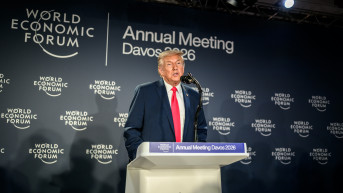
U.S. President Donald Trump, in his address at the World Economic Forum in Davos, sought to ease transatlantic tensions while also sending a clear signal that Washington is not abandoning its interest in Greenland, analysts told Kosovo Online. They assess that Brussels may nonetheless be satisfied with the announcement that force will not be used and that solutions will be sought through cooperation with European and NATO partners, while also warning that the new world order now taking shape could significantly reshape Europe.
Written by: Darko Savanovic
In his speech at the World Economic Forum— which he initially used to highlight domestic achievements during the first year of his second term—Trump made it clear that he would not give up on Greenland, citing its importance to Washington for national and international security.
He warned that the United States and the world face major dangers due to weaponry “he is not even allowed to speak about,” and described Greenland as an “unprotected piece of ice” between the United States, Russia, and China, above which, he said, major activities would take place in the event of war.
Although he believes that Greenland historically and geographically belongs to the United States, Trump has abandoned the idea of annexing it by force and has instead called for urgent negotiations on its purchase.
“That island is part of North America; it is our territory, and therefore it is in the interest of the United States. This has been our policy for hundreds of years—to prevent outsiders from entering our hemisphere. The United States can protect that territory, that piece of ice, enhance security, and ensure that both the world and we ourselves are safe. That is why I am calling for urgent negotiations on the purchase of Greenland, just as we have purchased many territories throughout history. There is nothing wrong with that,” Trump said.
European Union officials who addressed the Davos forum stated that the EU is ready to respond to and confront changing geopolitical circumstances. European Commission President Ursula von der Leyen said that the EU agrees with its American friends on the need to ensure security in the Arctic region, but emphasized that only the people of Greenland can decide its future.
A Diplomatic Signal from EU Leaders
Aleksandra Joksimovic, Director of the Center for Foreign Policy and former ambassador to London, assessed that U.S. President Donald Trump lowered tensions in his Davos speech and that Europe can be satisfied.
“I think that Europe, despite the high level of nervousness that preceded Trump’s arrival in Davos, will be satisfied with his speech. We should note that a large number of EU leaders left the gathering before Trump arrived, which is also a diplomatic signal. But it should be said that in his speech he first delivered many messages aimed at domestic political circumstances in the United States,” Joksimovic told Kosovo Online.
She believes Europe will be most satisfied by his statement that he has no intention of intervening militarily in Greenland, even though he continues to insist on negotiations over a potential sale.
She added that it is also significant for Europe that the U.S. president highlighted the possibility of reaching an agreement in Ukraine and confirmed that the United States remains fully committed to NATO.
She also pointed to his message that Europe “is not heading in the right direction,” while emphasizing that the United States participates 100 percent in NATO’s work and functioning and will continue to do so.
“I think these are among the most important messages we heard. There has been no dramatic distancing from Europe to the point of no return. It is likely that the level of trust that previously existed among allies has been lost and that it will take time to rebuild. But that does not mean Trump will not again come out with sharper statements at some point in the future. In any case, we can say that this speech was framed with far less tension than might have been expected, given all the messages he had sent—primarily to Europe—before this World Economic Forum began,” Joksimovic said.
Messages from Davos Also Affect the Region
Nikola Dencic, editor of the foreign affairs desk of Radio Belgrade’s First Program, assessed that U.S. President Donald Trump told Europe at the World Economic Forum in Davos that he expects cooperation from European and NATO partners.
Speaking to Kosovo Online, Dencic noted that Trump devoted most of his attention to U.S. progress over the past year, given that a year has passed since his inauguration for a second term.
“As for the messages sent to Europe as a whole—primarily to EU member states—they relate to the fact that Trump will not abandon some form of taking control over Greenland, which has been one of the most important topics for our continent and for the entire world in recent days and weeks,” Dencic said.
He recalled that Trump also stated there would be no violent takeover of control of that strategically important island, but that he expects cooperation from both European partners and all NATO partners so that what he considers one of the most important locations for U.S. security—Greenland—would in some way come under Washington’s control.
Dencic assessed that the messages sent by the U.S. president are directed primarily at EU countries, especially Western Europe, but that they certainly also affect the region and Serbia.
“On the one hand, as a country that belongs to this continent, and on the other, as a state in the process of negotiating accession to the European Union, it is certain that everything related to the Union can in some way also relate to official Belgrade,” Dencic said.
According to him, Serbia may in the period ahead face questions of positioning along the America–Europe axis, but it remains an open question whether Belgrade currently has reasons to do so and to what extent it should engage in debates at those levels.
Regarding the participation of Serbian President Aleksandar Vucic and Kosovo’s caretaker prime minister Albin Kurti at the World Economic Forum, Dencic said that the presence of European and global officials in Davos entails not only official panels and discussions but also numerous important meetings on the sidelines.
“According to available information, President Vucic has so far spoken with interlocutors about bilateral issues, energy, and Serbia’s further economic growth—topics primarily related to Serbia’s relations with other states—while also conveying messages that global issues are being considered and that efforts are being made to achieve a certain consensus,” Dencic said.
As for representatives from Pristina, Dencic assessed that, as at other international gatherings, they use the Davos forum to promote their agenda and seek support for the actions of Pristina’s authorities, with the results of those efforts yet to be seen.
A New World Order
Agim Shahini, President of the Kosovo Business Alliance, told Kosovo Online that this year’s World Economic Forum in Davos had a more pronounced political character and served to demonstrate the power of the United States, with a focus on a new order in the global economy and politics.
“We will most likely witness several events this year that we are not accustomed to, along with announcements of a new world order. We do not know what it will look like, nor what the strategic plan of the United States—the world’s largest power—will be,” Shahini said.
He noted that there are serious disagreements and conflicting interests among various actors at the global level, but that the potential establishment of a new world order could significantly change Europe.
“We do not know how this will unfold, but if it does indeed occur, a new order could be established globally and bring major changes to Europe. We have already seen the situation in Venezuela, and the war between Russia and Ukraine has been ongoing for more than three years with no concrete results, despite daily talk of its conclusion. There is also the Middle East, where major changes are underway. A Peace Committee for Palestine and Gaza is being formed. Because of all this, it is almost certain that a new order will be discussed this year; it remains only to be seen what it will look like,” Shahini said.


0 comments