
What can (and can't) a caretaker government do?
Every other day, ministers who are simultaneously acting as MPs. This dual role of Albin Kurti’s cabinet members—who took parliamentary oaths after the February 9 elections—is, according to opposition parties, a violation of the law. Kurti, however, insists that “the house cannot be left without a host” and that a resigned government must continue fulfilling its duties until a new one is elected. While it is not disputed that the role of a caretaker government is to ensure regular functioning of institutions, analysts point out that its powers are strictly limited.
Written by: Dusica Radeka Djordjevic
Last week, the Democratic League of Kosovo filed a criminal complaint for “abuse of official duty” against Prime Minister Albin Kurti and the ministers in caretaker roles who became MPs, arguing that the Prime Minister and the current ministers who resigned to assume parliamentary mandates no longer have the right to remain in government or make decisions.
Ramush Haradinaj, leader of the Alliance for the Future of Kosovo, also stated that Kurti is violating the law and committing a criminal offense by returning to his office after becoming a member of parliament.
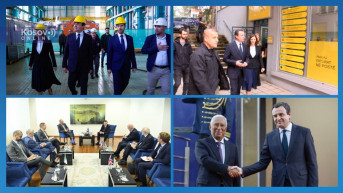
These legal controversies have not stopped international representatives from meeting with Albin Kurti in his capacity as caretaker prime minister. European Council President António Costa met with him two days ago in Pristina, and earlier this week he also met with ambassadors of the Quint countries and the head of the EU Office in Kosovo. Kurti also held talks with the new Head of the OSCE Mission in Kosovo, Gerard McGurk, as well as with Poland’s Foreign Minister Radosław Sikorski during a visit to Poznań.
Since assuming a caretaker role, Kurti has inaugurated new Kosovo Post branches in Leposavic and Zvecan and visited the Kosovo B power plant in Obilic on the occasion of the launch of modernization works at Block B2. He also reappointed Agron Llugaliu as Director General of Kosovo Customs—a decision legal experts say can be challenged, as caretaker governments are not authorized to make new appointments to public offices.
According to Kosovo’s Law on Government, a caretaker government may carry out only essential and previously planned activities listed in the Government’s Annual Work Plan and the Annual Budget Law. It may not propose initiatives for international agreements requiring parliamentary ratification, constitutional amendments, new laws, or initiate new public appointments. It may, however, propose a budget to the Assembly.
Analyst Erblin Hoxha notes that during a caretaker mandate, ministers and officials may participate in international forums, receive foreign delegations, and conduct official visits abroad—but only in a manner that reflects the transitional nature of their role.
This, Hoxha explains, means such activities must not result in binding agreements or representation in strategic negotiations that were not previously approved.
“In line with the Constitution and prevailing legal practice, a caretaker government is tasked with ensuring the regular and uninterrupted operation of state institutions. This includes basic administrative duties, execution of the approved state budget, and safeguarding national interests in ongoing matters. However, it is explicitly limited in its ability to initiate new legislation or major political reforms, make politically sensitive decisions, or undertake new financial obligations outside the previously approved budget framework,” Hoxha told Kosovo Online.
While some analysts interpret Kurti’s activities—such as inaugurating post office branches—as part of a pre-election campaign, Hoxha says ceremonial participation in such events is permissible within the caretaker mandate, provided it does not involve new political decisions, budget reallocations, or long-term contractual obligations, and is considered part of normal governmental duties.
Srđan Barac of the Center for Social Stability states that Albin Kurti has repeatedly shown a disregard for Kosovo’s laws, including the Constitution, and that he now openly violates the customary rule that a caretaker government should only perform technical functions.
While bilateral meetings may occur during a caretaker mandate, Barac explains, they are typically postponed because heads of state are expected to meet their counterparts when acting in full capacity. Agreements should only be made by those who hold a full mandate.
“When someone is in a caretaker role, such meetings cannot carry the same significance, nor can any international agreements or deals be signed,” Barac told Kosovo Online.
He stressed that Kurti’s dominant policy from the start has been aimed at driving Serbs out of Kosovo—and that this has been a consistent effort.
“What’s new is that, despite all the tricks and attempts after the elections, he still hasn’t managed to form a government. This raises a very legitimate question: is Kosovo entering a phase of political turmoil? Another key question is what the United States will do. We’ve seen them effectively moderate backstage processes before to show Kurti that his unilateralism has limits—that it won’t be tolerated. I believe now is the right time to prove that again,” Barac said.
Political analyst Shkëlzen Maljiqi also pointed out that, despite Kurti’s party having passed a law three years ago that prohibits members of government from simultaneously serving as MPs, Kurti and his ministers continue working from their offices as if nothing has changed.
Maljiqi said that Kurti should appoint a deputy from among party members who did not win parliamentary seats and allow that person to lead a proper caretaker government. But, as in other matters, Kurti remains, in his words, “defiant and arrogant.”
“Kurti is taking advantage of the fact that there are no deadlines for electing a new Speaker of the Assembly—just like he took advantage of the COVID situation when he tried to stay in power for as long as the pandemic lasted. But back then, the Assembly was still active and removed him with a two-thirds vote. Now he’s exploiting the situation again. He’s a master at creating confusion and smoke screens,” Maljiqi told Kosovo Online.


0 comments