
What did the NATO bombing bring to Serbs and what to Albanians in Kosovo?
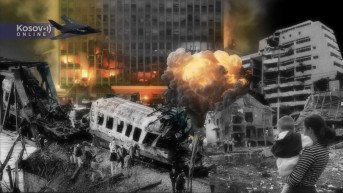
Serbs in Kosovo recall the 1999 NATO intervention—with which they were also exposed to attacks by the KLA—with deep suffering. Even 27 years later, many Albanians remain convinced that the bombing was necessary and view it as a form of salvation. Interlocutors of Kosovo Online offer differing assessments as to whether NATO aircraft, deployed without authorization from the UN Security Council, had to carry out a 78-day bombing campaign against the Federal Republic of Yugoslavia. For some, it was unavoidable due to the absence of political dialogue; for others, a negotiated solution would have been possible without it.
Written by: Dusica Radeka Djordjevic
Authorization to initiate the bombing of the Federal Republic of Yugoslavia was given by then NATO Secretary General Javier Solana.
He explained that diplomatic efforts to reach a political solution to the Kosovo crisis had failed and that there was no alternative but to undertake military action. He emphasized that the government of the FRY had rejected the demands of the international community.
Regarding the Rambouillet proposal—often described by officials in Belgrade as an ultimatum tantamount to accepting occupation—it was repeatedly stated that such terms could not be accepted.
Jan Oberg, Director of the Transnational Foundation for Peace and Future Research (TFF), who served as an adviser to Ibrahim Rugova in the 1990s, believes that a negotiated solution could have been found had there been no bombing.
As someone who spent four years mediating between Rugova and the authorities in Belgrade, including President Slobodan Milosevic, Oberg told Kosovo Online that he is convinced a mutually beneficial solution for both Serbs and Albanians could have been achieved.
“Something like cantonization, a form of federation, mutual demilitarization, and structures of cooperation, where Albanians and Serbs would benefit from cooperation instead of mutual hostility. It takes time to move from warfare and mutual killing to something else, but it does not help when someone comes from above and bombs your country beyond recognition,” he said.
“Illiterate in peace carry only a hammer”
Oberg emphasized that a peace plan had already been developed in the 1990s as part of a broader 2,500-page report, demonstrating the wide range of options available if conflict resolution and mediation are properly applied.
“However, there is not a single leader in the world who has a peace adviser. They all have military and legal advisers. And all these people who are illiterate when it comes to peace, mediation, and conflict resolution will have only one tool in their toolbox—a hammer. So, if your tapestry is slipping and you start hammering it, you only make it fall further, and if you keep hammering, the wall will collapse. That is what the international community, especially the Western world and NATO, are doing—they are hitting walls instead of building them,” Oberg said.
In his assessment, deep hostility still persists even after 27 years.
“For Kosovo Albanians, the NATO bombing delivered what they consider an independent state, recognized by many but not all—far from it—and at the same time represented a gross violation of the UN Security Council Resolution affirming the sovereignty and territorial integrity of Serbia. Furthermore, the conditions that I, as a peace researcher, would define as peace—cooperation, trust, mutual benefit—have not been met. Significant hostility still exists,” he stated.
For Serbs, he added, the bombing brought immense suffering and humiliation.
“I was here during the bombing, so I know what it meant to be here. I would be surprised if, in the foreseeable future, you had a Serbian leader who would say they want to join the West, NATO, and the European Union. When you are humiliated in such a way, it becomes part of your national history and memory,” Oberg believes.
A different perspective is offered by analyst Artan Muhaxhiri, who argues that NATO intervention occurred because there was no space left for political dialogue.
“It was necessary because the situation could not continue. Another Srebrenica or another Bosnia was inevitable, and the West did not want to allow that,” Muhaxhiri told Kosovo Online.
The conflict and differences, he assesses, were enormous, and there was no room for political dialogue.
“It was either for that situation to continue or for a powerful military force to intervene,” Muhaxhiri believes.
The beginning of the end of Serbian administration
Historian Aleksandar Gudzic told Kosovo Online that Serbs view the bombing as the beginning of suffering that continues to this day, while for Albanians it represents the final phase of the struggle to establish Kosovo’s statehood.
“Serbs see this event as the beginning of an aggression that later ended with the Military-Technical Agreement, the arrival of international forces, the start of the expulsion of Serbs from Kosovo, the displacement of 250,000 Serbs, and the removal of Serbs from almost all urban centers in Kosovo and Metohija. Kosovo Albanians view the very start of the bombing as the final phase of the struggle to separate from Serbia. They see that event as the beginning of the end of Serbian administration in this area,” Gudzic says.
Diverging views among Serbs and Albanians were also recorded by Kosovo Online reporters in North Mitrovica and Pristina.
“It was terrible—we didn’t know who to fear: the shells or the KLA. We fled with nothing. It didn’t bring good to anyone. But what could we do—it happened, and perhaps it could have been different, but it wasn’t,” said Zorica Tapuskovic, who was forced to leave her home in the village of Kovrage.
In Pristina, the sentiment is different.
“We remember that day as salvation for us—that’s how it is seen in Kosovo,” said Mirsad Krasniqi from Pristina.
The Beginning of Hardships That Serbs Still Face Today
According to Bojan Arbutina, Acting Director of the Museum of Genocide Victims in Belgrade, Serbian collective memory of the bombing is unified—marked by fear, despair, and a profound sense of injustice, particularly among the population in Kosovo and Metohija.
Following the end of the intervention, he notes, the Kumanovo Agreement was signed, marking the beginning of many of the challenges that persist to this day.
“Ask any member of our people what their memories are, and they will be tragic, cautionary memories that must not be forgotten. There is material evidence everywhere—from Belgrade and Nis to Podgorica—ruined buildings that still stand as a reminder of what the majority of European NATO member states did to one nation during the 78 days of aggression against the FRY,” Arbutina said.
According to the Serbian Ministry of Defence, 2,500 civilians were killed during the NATO bombing, including 89 children, as well as 1,031 members of the army and police. Around 6,000 civilians were wounded, including 2,700 children, along with 5,173 military and police personnel.
NATO Intervention Deepened the Crisis
Austrian peace activist David Stockinger points out that the NATO intervention violated international law, the UN Charter, and the principle of the inviolability of borders.
“This was a key turning point, marking the replacement of international law with the rule of force,” Stockinger said.
He also recalled that NATO politicians, primarily Germany and the United States, justified the war against the FRY by citing a humanitarian catastrophe.
“There is no doubt that crimes were committed on all sides in Kosovo, but fundamentally it was about something else. This was used as justification for a geopolitical war aimed at establishing a new world order in the Balkans,” Stockinger emphasized, concluding that the NATO intervention did not resolve the region’s open issues but instead deepened the crisis.




0 comments