
What would "positive dynamics in the relations between Slovakia and Kosovo" entail?
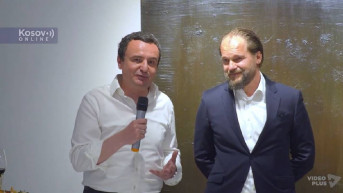
"If the situation were to change, perhaps there would be positive dynamics in the relations between Slovakia and Kosovo," said Rastislav Kostilnik, who has been the head of Slovakia's Liaison Office in Pristina for the past five years. At his farewell reception last week, where he made this statement, Kosovo's Prime Minister Albin Kurti was among the guests and thanked Kostilnik for his efforts and contribution to deepening bilateral relations between Kosovo and Slovakia.
Kurti has long looked askance at Miroslav Lajcak, also a Slovak, but the same cannot be said for Kostilnik. On the contrary, at the farewell reception, which also served as an exhibition of this diplomat's paintings, there was no shortage of warmth.
Slovakia is one of the five European Union countries that do not recognize Kosovo. It has a Liaison Office in Pristina, and during the recent vote in the NATO Parliamentary Assembly where Kosovo was granted an upgraded associate member status, Slovak representatives abstained. Moreover, its Prime Minister, Robert Fico, stated in March this year that he sees no reason for Slovakia to recognize Kosovo.
What, then, would Kostilnik's words mean that there could be "positive dynamics" in relations with Kosovo if the situation changed? Would it mean recognition of Kosovo or some intermediary step?
Professor of European Law from Pristina, Avni Mazreku, told Kosovo Online that the comment by the outgoing head of Slovakia's Liaison Office referred to a phase where Serbia might recognize Kosovo.
"Considering Slovakia's earlier stance that it would not recognize Kosovo before Serbia does, that potential change in situation mentioned by the Slovak diplomat, in my opinion, meant if the dialogue process, i.e., the situation between Serbia and Kosovo, reached a phase where Serbia recognizes Kosovo or there is de facto mutual recognition," Mazreku said.
The presence of Kosovo's Prime Minister Albin Kurti at Kostilnik's farewell reception is a positive step by the Kosovo Prime Minister, according to Mazreku.
"Kurti thereby promoted the confirmation that a higher level of cooperation with Slovakia should be achieved, considering that Slovak-Kosovo relations need to change, in fact, need to jump from the current situation to a new level of relations," says Mazreku.
The director of the Center for Foreign Policy and former Serbian ambassador to the United Kingdom, Aleksandra Joksimovic, believes that there are currently no signs indicating that Slovakia might change its stance on Kosovo's status, and Kostilnik's statement may refer to various areas where more intense cooperation is possible.
Joksimovic notes that Slovakia is not the only country that does not recognize Kosovo but has a Liaison Office in Pristina, and such live communication also takes place with other non-recognizing countries.
"It seems to me that such a statement can be read more as an indication of more intense cooperation that can occur in areas such as the economy, culture, and various other sectors where relations can intensify. There is constant speculation about whether Slovakia might change its stance on Kosovo, and I think there are pressures from all sides to either change their decision or maintain the status quo. Despite various pressures, these five non-recognizing EU countries have resisted different pressures over the past period and have so far shown no intention of changing their stance, which of course does not mean that such a stance cannot change in the future," Joksimovic tells our portal.
Commenting on Kurti's presence at the farewell reception of the head of Slovakia's Liaison Office, she says that it is in Pristina's interest to change the decision of the non-recognizing countries and sees the logic in why Kurti appeared at the reception.
"The mere fact that there is a Slovak Liaison Office means that there is some level of relationship established between the non-recognizing countries and Pristina. These relations must have their dynamics. Whether personal relations are cordial or not is not something that can decisively influence the foreign policy of a country, as it is created elsewhere, and when it comes to Slovakia, that is certainly in Bratislava. Therefore, above all, it is necessary to follow what the Slovak government says and thinks when it comes to this topic," Joksimovic emphasizes.
Retired diplomat Branko Brankovic believes that Slovakia will not recognize Kosovo, and thinks that the words of its representative in Pristina probably arise from information obtained from conversations with Miroslav Lajcak.
"They probably know something more from conversations with Lajcak than we do or know more about what Lajcak has discussed, agreed upon, or negotiated with those who command Kurti, regarding the so-called positive dynamics, something that would be resolved more positively," Brankovic tells Kosovo Online.
Explaining Slovakia's Liaison Office in Pristina despite not recognizing Kosovo, Brankovic states that in politics and diplomacy, it is crucial to be on the ground and know what is happening.
"That does not mean they are preparing to recognize Kosovo. Therefore, it is logical, smart, politically and diplomatically, to be present, to be able to react in time," says Brankovic.


comments