
Why was Pristina left out of the nomination of new U.S. ambassadors in the region?
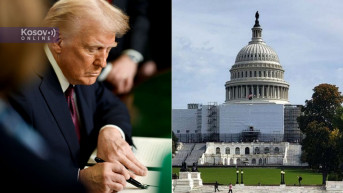
The absence of a nomination for a new top U.S. diplomatic representative in Pristina, while U.S. President Donald Trump has proposed new ambassadors for Belgrade, Podgorica, Sarajevo, and Sofia, may be interpreted as a signal that the Kosovo authorities are expected to take steps to improve cooperation with the United States. It may also indicate that the White House is waiting for the political situation in Kosovo to settle following the recent elections, according to analysts interviewed by Kosovo Online. What they consider evident, however, is that relations between Washington and the Pristina administration have deteriorated significantly.
Written by: Dusica Radeka Djordjevic
The United States has been without an ambassador in Pristina for a year and a half, since Jeffrey Hovenier completed his mandate.
Meanwhile, in September 2025, the United States suspended the planned strategic dialogue with Kosovo, and its resumption is still pending.
Nevertheless, in January this year, Pristina was among the first signatories of the Charter of the Peace Board, a conflict mediation initiative launched by Donald Trump.
Shortly before the elections held on June 7, Kosovo’s caretaker Prime Minister Albin Kurti stated that his government's relations with the United States were not excellent but were very good and stable. Former
Ambassador Jeffrey Hovenier, however, offered a very different assessment.
According to Hovenier, Kosovo’s standing in Washington has suffered a serious setback over the past 16 months.
“The new government will need to act quickly and decisively to consolidate its capacities and begin rebuilding trust between Kosovo and its partners, including the United States,” the former ambassador to Pristina said in an interview with Kosovo Online.
According to political analyst Artan Muhaxhiri, Trump’s decision to “skip” Kosovo when proposing several ambassadorial appointments for the region last week sends a message to Pristina that substantial effort is required on Kosovo’s part to improve relations with the U.S. administration and restore them to the level they once enjoyed.
Muhaxhiri says it is very clear that President Donald Trump’s administration has little interest in Kosovo’s political scene, unlike the previous administration.
For that reason, he told Kosovo Online, the position of U.S. ambassador to Pristina has remained vacant for such a long period.
“This is a clear message from the Trump administration to Kosovo that there must be many positive, progressive, and new steps, as well as greater determination on the part of Kosovo’s leadership, especially Prime Minister Kurti, to demonstrate increased readiness and concrete plans for cooperation with the United States. This is particularly important in geostrategic matters such as gas-related issues, which are very important to the U.S., as well as in other geopolitical areas,” Muhaxhiri assessed.
The Executive Director of the Pupin Initiative, Vuk Velebit, shares a similar view.
He says Kosovo is not a priority for the current U.S. administration and that the absence of a U.S. ambassadorial nomination for Kosovo may be interpreted as part of a broader shift in America’s approach to the region. At the same time, it is also possible that Washington is waiting for the election process to be completed or that the issue is simply not a priority at present.
“Noticeable Deterioration in Relations”
Velebit notes that it is difficult to determine precisely why the U.S. President has not yet nominated an ambassador to Pristina, but that the deterioration in relations between the Pristina administration and Washington is certainly noticeable.
“In conversations in Washington, one can observe that when discussing U.S.-Serbia relations, the Belgrade-Pristina dialogue is no longer mentioned in the way it used to be. There is accumulated frustration in Washington with Albin Kurti over the past several years, especially now under the Trump administration. I therefore believe that Kosovo has been left somewhat on the sidelines,” Velebit told Kosovo Online.
He explains that the deterioration in relations between Pristina and Washington was also evident when the strategic dialogue with Kosovo was suspended, despite having been announced at the same time as the strategic dialogue with Serbia.
He further points out that a U.S. State Department document submitted to Congress last month clearly states that the first strategic dialogue with Serbia will be launched and held this year.
“These are visible changes in the way the U.S. administration approaches the region, particularly in relation to Serbs throughout the region—whether in The Republic of Srpska, in Kosovo and Metohija, or in terms of official relations between Belgrade and Washington,” he said.
Given that the State Department document makes no mention of a strategic dialogue with Pristina, Velebit believes this is certainly a message to Albin Kurti that the Trump administration does not wish to cooperate with him.
“They are aware that Albin Kurti is, in his conduct, a Bolshevik and fundamentally anti-American leader. The Americans would probably prefer to see someone else in Pristina, but I do believe this is a message. The greatest consequences of Albin Kurti’s policies are being borne by the people living in Kosovo and Metohija, whether Albanians or Serbs,” Velebit said.
On the other hand, he notes that a positive change can be observed in Washington’s approach toward the Serbian people in the region, as the U.S. Embassy has become more active—perhaps even more than before—and more vocal regarding the protection of the human and religious rights of Serbs in Kosovo.
Ambassadorial Candidate Soon?
Following Hovenier’s departure from Pristina, Anu Pratipati assumed the duties of Chargé d’Affaires at the U.S. Embassy on December 30, 2024.
According to Luke Zahner, a senior fellow in the National Security and International Policy Department at the Center for American Progress in Washington and a former U.S. diplomat, Pratipati is a highly qualified chargé d’affaires, which is why he does not believe the lack of a formal ambassadorial nomination poses a problem.
In his assessment, the embassy in Pristina is functioning at full capacity.
“The embassy remains highly engaged on the ground. It currently has a very qualified chargé d’affaires. We may not see major initiatives pushed by the United States regarding Serbia and Kosovo or the region as a whole. However, I do not believe this will necessarily have a negative impact on bilateral relations in the immediate future,” the former U.S. diplomat told Kosovo Online.
He also expects that a candidate for U.S. ambassador to Kosovo will be nominated in the coming weeks or months.
Last week, U.S. President Donald Trump nominated Michael Young, an expert in international law and diplomacy, as U.S. Ambassador to Serbia. Ronald Johnson, a retired brigadier general, was nominated as ambassador to Bosnia and Herzegovina; Peter McCoy, a former member of the South Carolina House of Representatives and former federal prosecutor for the District of South Carolina, was nominated for Montenegro; and Douglas Holder, a former member of the Florida House of
Representatives with private-sector experience, was nominated for Bulgaria.
Earlier, in April, retired Lieutenant General Eric Wendt was nominated as ambassador to Albania. He has already received approval from the U.S. Senate Foreign Relations Committee and is awaiting confirmation by the full Senate.

0 comments