
Would Osmani politically profit or lose if she were to bring down the government of Albin Kurti?
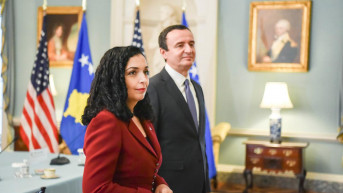
The opposition in the Kosovo Assembly does not have enough votes to bring down the government of Albin Kurti, and one scenario for how the government could fall, which was recently launched from opposition circles, is that Kosovo President Vjosa Osmani could be the decisive factor through the deputies of the Guxo list. However, Kosovo Online interlocutors believe that Osmani would lose more than she could gain politically by engaging in such action.
Opposition Democratic Party of Kosovo MP Bekim Haxhiu recently noted that Kurti and Osmani do not have the same level of communication they had at the beginning and did not rule out the possibility that Osmani, through the deputies of the Guxo list, of which she is the founder, could overthrow the prime minister because Kurti "is leading Kosovo towards a cliff," and also because of relations with the United States.
"The deputies of the Guxo list who do not support Kurti's government decisions and legislative proposals range from eight to 12, which provides the number needed to bring down the government, as the opposition itself does not have enough deputies. Perhaps Vjosa Osmani will take a step because Kurti is leading the country towards a cliff," Haxhiu said.
Osmani has not been at the helm of the Guxo list since she became the President of Kosovo in 2021, in the meantime, in February 2022, the list was registered as a political party, and since September of that year, Guxo has been led by Donika Gervalla, the current Minister of Foreign Affairs. In the parliamentary elections in February 2021, Guxo ran on the Self-Determination Movement's electoral list, which received just over 50 percent of the vote. After those elections, Osmani was elected as the President of Kosovo, while prominent members of the Guxo list, Gervalla and Lulzim Peci, obtained ministerial positions in Kurti's government.
Political analyst Leart Hoxha says for Kosovo Online that Kosovo's President Vjosa Osmani would not gain any political benefit from toppling Albin Kurti's government through the MPs of the Guxo list. Speculations suggesting such a scenario is not excluded, Hoxha considers as a form of pressure on Osmani.
"The numbers indicate it as a possibility, but it's merely a mathematical chance. I doubt she would engage in such calculations. Additionally, this doesn't only depend on the MPs of the Guxo list; there are also MPs from the Serb List and other minorities, and finally, the entire opposition. If they all agree, it would be possible. I don't believe such an agreement will be reached, as everyone has explicitly stated they won't topple Kurti with the votes of the Serb List. I doubt any party can afford to change that stance, and if the Serb List is excluded from this equation, it's even harder to find votes elsewhere," Hoxha states.
He adds that Osmani has been trying to fulfill her role as president properly and distance herself as much as possible from party politics.
"I think she's smart enough and experienced enough as a political figure to know that she can't afford that. Even amidst the international community's pressure on the Prime Minister, Osmani, as the head of state, is playing a decent role and trying to keep everything under control and maintain Kosovo's image in the eyes of international partners from worsening," Hoxha says.
Political scientist Ognjen Gogic also does not believe in speculation that Vjosa Osmani would cause the downfall of the Government of Albin Kurti because, as he says, there is both an ideological and pragmatic connection between Osmani and Kurti. He also notes for Kosovo Online that such a move would not bring political gains to Osmani or the Guxo list, but rather voters would punish her for it, while the Self-Determination Movement could retaliate by initiating her impeachment procedure.
Gogic says that this is about spin coming from the opposition, which has an interest in trying to generate conflict between Osmani and Kurti.
"I don't believe in such a scenario for several reasons. Firstly, Osmani left her own party, the Democratic League of Kosovo (LDK), out of solidarity with Kurti. Just when the Americans orchestrated the fall of Kurti's first government because he was dishonest towards them, Osmani stood by Kurti. She could have politically benefited from leaving him at that time and could have become the Prime Minister if she wanted, but she stayed with him, and in a way, she took a risk because, at that moment, it wasn't certain that there would be elections so soon and that she would benefit from supporting him. Osmani became the President of Kosovo thanks to the support of Self-Determination," Gogic recalls.
If the Guxo party were to participate in toppling Kurti's government, Gogic indicates that they wouldn't be able to appoint a prime minister in the current parliamentary term, nor would they gain enough mandates in the next elections to lead a coalition.
"At best, they could be a minor partner in a coalition and have less significance than they do now by supporting Kurti's government. It's more likely that after the new parliamentary elections, which will be held at the latest by early next year, there will be pressure on Osmani's party to align with the new majorities. Although there's also the question of whether that party would pass the threshold, which is uncertain. If they entered parliament, there would likely be pressure for them to join a coalition consisting of everyone else – the Democratic Party of Kosovo, the Democratic League of Kosovo, Haradinaj's alliance, and maybe even the Serbian party. So, I would expect a new combination to emerge after the elections," Gogic says.
However, if the scenario of Guxo initiating the resolution of Kurti's government were to happen, Gogic says it would only be a trick that Kurti would pull off with his associates to move towards early elections if he assesses that it's more politically favorable than waiting for the regular term in February 2025.
When asked whether Osmani would be a different negotiator for Kosovo in dialogue with Belgrade compared to Kurti, Hoxha says that in dialogue, much depends not only on who the negotiator is but also on the political situation, which is broader than the will of one politician.
"In Kosovo, we've had four or five negotiators from Edita Tahiri onwards, and at the same time, on the Serbian side, even though Vucic has been in power, he has not led the dialogue all the time. What we see is a lack of political will to implement what was signed in 2013 and 2015 and what was agreed upon in 2023. Without political will, I doubt much more can be done because it doesn't depend on one person; there are negotiating teams involved. Also, much in the Western Balkans is conditioned by the situation in Ukraine, various events in Europe, how these countries position themselves towards Russia and NATO, so much doesn't depend solely on the chief negotiator," Hoxha believes.
Speaking about the similarities and differences between Kurti and Osmani and what she would be like as a negotiator for Kosovo in dialogue with Serbia, our interlocutor says that Osmani is equally radical when it comes to nationalism as Kurti, which has connected them, but she might be more moderate as a dialogue participant only to avoid damaging Kosovo's relations with the Western part of the international community.
As he adds, Osmani was expected to have a different approach because it's generally believed that women in politics are more moderate, she's a relatively young person and educated in the West.
"From her, a different course was expected, but she has become perhaps the most radical politician on the Kosovo political scene. Her radicalism is directed towards Serbia and Serbs; she often refers to Serbia in her public appearances as a 'genocidal state.' She's not someone who has shown any favoritism or willingness to compromise with Serbs and Serbia. Osmani speaks Serbian fluently, but she has never addressed the media in Serbian, nor has her cabinet shown readiness to respect language rights and provide translation at public events. So, she is building her political image on nationalism and an anti-Serb stance," Gogic says.
What sets Osmani and Kurti apart, he adds, is their attitude towards the West. Although Osmani is radical and uncompromising towards Serbs, she is still not in favor of Kosovo confronting Western partners.
"Escobar pointed out during his visit to Kosovo that Osmani was the best partner the Americans have in Kosovo. She would not pursue a policy of isolationism or a policy that would damage Kosovo's relations with the Western international community at the cost of making compromises in the dialogue with Belgrade. In that sense, she would be more susceptible to pressures and demands coming from the West, which sometimes actually benefit the Serbian side. So, she would be somewhat more straightforward for dialogue and perhaps the dialogue would yield greater results," Gogic says.


0 comments