
Catastrophic and almost immeasurable economic consequences of NATO bombing
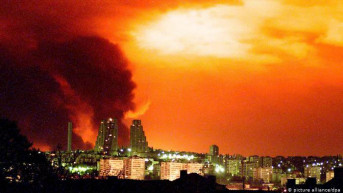
The NATO bombing 24 years ago left immeasurable economic consequences on Serbia, which are difficult to accurately calculate if you take into account the indirect damage, the bad political image of Serbia at the time, as well as the halted and permanently lost potential for development, economists told Tanjug on the occasion of the anniversary of the beginning of the aggression.
Although the estimates of the damage of the bombing, during 78 days in 1999, range up to 100 billion dollars, Ivan Nikolic from the Economic Institute and the author of the magazine MAT says that the state has never formally made a final account and calculation of all those losses, both direct and indirect or induced, which are the most pronounced, RTV reports.
"There were ad hoc studies by individual institutes and NGOs, such as a list of destroyed state property from the Construction Directorate in 2006. According to those estimates, direct costs ranged from four to five billion (dollars), and with indirect and induced costs they reached 40 billion, according to the estimation of G17 in 2000. Also, at that time, the Economic Institute was doing analyzes with larger damage amounting to 50 billion," Nikolic said.
He pointed out that the assessment of direct damage was not so important as the fact that the NATO bombing had had a catastrophic effect on Serbia's economy.
"The media image of Serbia in those months before the bombing, which was created in order to justify NATO aggression, permanently set Serbia's economy back and presented it as an economic pariah in Europe. We were labeled as the worst possible in such an environment, so no normal person thought to do business with us," Nikolic said.
He pointed out that it was necessary to take into account the lost human capital, the lost perspective, as well as the long-term consequences that had determined the fate of Serbia, and probably, from an economic point of view, of the region as well.
"If we look more broadly, then there is no doubt that the act of bombing and aggression permanently collapsed the international order, international institutions, and international law. And we see those consequences to this day. If we were to calculate the economic effects comprehensively, then we would also have to take that into account. Viewed in such a way, we would probably reach huge amounts. Therefore, it is enough to say that the economic damage was exceptional and almost immeasurable," Nikolic said.
He says that decades should pass in order for us, with achieved political stability, to establish more significant contacts with the external environment and present Serbia in the light it deserves and attract larger foreign investments.
When it comes to direct economic damage, he says that the historical minimum of industrial production was recorded in May 1999, not only in relation to 1998, since the average production in 1999 was lower by 25.6 percent due to the bombing.
"At that moment, the level of the physical volume of industrial production was five percent lower than the minimum recorded in January 1994 at the height of hyperinflation. Compared to January 1989, when the transition formally began, the level of May 1999 was lower by 81.6 percent, so only about 18 percent of the production from the beginning of the transition was recorded at that time. That was truly catastrophic, that was the bottom, and from that moment Serbia went back a century," Nikolic said.
He says that, after reaching the Dayton Agreement, we started to recover, and that during the summer of 1997, Telekom was sold and that brought in, for that time and for us, quite a lot of money. The industry began to recover, even in 1998, despite the negative tendencies towards the end of the year, due to the bad atmosphere and the aggravation before the bombing.
"Everything that followed after that, both political changes and a completely new economic concept and privatization, was somehow limited by those unfavorable events that culminated in 1999," Nikolic said.
He says that even now there are different damage estimates for the war in Ukraine and that the World Bank and the IMF have estimated that the direct damage amounts to more than 400 billion dollars.
Analyst Bojan Stanic, from the Strategic Analysis Sector of the Serbian Chamber of Commerce, says that first of all, it should be borne in mind that under the influence of sanctions from 1992 to 1995, the Serbian economy was already significantly slowed down, and even paralyzed.
"Many companies had to blame the workers; they also lost the large internal market of the former Yugoslavia, and certainly the international one. Then there was a recovery in 1996, 1997, and 1998, when there were relatively high growth rates, on average around five percent And when the bombing happened, we had a sudden drop in economic activity, measured by the GDP rate, which was minus 18 percent, but, again, that rate was conditionally speaking lower, it was a smaller drop than there was, for example, 1992 and 1993," Stanic said.
He says that the Serbian economy had already significantly lost its potential then and that during the bombing, the infrastructure and certain industrial complexes were primarily targeted, many of which were not even working at their capacity from, for example, 1989.
"Nevertheless, the direct consequence of the bombing was that Serbia, for example, remained cut off from its natural, agricultural, industrial, and other resources on the territory of Kosovo and Metohija. Then, cooperation, primarily political, between Beorgad and Podgorica, eventually led to the independence of Montenegro. This had profound consequences, which are still felt in some way today," Stanic said.
He notes that the bombing was certainly preceded by a major blow to the economy in the early 1990s, which, as he said, "sealed a bad decade for the economy of Serbia."
He said that it was very difficult to accurately assess the damage of the NATO bombing, both for economic reasons and political reasons.
"There was an estimate of around 100 billion dollars, and then certain analysts lowered it to 60 billion, but in any case, the damage was huge if you take into account the permanently lost potential," he said.
He notes that the 1990s, on the other hand, were significant for the world economy, as it was a period of rapid growth, especially in those parts that were outside the West, such as Eastern Europe, which was in transition.
"During the nineties, only the area of the former Yugoslavia, (excluding Slovenia) and the area of the former USSR in Europe were in a deep recession, so we can say in a depression since Serbia was certainly in a depression during 1992 and 1993. So, we have a lost potential, which is difficult to compensate for today," Stanic said.
He adds that then populous countries, such as China, India, Indonesia, and others, entered the international market and grabbed that part of the market and showed their competitiveness in it.
He says that Serbia is still trying to catch up.
In March 2006, the Construction Directorate of Serbia published the balance sheet of destroyed buildings during the NATO bombing.
According to that study, 54 road infrastructure objects were destroyed, of which 44 were bridges, 18 railway infrastructure objects, of which 17 were bridges, and 148 high-rise buildings, including residential and public buildings.
This study did not take into account private buildings and houses.
According to some estimates, the total loss of the social product amounted to 40 percent.
At a press conference on April 3, 2001, the president of the FRY of the time, Vojislav Kostunica, stated that the total damage had been about 300 billion dollars.


0 comments