
Milic: At this moment, it is only possible to make a horror or psychological drama about Kosovo
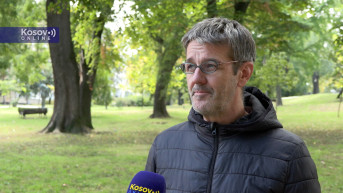
Director Dejan Milic says that, given everything that has happened in Kosovo over the past decades, it is only possible to make a horror or psychological drama on the subject at this moment.
Two years ago, Milic made the film "Mrak" (Darkness), which deals with this topic. He described it at the time as politically incorrect because it views the situation in Kosovo from a subjective perspective, but, as he tells Kosovo Online, that was his goal and intention.
"I simply wanted to put viewers in the position of that mother and child who are surviving a catastrophic situation," explains Milic.
When asked if films like this require a certain amount of time to pass, he says that the distance from which he made the film may have even been too long.
"It doesn't always mean that historical distance is necessary for an artistic treatment of a topic. I simply believe that emotion is the most important thing, and the emotional charge I had at that moment, the feeling I had towards the story I wanted to tell, perhaps hastened the making of this film. But I don’t think it was necessary to wait 20, 30, or 40 years for all this to pass. Because, as you can see, things aren't really improving for the Serbian population in Kosovo after all these years," the director explains.
He described his film as a "psychological horror," explaining that this is what Serbs in Kosovo experience daily. He adds that making a comedy about Kosovo would be difficult.
"A comedy could be made, but I think it’s simply not appropriate at this moment, over the past 10, 15, 20 years. So, if you ask for my opinion, I believe that a genre like horror, psychological drama, or some kind of tension is the only possible one for Kosovo at this moment," Milic explains.
He recalls that the world premiere of "Mrak" was at the Trieste Film Festival, where the film won the audience award.
"The audience received it well everywhere, but the political theme that my film touched on somewhat prevented it from traveling the world. So, we didn’t have many opportunities to show the film on certain continents where it was very important for me to present it," he says.
When asked why more filmmakers from his industry don’t take Kosovo as a theme for their films, Milic says he doesn’t have an answer.
"As far as I know, Goran Radovanovic, myself, and Zarko Dragojevic, our older colleague who made two films on the Kosovo topic in the late '80s, are the only filmmakers who have dealt with Kosovo and Metohija in a fictional sense, in terms of feature films. I don’t know why that is. I don’t know if people are not interested, if they don’t care about what’s happening around us, but that’s the essence. The essence is that we have to make stories that concern us," Milic says.
He adds that there are countless topics relevant to Serbia at any given moment.
"At that moment, the story of the girl who wrote a letter to the president, having no one else to turn to for help, struck me as extremely emotional and highly relevant. It was, essentially, a cry for help, and I found it incredibly moving and timely, which is why I made the film. Now, I really don’t know why some of my colleagues avoid the Kosovo topic. There are many stories that could be told on that subject, but I leave that up to them. Everyone is individually responsible for their actions," Milic reflects.


comments