
Gogic: Voters responded to the political situation with abstention, Osmani suffered a setback
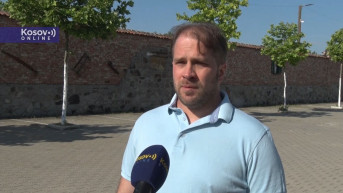
Voters in Kosovo responded to the political situation by abstaining, and there is no basis for claiming that votes from one party shifted to another, political scientist Ognjen Gogic said, adding that Vjosa Osmani, the outgoing president and the Democratic League of Kosovo's candidate for another term in office, suffered a setback.
“Voters in Kosovo responded to the political situation and the choices offered by abstaining. There was a huge drop in turnout, partly explained by the fact that the diaspora was not present in Kosovo this time to the same extent as in December, but that is not the only reason for the decline. The local population also abstained to a large extent and skipped these elections. Therefore, it cannot be said that votes moved from one party to another. Rather, it can be said that voters of all parties chose abstention,” Gogic told Kosovo Online, speaking about the message voters sent to Albin Kurti and Vjosa Osmani, but not only to them.
Gogic pointed out that the elections were essentially a battle for parties to retain their voter base, and that they failed in that effort.
“There was never any real possibility of one party taking voters away from another. Everyone dissatisfied with the party they had previously supported chose abstention, and this is most evident in the result of Self-Determination, which recorded a drastic decline in support in terms of the actual number of votes. Some of their votes may still arrive by mail, but certainly not in the same proportion as in December when supporters physically came to vote. All other parties also recorded a decline,” our interlocutor said.
He notes that the Alliance recorded the smallest decline, adding that the party successfully overcame both a leadership change and a rebranding process, including a change of name. In his view, it may have set an example for other parties on how to approach internal reform if they hope to achieve better results.
Gogic stressed that Vjosa Osmani suffered a setback in the elections and failed to attract new voters to the Democratic League of Kosovo.
“After all, she was someone who received around 300,000 preferential votes in 2021 when she led the Self-Determination list. At that time, she was elected president because there was a consensus within the Albanian community that she was the right person for the position. That can no longer be said today. She failed to attract new voters to the Democratic League of Kosovo. The party finished in third place and, although it achieved a higher percentage than in December, it won fewer votes. Therefore, she cannot be satisfied with the result, and Osmani cannot be credited with any growth because there was, in fact, none,” Gogic explained.
He recalled that in the final days of the campaign, Osmani returned to the legacy of Democratic League of Kosovo founder Ibrahim Rugova, displaying his portraits and appealing to voters' nostalgia for Rugova, but that strategy did not resonate with the Albanian public because she had not mentioned him for five years.
He added that it is also questionable whether Osmani has a future on Kosovo's political scene after these election results.
“The proposal that came from the Democratic League of Kosovo to Kurti, namely that they would reach an agreement with him in the new parliament if he accepted Osmani as president, is an unreasonable offer for Kurti because he was the one who brought about these elections precisely because he did not want to support Osmani's election. He has even less reason to do so now, after she suffered a major setback. Therefore, the rift and crisis in relations among Albanian parties will probably continue, and it will be difficult to reach agreements on forming institutions. The only unknown at this point is the Alliance because it is a party with a new policy orientation, and perhaps it will be willing to reach agreements with Kurti. We will see that in the coming period,” Gogic concluded.



0 comments