
Craxi: Concerns of Serbs in Kosovo are real – When laws complicate daily life, it becomes a political issue
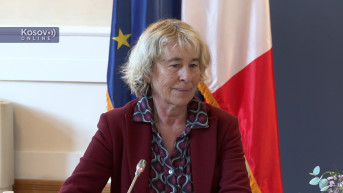
Italian Senator and Chair of the Senate Committee on Foreign Affairs and Defense, Stefania Craxi, stated in an interview with Kosovo Online that the concerns of Serbs in Kosovo regarding the Law on Foreigners are real, emphasizing that this is not a technical issue, but a political one. According to her, restricting access to institutions creates the risk of “silent displacement,” and therefore, she adds, it is necessary to find a lasting solution based on respect for the fundamental rights of all citizens.
Senator Craxi stressed that no administrative norm should become a tool of discriminatory pressure against a community, noting that a scenario of displacement and rising tensions must be prevented.
As she pointed out, the Western Balkans is a space of interaction among continents, cultures, and interests, but unfortunately also a hotspot of instability. For Italy, according to her, the Western Balkans represent a strategic priority.
In the interview for our portal, Craxi also stated that security in the Balkans is not built against someone, but within a shared multilateral framework.
In Trieste, you stated that the displacement of Serbs from Kosovo would represent a failure that must not be allowed. At present, Serbs in Kosovo are concerned about laws that complicate work, residence, education, and healthcare. What is your position on this?
No administrative norm should be transformed into an instrument of discriminatory pressure on a community. When laws on residence, employment, education, and healthcare—affecting everyday life—begin to make life more difficult for a minority, this is no longer a “technical” issue, but a deeply political one. The concerns of Serbs in Kosovo are real and must be addressed unequivocally. If access to schools, hospitals, and essential services is restricted, it creates fertile ground for silent displacement and rising tensions, leading to further destabilization. Such a scenario must be prevented.
How can what some describe as the “administrative persecution” of Serbs in Kosovo be prevented?
A different approach is required—one based on awareness of the unsustainability of any measures that affect fundamental human rights. Efforts must be invested in building a path of dialogue, while avoiding opportunities for conflict. Of course, this is easier said than done, but the real risk is a prolonged conflict situation. Such a prospect is not something the peoples of this region, already burdened by decades of suffering, deserve.
In Trieste, you also referred to the appeal of Patriarch Porfirije addressed to world leaders to protect Serbs from displacement. Among those leaders is Prime Minister Giorgia Meloni. What is Italy’s orientation toward the Western Balkans?
Our connection with the Balkan region has centuries-old roots. It is not merely a consequence of geographical proximity or historical circumstances, but also of a shared sensibility and the ability to understand the deep processes shaping the region. The Balkans are a space where continents, cultures, and interests intersect, but unfortunately also a hotspot of instability. For Italy, this region represents a strategic priority—geopolitical considerations, even before security concerns, have long pointed to the need for a comprehensive and structured approach. Within this framework, we strongly support its path toward European integration, while firmly insisting on key principles: protection of minorities, rejection of all forms of discrimination, and, in this specific case, support for the dialogue between Belgrade and Pristina. The appeal of Patriarch Porfirije should be viewed as a political signal: the issue of Kosovo is not closed, and it continues to be perceived at the international level as a matter of security and rights.
Italian soldiers have long been part of the KFOR mission. Recently, media reported that U.S. President Donald Trump is considering reducing the number of American troops in NATO missions. In the context of new risks for Serbs in Kosovo, do you believe Italy should continue or even strengthen its presence in the event of a partial U.S. withdrawal?
The KFOR mission certainly does not have merely symbolic significance; it represents a concrete pillar of stability. At a time when the regional balance is fragile, any signal of withdrawal could be interpreted as a step backward in deterrence dynamics. Of course, any consideration must take place within dialogue among allies, but security in the Balkans cannot be delegated—it requires direct engagement.
Soon it will be 27 years since the beginning of the NATO bombing of the former Federal Republic of Yugoslavia. What are your memories of that period, and do you see a solution to ending the crisis in Kosovo?
The year 1999 represented the final chapter of a painful process that marked the lives of millions of people, bringing war back to the heart of Europe after half a century dominated by the logic of bipolar confrontation. Contrary to expectations, the period that followed did not bring lasting peace nor did it steer relations among peoples and states toward harmony. One cannot ignore the complexity of the circumstances that led NATO to intervene, as doing so would disregard historical truth. However, the past must not serve as an excuse for the present. Ensuring the rights of every community is the other side of the coin of peace.
Pristina, Zagreb, and Tirana have recently launched trilateral military cooperation, which Belgrade has characterized as a threat to regional security. What is the position of the Italian Senate Committee on Foreign Affairs and Defense?
Any ideological interpretation should be avoided. On the one hand, Belgrade’s concerns are understandable; on the other, cooperation among states is not inherently a threat, provided it remains transparent and focused on defensive objectives. The issue is not the agreement itself, but the context: a high level of distrust, unresolved tensions, and a perception of encirclement. In such an environment, even legitimate initiatives can have destabilizing effects. Italy’s position is clear: caution, transparency, and rejection of any escalation. Security in the Balkans is not built against someone, but within a shared multilateral framework.



0 comments