
Lajcak: Vucic and Kurti agreed on new elections, which must be held in the coming months

The Special Representative of the European Union for the dialogue between Belgrade and Pristina, Miroslav Lajcak, said that at the last crisis management meeting in Brussels, the two sides had agreed that new elections were one of the key elements of getting out of the current crisis in the north of Kosovo, but that they had not agreed on how to reach de-escalation.
In an interview with Euronews Serbia, he said that the situation was serious and that no one was pretending that we didn't have a big crisis.
As he stated, there was no formal deadline by which Belgrade and Pristina should fulfill the EU's demands, which were formulated in three points, but he pointed out that the situation was so tense that the highest world officials had to deal with it, which affected the image of Serbia and Kosovo and the region.
Lajcak also spoke about the proposals of Albanian Prime Minister Edi Rama, but also about the ban on the entry of trucks with Serbian goods into the territory of Kosovo, as well as how the European Union observes the arrests of the Serbs in Kosovo.
Let's start with the last comments we had these days, they come from Josep Borrell after the meeting with the ministers of foreign affairs of the EU member states. They are already losing patience, we also heard that new measures were being planned for Pristina. Will there be a measure for Belgrade as well and how is it generally viewed?
They criticize me for being more on the side of Pristina than Belgrade, but they also criticize me for being more on the side of Belgrade than Pristina. I believe it shows that I'm somewhere in the middle, as it should be. We are very concerned about the situation. We have had hundreds or thousands of people on the streets for more than a month. We have members of the Kosovo Special Police and members of KFOR. This is a situation that clearly shows that provocations can occur. We have a very tense atmosphere. That is why de-escalation is a key issue for us - for people to go back to their lives, and for us to go back to our work and deal with political issues, not security issues.
In that situation, European institutions, member states, and the European Commission decided on some measures to strengthen their influence on foreign countries. It is not my initiative. As a negotiator, I do not play a role in that. The measures are related to one or the other side that does not fulfill what is expected. You know very well that these are EU demands based on three points - de-escalation, new elections in the north with the participation of the Kosovo Serbs, and a return to dialogue and implementation of the Ohrid agreement.
How long will you have the patience to wait? Have you given a deadline for the parties to complete those points?
There is no formal deadline. But in politics, everything is connected. See how many high international representatives are engaged in this matter. We had phone calls from European Commission President Ursula von der Leyen and US Secretary of State Antony Blinken. The situation is so tense and serious that the world's highest officials have to deal with it and get involved in the solution. All this somehow reflects on the atmosphere in the international community, on the image of Kosovo, Serbia, and the entire region. So, I think that it is primarily in the interest of Serbia and Kosovo that this issue be resolved and that the region can deal with European issues, not crisis management.
To some extent, you are criticized that it seems as if the words of the EU are losing their force in the sense of that one specific word, which is de-escalation. We have been hearing about de-escalation for a month. Without any intention of diminishing the importance of that, understanding what you mean, what could be done more concretely to de-escalate?
De-escalation means that the mayors withdraw from the buildings they are currently in, primarily in Leposavic. And to work from some other premises, as the two mayors already do. It means that they deal with some administrative affairs, but not political ones. They did not receive a mandate for that from the voters in the Serbian community. At the same time, we expect the demonstrators, Special Police, and KFOR to withdraw. That we have peace, that people return to their lives, and that we return to our work. It's de-escalation. Then the next step is to discuss when we will have new elections and how we will get to them.
Do you expect new elections in the coming months?
New elections must surely be held in the coming months. And that was one of the points on which Vucic and Kurti agreed. It is clear that mayors do not have the legitimacy they should have. Mayors with legitimacy can only be those elected by the Serbs from Kosovo. The question we are dealing with is when and how we will get there. And of course, that the Serbs have the motivation to feel safe and that we have elections that are free and representative.
Do you think they agreed on that at this previous meeting that was held in Brussels? What are your impressions? Is there any indication that they can agree on anything else?
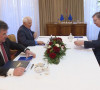
That meeting last Thursday in Brussels was a crisis management meeting. So it was not a meeting dedicated to normalization, and dialogue, unfortunately. The positive thing is that both Vucic and Kurti understood how serious the situation is. No one hides this and does not pretend that we do not have a serious crisis in the north. And secondly, they agreed that one of the key elements of getting out of the crisis is new elections. Where they disagreed was the issue of de-escalation. How will these mayors function and from where.
Albanian Prime Minister Edi Rama met with Borrell. After those meetings, he said a detail that had intrigued the public, refers to the possibility of holding a conference at which the leaders of Belgrade, Pristina, the EU, and the US would be present. Is it an initiative of the EU or Edi Rama?
It is Edi Rama's initiative. I must say that he plays an active and constructive role in the entire crisis because he is a good expert on the situation on the ground. Of course, as the Prime Minister of Albania, his voice is authoritative enough to be heard. I am in regular contact with him, and I know how much time and authority he invested in finding a solution. That's the proposal he came up with. We are in daily contact with the US and key European capitals. But of course, the best platform to resolve issues is dialogue and we need to return to dialogue.
You wouldn't rule out the possibility of such a conference?
There was no discussion about the expectations of that conference. It is too early to speculate on that. I want to emphasize once again that I see Rama's role as constructive.
Was his proposal regarding the CSM constructive?
It is a very serious and good paper. We have analyzed it and I think it is a quality paper. Of course, it comes from outside the process. According to all the documents from the dialogue, it is clear that the Statute of the CSM should be built within the dialogue. As for the process, it is not a part of that. But in terms of substance and content, some elements can be used.
Kosovo policemen were released, and one arrested Serb was released. But another person was also arrested the day after the talks in Brussels. Are these some messages that Belgrade and Pristina are sending to the EU?
The issue of arrest is very sensitive, and a huge "irritant" in the whole process. Regarding the arrest of the Serbs from Kosovo, we hear from the Kosovo side that it is the rule of law and that there is enough material against those people. We hear from Serbia that it is a political campaign against the Serbs in Kosovo. That is why we must have a detailed insight into each specific case, to be able to assess the essence. That's why we gave a new task to EULEX, which has it in its mandate. The High Representative asked EULEX to monitor all those cases in detail and more detail than before. That we have an accurate insight and that we, based on that analysis, can say how we see those cases. It is clear that if someone has broken the law, they must be held accountable. On the other hand, we must not allow arrests to be misused for political purposes.
Another thing that creates escalation on the ground is the ban on the entry of trucks with Serbian goods into the territory of Kosovo. How do you see it?
We advocate and strive to establish exactly the opposite - the four European freedoms, which mean the free flow of goods. These blockages are just the opposite. And that is a question for the European Commission first of all, but of course also a question of obligations in relation to CEFTA membership. And the question is the harmony of the measure with the letter and spirit of the Stabilization and Association Agreement. No one can say that this is a move that brings the region closer to the EU. And that should be resolved as soon as possible.
On several occasions, we could hear from you and your colleagues that the situation should be resolved in the coming period, bearing in mind that the European Union and America are facing elections and that you will all have other things to deal with together. Can you say, at this point, that you are optimistic and that anything will be completed by the end of the year?
We can quickly and easily return to the normalization process. We really need to de-escalate. And then we can continue working on the implementation. We have an agreement that says exactly what we have to do. We don't need to think about it – what to do now. The platform is here. But I must say that the EU, the US, and the international community are really irritated by the fact that we have to deal with the crisis in the north of Kosovo again in a situation where we have a war in Ukraine and when we should be focusing on that. That crisis should not have happened. It was predictable, it was clear what consequences it would cause, and that is why the international community is losing patience. That crisis was caused without need, and that's why everyone expects us to return to the agenda and normalization.


0 comments