
Lodola: NATO fully supports the dialogue for the normalization of Belgrade-Pristina relations; both sides should make compromises
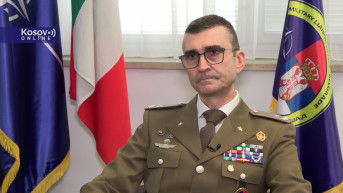
The Head of the NATO Office in Belgrade, Brigadier General Pierluigi Lodola, emphasized in an interview with Kosovo Online that the Western Balkans remains one of the key priorities for the Alliance, and that NATO continues to fully support the EU-facilitated dialogue for the normalization of relations between Belgrade and Pristina, as the only framework for resolving pending political issues with respect for the rights of all communities.
Lodola further states that the Western Balkans region has made significant progress in recent decades and that KFOR continues to carry out its mission in Kosovo in accordance with United Nations Security Council Resolution 1244 from 1999.
“The Western Balkans remains high on NATO’s agenda. It is a region of strategic importance for the Alliance, as reiterated by our leaders at the NATO Summit last July, by our Defence Ministers in Brussels this February, and by the NATO Secretary General, Mark Rutte, during his official visits to Sarajevo and Pristina in March 2025. Overall, the region has made significant progress in the past decades. However, we see some concerning trends. In Bosnia and Herzegovina, anti-Dayton activities that undermine the country’s constitutional order and the authority of state-level institutions are a threat to stability and security. NATO’s commitment to the region’s stability is steadfast and we will not allow a security vacuum to emerge. KFOR continues to play its role in Kosovo, as mandated by the United Nations Security Council Resolution 1244 of 1999, and we continue to work closely with our international partners, especially the European Union. In Bosnia and Herzegovina, NATO supports the EU-led Operation Althea through the Berlin Plus Arrangements. NATO also provides support to Bosnia and Herzegovina with a number of initiatives, including through the implementation of the Defence Capacity Building Package, as well as the daily efforts of our Headquarters in Sarajevo and our Political Engagement Support Cell. These efforts are for the benefit of all citizens and are complementary to the country’s EU accession process, which we fully support. In Belgrade, our office oversees the continued development of political dialogue and practical cooperation between NATO and Serbia, since Serbia’s signature of NATO’s Partnership for Peace programme in 2006. We undertake all these efforts to ensure that peace in the region is protected. Because the security of the Western Balkans is vital for us too, and we will not allow it to be jeopardised. Serbia is an important partner in the Western Balkans and we count on Serbia to use its role in the interest of stability and good-neighborly relations in the region,” Brigadier General Lodola said.
How important is the dialogue between Belgrade and Pristina?
NATO continues to fully support the EU-facilitated dialogue for the normalisation of relations between Belgrade and Pristina. This is the only framework to solve pending political issues with respect for the rights of all communities. We have welcomed the appointment of Peter Sørensen as the new EU Special Representative for the Belgrade-Pristina Dialogue – who has already travelled to Pristina and Belgrade. The NATO Deputy Secretary General, Radmila Shekerinska and the KFOR Commander, Major General Barduani, have recently met with him. To move forward, it is important that Belgrade and Pristina implement existing agreements. Both sides must show flexibility to make the necessary compromises. This is key to lasting security in Kosovo, for the benefit of all communities, and to regional stability.
When talking about NATO, it is difficult not to mention 1999 and the bombing of Serbia – how painful do you think those memories are for the Serbian people after 26 years?
We know that the memories of the 1999 Air Campaign are still painful to many, especially to those who lost family members. We offered our condolences to all those who lost their loved ones; and we have made clear, many times, that each innocent life lost was a tragedy, which we deeply regret. NATO’s air campaign in 1999 was to halt the humanitarian catastrophe that was unfolding in Kosovo, after many failed international diplomatic efforts to resolve the conflict. We cannot change the past, but we can move forward. And that is what NATO is doing through our partnerships in the region, including with Serbia – working towards a better future.
How important is the cooperation between NATO and Serbia, especially between KFOR and the Serbian Armed Forces?
NATO values its long-standing partnership with Serbia, in full respect of Serbia’s stated policy of military neutrality. Together, we have developed a wide-ranging programme of cooperation over the past 19 years, since Serbia joined NATO’s Partnership for Peace in 2006. For instance, we have worked together for 10 years through NATO’s Science for Peace and Security Programme, including on energy and environmental security and cyber-defence. This sort of practical cooperation helps to protect people and save lives. Also, we continue capacity-building programmes aimed at further strengthening the operational standards of Serbian Armed Forces personnel deployed with EU-led or UN-led peacekeeping operations. When it comes to relations between KFOR and the Serbian Armed Forces, they are on a solid track. Units of KFOR and Serbian Armed Forces regularly conduct synchronised patrols along both sides of the Administrative Boundary Line (the so-called ABL) between Kosovo and Serbia. Such activities enhance security in the area and help to boost cooperation among our counterparts, for the benefit of all communities. The KFOR Commander, Major General Enrico Barduani (from Italy) is in frequent contact with the Chief of Staff of the Serbian Armed Forces, General Milan Mojsilović. They met a few weeks ago, here in Belgrade. Regular and transparent communication and interaction help to increase mutual situational awareness and avoid misunderstandings, and contribute to regional stability, for the benefit of all communities.For over two decades, KFOR has maintained a safe and secure environment for all people in Kosovo and freedom of movement, in accordance with its long-standing UN mandate. KFOR continues to fulfil this mandate, impartially and at all times, with more than 4700 troops contributed by 33 countries (including NATO Allies and partners). In the wake of the violence we saw in 2023, NATO deployed up to 1,000 additional troops in Kosovo and increased KFOR’s posture in northern Kosovo. This was the biggest reinforcement of our mission in a decade.We continue to call upon the Serbian authorities to ensure that those responsible for violence in 2023 in Kosovo are brought to justice.
The Serbian Armed Forces participate in numerous peacekeeping missions, where they work side by side with officers from NATO member countries. What is your view on this?
We highly value Serbia’s contribution to international peacekeeping missions, including the joint deployment with Italian forces in UNIFIL in Lebanon. Serbia’s participation in United Nations and European Union peacekeeping missions reflects the country’s commitment to contribute to international peace and stability and shows the professionalism of the Serbian Armed Forces.I am glad to say that through education, training, evaluations, and exercises, NATO also helps Serbia develop the level of interoperability required for participating in multinational operations. So the successful participation of Serbia is also our success. Interoperability of our forces is not just technical, it is about trust, readiness, and cooperation and shared responsibility. When NATO helps Serbia build interoperability, it means our forces can communicate, coordinate, and operate effectively together in times of crisis. This enhances our ability to respond to challenges during peacekeeping operations, or any other threat to stability, including natural disasters, together, as partners. Through these missions, we’re not just helping others; we are also gaining experience, building trust, and showing that our countries can work together in support to international peace and security.
Should Serbia reconsider its policy of neutrality and join NATO?
NATO fully respects Serbia’s stated policy of military neutrality. We can have strong relations with partners, without them being members. We fully respect their decision not to join NATO, just as we respect the decision of others to join. Serbia is a long-standing NATO partner. Our partnership is the result of a sovereign decision taken by the Serbian authorities to formalise their relations with NATO. It is tailored to Serbia’s needs and it is articulated in domains where NATO can bring added value and both sides see a mutual interest. What matters ultimately is the quality of our partnership in pursuit of shared goals, mutual trust, and adherence to the same values. This is what underpins NATO approach to partnerships and what we expect NATO partners to do.
Is there room to improve cooperation between Serbia and NATO?
Absolutely. Since Serbia signed NATO’s Partnership for Peace Programme in 2006, we have developed practical cooperation in a number of areas, including, for instance, natural disaster response, military medicine, environmental security, and scientific cooperation. The civil preparedness NATO exercise “Serbia 2018” – jointly organised and conducted in Mladenovac by the Ministry of Interior of Serbia and NATO’s Euro-Atlantic Disaster Response Coordination Centre (EADRCC) – was a particularly important event. With around 2,000 personnel from 40 countries – including NATO Allies and partners – it was the largest exercise organised by the EADRCC, and the first hosted by Serbia. Through the NATO Science for Peace and Security Programme, Serbia has contributed to more than 50 activities under this Programme. These have included energy and environmental security, defence against chemical/biological/radiological/nuclear agents, counter-terrorism, cyber-defence, and human security. NATO also helped Serbia to destroy tons of unstable, surplus ammunition, through the successful completion of a Trust Fund project in Kragujevac; and we are assisting the Serbian Armed Forces in developing capacities in line with the highest international standards. So we have a solid foundation and we stand ready to build upon that, always in full respect of Serbia’s stated policy of military neutrality. Ultimately, though, it is up to Serbia to decide how to move its partnership with NATO forward. Serbia is important for regional stability. We look to Serbia to engage with NATO and its neighbours in a constructive manner. NATO’s Secretary General Rutte met with President Vucic in March, in Brussels, and reiterated this message. Also, we expect a constructive approach in Serbia’s public communications on the mutual benefits of NATO-Serbia cooperation. My team and I are fully ready to continue providing our support and contributions in this important endeavour.
0 comments