
Selakovic: Those who sponsored the independence of Kosovo are in a hurry, but they will never have what they want from us
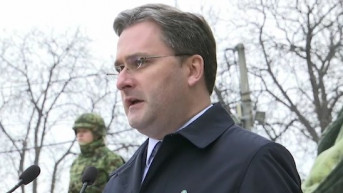
Minister of Labour, Employment, Veteran and Social Policy of Serbia, Nikola Selakovic, says that Serbia has every right to call today, Armistice Day, a day of its victory, primarily because of the courage in facing two empires and one neighboring country and the number of sacrifices it endured.
Selakovic, in an interview with "Novosti", says that formally and legally, this day is Armistice Day, signed on November 11, 1918, in a train with the Second German Reich.
"Essentially, that armistice wouldn't have happened without the Allied victory. World War I was only a prelude to the Second, which ended with Germany's capitulation. It's likely that what happened in 1918 wouldn't be repeated, which is simply signing an armistice under certain very restrictive conditions. Without adhering to the form but focusing on the essence, Serbia has every right to call that day a day of its victory, the victory of David over Goliath, a small country in terms of territory and population, which two empires and a neighboring country attacked during a part of the war. Considering the immense sacrifices the Serbs endured and the entire epic of the war, which is unique in many ways in world history, I believe it's a moral duty to name this day as a day of victory in the First World War", Selakovic says.
How much is the period of the Great War prone to post-historical engineering? We have witnessed constant attempts to turn Gavrilo Princip into a Serbian terrorist, and not only in the former Yugoslav republics west of the Drina River...
Undoubtedly, when it comes to Gavrilo Princip, he was an assassin, not a terrorist. Those who are closer to the one who was killed in the assassination will never accept that their heir was a tyrant. Everything indicates that - Austria-Hungary's treatment of the Serbs in Bosnia and Herzegovina, the fact that the Serbs were unjustly imprisoned, their property confiscated, and subjected to mistreatment in prisons. Austria-Hungary's official policy in Bosnia and Herzegovina systematically began to deny the rights of the Serbs to their national identity and imposed the ideology of Bosniakism. They persistently worked on ethnic engineering and the resettlement of non-indigenous people, so it's clear that the goal was to change the image of that region in which Serbian sentiment predominated. A group of young people believed that the consequences of tyrannical rule would end the moment they carried out the assassination of the heir, who deliberately, knowing the significance of Vidovdan for the Serbs, came to military maneuvers in Eastern Bosnia, thus provoking the Serbs.
How did it even come to the point where, for example, Hashim Thaci sat behind the presidents of the victorious powers in Paris on the centenary of the end of the Great War? And was our love one-sided if today the descendants of Franchet d'Esperey, along with the Americans and the British, are dismembering Serbia?
The counter-question is - what have we done after the period of the Kingdom of Yugoslavia, in which France rightfully held the place of a great ally from the First World War, and what have we been trying to achieve until recently? Friendships and alliances are something that needs to be nurtured; investments must be consistent and continuous. Our people who went through the ordeal of the Great War and stood shoulder to shoulder with French soldiers on the Salonika Front, liberating our homeland, had a strong sense of France as our protector. After the First World War, things changed, and it was unrealistic and romantic to expect in the 1990s that France would wake up from some dream and be where it was in 1918. No one in international relations lives on past glory. The tradition of good relations can be a good foundation for building something in the future, but it certainly doesn't automatically imply the right attitude or behavior. At the moment when Hashim Thaci is sitting behind Macron, in France, we no longer have the generations that, alongside our grandfathers and great-grandfathers, broke through the Salonika Front. Someone from the descendants may continue the story of our relationship, but it's much weaker than something fresh. France is the country in which our country was most intensively demonized in the 1990s. President Vucic is investing in relations with French President Macron, and he is keen to build upon the trend of rapprochement. When you sifted through the ashes a bit, that old enthusiasm emerged, as seen during Macron's speech at Kalemegdan. Of course, one swallow does not make a summer. France is a country that has recognized Kosovo, and we must fight and see what we have done to prevent that.
Recently, a century after his death, a monument to General Boza Jankovic was finally unveiled. If Kosovo is the dearest Serbian word, why did we wait so long to honor the savior of Kosovo?
We often remember our dearest words when we face the possibility of losing them, not when we have given them their full glory and liberated Kosovo after centuries of Ottoman bondage. General Bozidar Boza Jankovic was one of the most talented Serbian military leaders. The fact that he was brought out of retirement and placed at the helm of the Third Army, with the sacred task of liberating Kosovo, is evidence of his military prowess. Few people know who Bozidar Jankovic was. If the state did not have the strength to erect a monument, why not in Belgrade, where he was born? One period of our history was overlooked. Now we are returning to it. Throughout the 19th century, Belgrade only received a monument to Prince Mihailo. Today, we can erect a magnificent monument to Stefan Nemanja, King Peter in Novi Sad, complete the Temple of Saint Sava, make films about King Peter I, Dara from Jasenovac, the Storm, "A Lullaby for Soldiers", "Heroes of Halyard", Serbia can do that today and wants to. From 1945 to 1990, it didn't want to, even though it could. Where have we seen that it could? One of the best films, "March on the Drina", was made in 1964, and a monument to Vojvoda Misic was erected in the 1980s in Mionica. Don't be surprised by everything that happened to us in Kosovo and Metohija and what happens when we couldn't put on a pedestal the one who fulfilled the centuries-old task of avenging Kosovo.
How much do the commemorative medals you introduced mean to the veterans, and are they even more valuable than benefits for them? Do you have a record of how many have applied for benefits?
I have strived to implement what is a legal right for the veterans. The presentation of veteran medals accompanies our work. A year ago, we had 25,247 veterans, and now we have 40,638 veterans. That's an increase of 61 percent. I am confident that in the coming period, we will have even more veterans. We are showing that being a veteran is not something to be ashamed of, which was the case at one point, and that we need to express our gratitude and respect to these people. War veterans and the families of veterans are better provided for than ever. Neglecting veterans has ceased, and the saying, "The people will gild it all", is an ugly testimony of the past.
How, as a minister and someone who loves and is well-versed in history, do you react to the assessments, for example, of Professor Dubravka Stojanovic, who reduces the Battle of Kosovo to almost a fabrication and empty boasting of King Tvrtko in front of the Latins? Why is this spirit of self-denial so strong in the so-called civil Serbia?
What do you expect from the historical school in Serbian universities that grew up during the time of communism, and whose main goal was to absolutely denigrate Serbian history? I won't judge any individual, but I will say that history during the communist era was interpreted on ideological grounds, on Marxist-Leninist principles, and Leninism imposed a framework in which the largest nation in the USSR was the greatest culprit and cause of woes. That's how they began to interpret history in Yugoslavia, and from there, the Comintern mantra was coined that a weak Serbia equals a strong Yugoslavia and that the Serbs needed to be broken. How can you break them if you don't want to crush them psychologically and offer an ideologically interpreted history?
Do you feel that the West's plan is to gradually force us to recognize Kosovo - to accept Kurti's passports, flag, and license plates so that substantial recognition on our part won't even be necessary? There is a narrow maneuvering space in which we can operate.
How can it be narrow, when Vucic came to the helm of the Government, we had a situation where 80-85 countries had recognized the independence of Kosovo. And then you come to the point where you bring the issue back to the negotiating table, as until then, you had hardly ever been at the table but rather on the table. Our situation has never been easy. The difficult circumstance is that there is a tyrannical regime of Albin Kurti in Pristina, whose goal is the removal of the Serbs and the church. The fact that in the Middle East and Ukraine, we have two conflicts leading to polarization and the alignment of states, and our military and politically neutral position is fragile and difficult to maintain, but we protect it. Those who sponsored the independence of Kosovo are in a hurry and pressure us to do something that no other country has done, but in our persistence, we try to be as firm as possible. What they want from us, which is recognition of Kosovo, they will never have. During the time of those who accused Vucic of leading the country toward recognition, there were the most recognitions, but during our tenure, 26 countries withdrew recognition. You have notes in the Ministry of Foreign Affairs where US diplomats are told that recognition should be postponed until Boris Tadic wins the elections. And now these people come and talk about Kosovo. Like the man whose party's former president signed the release of Kurti and the terrorists - the Mazrek brothers, who described in detail how they raped children, killed them, and threw them into lime. In their time, the Smederevo steel plant operated by cutting up our tanks. If someone wanted to recognize Kosovo, it would have been done in the early years of their rule. And they didn't want to do it then, they don't want it now, and they won't in the future.
0 comments