
An attempt to sever the bond between the faithful and their holy sites
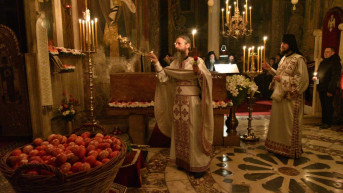
"Is everything all right?" the guide of a bus full of pilgrims recently asked one of the commanders of the so-called Kosovo Police at an administrative crossing into Kosovo and Metohija. "Yes, yes," came the reply, and the waiting continued. After an hour, the guide once again sought an explanation. "Is there something I need to change?" This time the answer was: "Yes... You need to change your head."
A year later, that remark has effectively been turned into a leaflet distributed by the police at administrative crossings. Referring to applicable legislation, it states that "any person performing the activity of a tourist guide within the territory of the Republic of Kosovo and leading organized tourist groups for tourism purposes must possess a valid license issued by the Ministry of Culture and Tourism."
The decision is a clear response to the growing number of pilgrims visiting Kosovo and Metohija. Behind it, there appears to be a fear of hundreds of thousands of Serbs from Serbia, Montenegro, Republika Srpska, and the wider diaspora coming to visit their holy sites, their lost towns, and their ancestral homeland.
The Raska-Prizren Diocese immediately reacted, calling for a clear distinction to be made between believers visiting monasteries and tourists who include monasteries in Kosovo and Metohija in their itineraries. In its statement, the Diocese referred to both local and international law:
"The monasteries of the Serbian Orthodox Church in Kosovo and Metohija are, above all, living holy sites—places of worship, prayer, and monastic life. The overwhelming majority of visitors do not come to these shrines as tourists but as pilgrims who wish to participate in religious services, venerate holy relics, seek spiritual guidance, and visit the monasteries as part of their religious life.
Freedom of religion directly includes the right of believers to visit their holy sites freely, participate in worship, and organize pilgrimages. Kosovo's Constitution and the Law on Freedom of Religion contain special guarantees for religious communities, including the Serbian Orthodox Church, protecting its status and explicitly guaranteeing unrestricted access for pilgrims and other visitors to religious sites.
We particularly emphasize that Article 8.2 of the Law on Freedom of Religion expressly guarantees unrestricted access for pilgrims, guests, and persons permanently or temporarily residing in religious institutions, while requiring that this guarantee be respected in the implementation of regulations governing travel and residence. Furthermore, Article 7A of the same law prohibits the arbitrary prevention of the entry and stay of clergy, candidates for the priesthood, monks, nuns, and visitors of the Serbian Orthodox Church."
How a system that claims Serbs seized Albanian churches in the Middle Ages, institutions that maintain lists of prohibited Serbian words, and a society stripped of its multiethnic character will respond remains to be seen.
For now, however, it is evident that a new institution has been created—that of the licensed guide who will be required to accompany Serbian believers to liturgies or visits to approximately one thousand holy sites throughout Kosovo and Metohija.
Representatives of Serbian travel organizations registered within Kosovo's institutional system and local municipal structures say that local guides do exist, but that Serbs "do not have a single licensed tourist guide at the higher, national level." Among roughly twenty registered and licensed Albanian and other guides, only a handful are able to provide services in the Serbian language.
In essence, a form of institutional supervisor has been introduced—someone who will accompany Christians into churches that are their own property. Church dignitaries and Serbian believers will now be able to visit and pray in the endowments of Serbian medieval rulers only under a license issued by the Kosovo authorities.
"Those coming to Kosovo and Metohija from central Serbia are not tourists; they are pilgrims—very specific groups of pilgrims. This is about spiritual pilgrimage and groups visiting the holy sites of the Serbian Orthodox Church. It would be truly interesting to see how these so-called guides accredited by Kosovo would behave in Decani or in the Patriarchate of Pec," Professor Milos Kovic, who has been taking his students to Kosovo and Metohija for decades, told RT Balkan.
He also suggested another possibility:
"If they prevent us from coming in groups, we will come individually. Then we will see whether they intend to place one of their guides in every single car."
Violating religious rights simultaneously infringes upon private property rights. All members of the Serbian Orthodox Church are, in a sense, the custodians and owners of their holy sites because those who built them dedicated them to the faithful and entrusted them to their care.
The requirement for a licensed guide within these shrines represents an attempt, twenty-seven years after the conflict, to sever the organic bond between believers and their holy places, between owners and their heritage, and between the fragile freedom that survives within Serbian enclaves and the outside world that understands and supports them.
Perhaps the greatest surprise is that life within those holy sites has endured, just as life within the enclaves has endured. That reality, reaffirmed countless times, is proof that the very idea of survival has prevailed.
As history and subsequent analysis now suggest, the latest decision reflects a combination of Albanian nationalism and communist methods, recalling a period when monasteries and churches were emptied of monks and clergy and replaced by museum custodians.
Today's licensed guide, in this view, resembles the curator of the communist era—a person tasked with receiving visitors in attractive buildings, galleries of frescoes, or among the ruins of holy places, while providing them with the "official" interpretation.
Written for Politika by journalist and writer Zivojin Rakocevic
0 comments