
Belgrade - Pristina via Ljubljana: Why is Pahor offering to be Lajcak's successor?
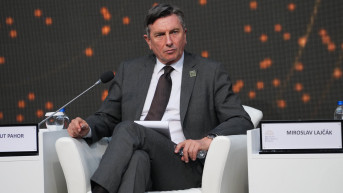
"The process to appoint Lajcak's successor in Brussels has not officially started yet, but lobbying for Borut Pahor to be the prime candidate is well underway. The top echelons of the Slovenian state and Ljubljana's diplomatic network are backing Pahor's desire to take on this challenging role," stated high sources
Prepared by: Milos Garic
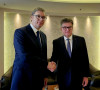
Yesterday, the EU High Representative for Foreign Affairs and Security Policy, Josep Borrell, appointed Miroslav Lajcak as the new European Union ambassador to Switzerland, definitively vacating the position of the Special Representative for the Belgrade-Pristina dialogue, a role for which the long-standing Slovenian politician Borut Pahor is actively contending.
On Borrell's list for the upcoming EU diplomatic corps rotation ahead of the elections in June, it has not been specified who will succeed Lajcak from summer onwards. However, Borut Pahor has apparently received a positive signal from the decision-makers.
"Some time ago, those who believe I would be well-suited for this role warned me that Lajcak might leave earlier and encouraged me to consider running. After ending my political career, I was often asked whether I would apply for international positions. My answer was no, unless an opportunity arose to work on the Western Balkans. Essentially, there are two roles – the High Representative of the international community, currently Christian Schmidt, and the EU Special Representative for the dialogue between Pristina and Belgrade," Pahor told the media a few days ago.
From Non-Papers to Mandate
After a four-year term, Miroslav Lajcak leaves behind unimpressive results as the main EU mediator between the Serbian and Albanian sides. In fact, this function is now quite compromised, and official Pristina has openly challenged Lajcak's role many times, raising the question of why Pahor is so interested in succeeding him.
Historian and political analyst Ognjen Karanovic recalls Pahor's involvement with the Kosovo issue in the past.
"I don't know how much our public remembers Borut Pahor's role from two years ago, and even from the time he was both the President and Prime Minister of Slovenia. We all remember that he was pointed out by political structures in the Western Balkans region for sending that infamous non-paper document that magically appeared in public. He, of course, denied being the author of the idea about changing borders in the Western Balkans. Thus, his role in relation to the Kosovo issue, concerning the southern Serbian province, is well known not just because of those circumstances from two years ago but over the past several decades," Karanovic pointed out for Context.
He adds that Slovenia has a history of special relations with the Albanian separatist movement in the southern Serbian province, which is not unknown.
"On the other hand, Pahor is a very ambitious politician. The Slovenian public will tell you that he was a very capable statesman, a shrewd politician, already several decades ago, since the last congress of the League of Communists of Yugoslavia. At that 14th Congress of the League of Communists of Yugoslavia in 1990, Pahor became known to the wider Yugoslav political public. Of course, in the following decades, he has profiled and affirmed himself as an influential Slovenian statesman and politician. Now, whether he will be more successful than Miroslav Lajcak if he comes to that position, I doubt it, because the issue of the southern Serbian province, namely solving that issue, especially when it comes to implementing the provisions of the Brussels Agreement, was not in the hands of Miroslav Lajcak, and certainly will not be in the hands of Borut Pahor," explains Karanovic.
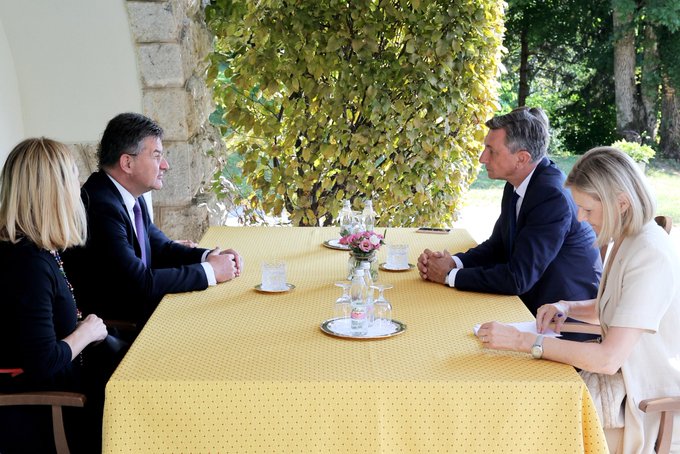
The Position of Envoy is Operational, Without Influence
"All previous mediators, from Catherine Ashton and Federica Mogherini to Miroslav Lajcak, and even Pahor, as well as all the special envoys from Hill to Escobar, none of them achieved any significant success simply because their countries, especially when it comes to the major powers from NATO member states, actually want a solution to the Kosovo issue only in accordance with their geopolitical and political perspectives. This is contrary to international public law, certainly to the interests of the Serbian people and the state of Serbia, and against the United Nations Charter and other international documents. Thus, this issue is unsolvable as long as the political processes themselves do not return to the framework of international public law and a dialogue that would arise from these international acts and documents," emphasized Karanovic.
Good Salary as a Motivation
He sees a completely new approach by the international community as a necessary innovation.
"As long as there is political violence, by Kurti as well as the political West, over international public law, as long as they encourage Kurti or do not prevent him from violating everything achieved so far, we will not have a solution. It could be Borut Pahor, it could be Miroslav Lajcak, it could be any mediator, they might have more or less political weight or significance personally, but it does not depend on them. So, my opinion is that a completely new approach by the international community is needed to resolve the Kosovo issue, but we do not see this new approach, we do not even see its outlines, we do not see that it is possible under these circumstances. There is no will for it, especially in light of the madness that has prevailed since the start of the Russo-Ukrainian war, and now with the new escalation of war in the Middle East. Perhaps some changes would occur if the administration in Washington were to change after the November presidential elections," concludes Karanovic.
Assistant professor at the Faculty of Political Sciences in Belgrade, Stefan Surlic, says for Kontekst that there is a personal interest for Pahor in coming to the position of EU envoy for the dialogue.
"Pahor offers himself because he comes from a country close to the region, and Slovenia has recognized the independence of Kosovo, but I think there is a personal interest, namely a diplomatic ambition of Borut Pahor. He wants to be a key figure who can present himself as a mediator, who will like Lajcak at the beginning have very ambitious demands, expectations. Then he will face problems that will not be easily solved. But, certainly, I think that the position of mediator is attractive also because of the financial benefit, which is not small; as far as I know, it is a salary of 20,000 euros per month, which is a decent, nice salary. Also, it's a diplomatically challenging job and of course a stepping stone for further international career. And so I think that is necessary for a person with political experience like Borut Pahor," states Surlic.
Professor at the University of Pristina, Fadil Maloku, emphasizes the importance of economic cooperation.
"I think that Pristina and Belgrade, along with the international factor, are making a very serious mistake. Namely, since the war of 1999 to date, I have never heard that a single project with economic dimensions was attempted to be implemented in Kosovo, especially in the northern part. Also, neither Belgrade nor Pristina have had the interest to integrate Serbs as one of the largest ethnic groups, along with Albanians and others, through economic policy and logic. Namely, all previous attempts to calm the situation have been either political or police-based, and I have never heard of economic investments being discussed. I do not absolve Washington or Brussels from this. In these 25 years, they could have done something. I'm not saying we need some kind of iconography of 'brotherhood and unity', but primarily a multi-ethnic factory or say the revival of Trepca, which in the former Yugoslavia brought ordinary people together. Don't get me wrong, I'm not talking about a Yugonostalgic history here, but about a concrete plan where the main actors are the international factor, Belgrade, and Pristina. Kosovo needs a Marshall Plan that would instill trust in ordinary people, which is greatly lacking these past twenty years, to create indications towards convergence and towards a civic society. Where human rights are more important than collective rights. The way it is done in the Western world," Maloku advised for Kontekst.
comments