
FEUILLETON 25 years of NATO bombing of Serbia (29): Chernomyrdin: Milosevic is a sick man like Hitler
Written for Kosovo Online by Dragan Bisenic
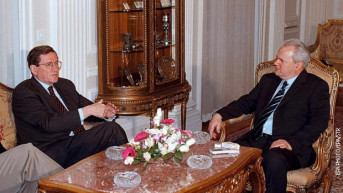
In the Serbian public, even among the participants of the negotiations, there has been speculation for decades about who said the infamous phrase that Yugoslavia would be leveled to the ground if it did not accept the proposed agreement. Some attributed this to Ahtisaari, and some to Chernomyrdin. Chernomyrdin himself, in a conversation with Vice President Gore, attributes this sentence to himself. "I told him: you have 3-4 months and Yugoslavia will be flattened like a sheet of paper," Chernomyrdin recounts his words to Milosevic. Additionally, Chernomyrdin added: "You see, he is a sick person, and his nation doesn't know what's happening. Like Germany under Hitler. Only later did Germany realize what Hitler had gotten them into. Meanwhile, his country is being destroyed."
He illustrates this with the family history of Milosevic, marked by the suicides of his father and mother, and several other relatives. Since this was a private conversation that lasted 10 hours, it is logical that its content was recounted as rumor, but not as a documented claim. Now we can say that it was Viktor Chernomyrdin who uttered that sentence.
At this meeting in Washington, which followed his meeting in Belgrade on Friday, May 30th, where the first document with Milosevic on the conditions for ending the bombing was signed, the Russian envoy again emphasized that Milosevic was counting on a ground operation to thus bring NATO into a situation where, due to casualties and public pressure, it would accept ending the conflict under conditions he would dictate. At this meeting, Chernomyrdin was close to giving up on the deal, as he did not encounter the expected understanding from the American side.
In his memoirs, Chernomyrdin noted that he observed that Americans do not tolerate different thinking about the Yugoslav issue, even among their compatriots, and immediately classify them as dissidents. A unified line of behavior was being established, although Chernomyrdin mentions that before him, Jesse Jackson had been in Belgrade securing the release of three captured American soldiers, but Clinton was not satisfied with Jackson's trip with the delegation, nor the arrival of the American pilots. Clinton, as Chernomyrdin notes, believed that Milosevic himself had missed the right time and now could only be spoken to in the language of force. "The sooner he 'comes to his senses,' the better for him."
American politician and head of the delegation of religious leaders who had been in Belgrade since Thursday night, April 29th, Jesse Jackson met twice with Yugoslav President Milosevic and eventually succeeded in freeing three captured American pilots.
Jackson led a humanitarian mission with a delegation of 34 people from the USA. He dismissed the possibility of having any diplomatic or political duty, but observers believe otherwise. The decision by the Yugoslav president only confirmed rumors about the possible backgrounds of the talks for a diplomatic solution.
He had several meetings with the religious heads of Serbia and Yugoslav politicians. He visited destroyed facilities in Belgrade. The night he arrived in Belgrade was the most dramatic night in Belgrade and Serbia since the start of the operation. Some parts of Belgrade were without electricity and water.
"With one eye I see the destruction in Yugoslavia, and with the other, the fate of the people in Kosovo," Jackson said. He added that bombing Serbian television was the same as bombing NBC or CNN, during his visit to the destroyed Serbian television building.
In a conversation with Serbian Orthodox Patriarch Pavle, Jackson said that waging war is easier than conducting diplomacy. "The Yugoslavs are paying a high price for a war they do not understand," Jackson said.
"Although the bombing tonight was very intense, there is room for diplomacy. Until a diplomatic solution is found, the bombing will escalate and widen. More explanations that the U.S. Congress demanded from the American president, give room for Yugoslav diplomacy to demonstrate readiness to stop the violence in Kosovo, return the refugees, and allow international peace forces to protect both Serbs and Albanians," Jackson said.
Spokesperson for the Yugoslav Ministry of Foreign Affairs Nebojsa Vujovic said that the latest bombing attacks in the center of Belgrade were not just attacks on buildings. They were attacks on diplomatic efforts and a possible political solution for Kosovo. Vujovic said that the Yugoslav position remains unchanged: Yugoslavia only accepts a UN civilian mission, the mandate and scope of which will be decided in a political process with Russia's constructive role.
He stated that during the recent visit of Russia's special envoy Viktor Chernomyrdin, "political principles that provide the best basis for a solution in Kosovo and Metohija" were established.
Under such circumstances, the Russian envoy traveled to Washington for talks with American officials on May 3, 1999. In describing these talks in his memoirs, Chernomyrdin, however, does not mention and does not indicate in any way the very harsh words he himself used against Milosevic in conversations with American interlocutors.
Now follows the continuation of the transcript of the conversation published by the Clinton Library. Of course, the possibility of a certain tendency in the disclosure of this transcript should not be dismissed, as it does not support the ideological picture of the behavior of the Russian negotiator during the 1999 bombing, but it is not so unknown, considering that a significant number of participants in the negotiations from the Russian side, in their memoirs, openly criticized the stance and manner of negotiations that Chernomyrdin had.
CHERNOMYRDIN: I am convinced that Milosevic fully understands this. He is a sick man, but not to the extent that he cannot understand what is happening. Remember his actions when you started bombing. He wanted no progress. He was preparing for something on a larger scale - ground operations. I told Strobe that these were my first impressions. Because his country was being bombarded, factories destroyed, people dying. That's what I thought it would be - like a normal person.
VICE PRESIDENT GORE: We see him the same way.
CHERNOMYRDIN: He's waiting for a ground operation. That's what he wants.
GORE: He won't get it.
CHERNOMYRDIN: He has planned all this in advance. He got rid of the opposition. Now he is a national hero. He has consolidated the nation around himself. He couldn't do this in the past. Now he realizes that there is room for movement. I told him: you will have 3-4 months, and Yugoslavia will be flattened like a flat plate. He said people will support their country and will not yield. You see, he is a sick person, and his nation does not know what is happening. Like Germany under Hitler. Only later did Germany realize what Hitler had gotten them into. Meanwhile, his country is being destroyed. People are unemployed. You talk about the return of refugees - but where? Pristina? Nothing is left. They will not return. There is no home to return to. Milosevic understands everything. I am not such a brute to tell him that your people will curse you and you need to stop what you are doing.
I am not a diplomat. I am not here for small talk. At my second meeting, we agreed. When he agreed to reduce and withdraw forces, support international presence there by NATO. No one says that only Russia will be part of the forces. The only thing he says is to give me an umbrella [hat]. I won't surrender to either Russia or NATO, but to the UN. That's why I raised Kofi Annan. I asked him if he thought Annan would solve it – that it wouldn't depend on him because he doesn't have a mandate and that the U.S. would be the main country. He said, "I understand, but give me a chance." Let's sit down at the negotiating table and dictate our terms. Then the refugees will return, and the military presence will be reduced. And no one will ask him whether he approves or not. Russia is not a participant. We want to be guarantors. But if we send Russian troops, do you think we will just stay and watch you? We won't send people to be shot and killed. Milosevic said that he and NATO would withdraw forces from the border. I asked how? Numbers must be decided in negotiations. We can sort this out. He agreed to a protectorate. Today he agrees. He is at the negotiating table. But we must make progress. In my conversation, I used harsher words. But he agreed to five items. So, we must start serious negotiations, and everything will be resolved.
GORE: Thank you. This was not easy for you. We agree that he is a sick person and appreciate your honesty. We know his history - his mother and father committed suicide. His wife brought out the worst in him. The tragedy is that the Serbian people are cursed with a demagogue who brings out the worst ultranationalist hatred toward people who are different. We see the tragedy in a similar way. I agree with you that there are dangers. First, let me say that Kofi Annan is unreliable. I am telling you this in confidence. We cannot rely on him. This feeling is so strong that we are not willing to have him in charge of negotiations. But maybe it would be possible for the U.S. and Russia behind the scenes – we consult with NATO, and you with Milosevic – to draft UN Security Council Resolutions based on Chapter VII of the UN Charter containing the terms we discuss and use them as a basis for further diplomatic action. If we could find countries considered neutral to lead the drafting of the document we are preparing, that might serve as the fig leaf needed for Milosevic and resolve our lack of trust in Annan. We are open to other suggestions. We are open to that. Another point. With all the progress you have made on your travels, there are still major differences between what Milosevic and NATO consider acceptable: the presence of Serbian police around sensitive locations; border protection; simultaneity and duration of withdrawal – the order of withdrawal and stopping of bombings. These are gaps that can be narrowed. That is the role you can play. Or a different one. You be the judge. Third point. What happens with the escalation of bombings? I understand your claim that Milosevic is gaining strength and uniting people. But only to a certain point. We see mass desertions. Serbian police are going door to door in Belgrade and rounding up young men for the army before they manage to slip out the back door. I have seen reports that the VJ ceases to exist in areas as an entity due to the damage we have inflicted. So he will shift the point of his strengthening to one that weakens him.
To conclude: we see a strategy in two stages: a planned UN Security Council Resolution to give Milosevic a "fig leaf"; and you are working on your interpretations of our positions to talk to Milosevic. And maybe we have to do that first, that the differences must be narrowed to get to the UN Security Council Resolution.
CHERNOMYRDIN: If Milosevic agrees to all conditions, who will deal with him? We are mediators, acting on instructions from President Yeltsin. We can make five more visits, but if Milosevic agrees, who will deal with him?
GORE: Two points. First, decisions on our side are taken by NATO. If not for the requirement for a "fig leaf," it would be the Contact Group. For the second, I would like to address Sandy.
BERGER: Assuming that you could narrow the differences, we could draft a UN Security Council Resolution to embody this. Milosevic would then accept the UN mandate. He surrenders to the UN, not to Kofi Annan. But the preliminary step to maximize that chance that will happen is narrowing the differences. Maybe he won't like everything.... Then he agrees to the rule of the UN, not the U.S., Russia, or NATO.
CHERNOMYRDIN: If it's a resolution, it should be passed by the UN Security Council.
GORE: That would be written behind the scenes by the U.S. and Russia.
CHERNOMYRDIN: Yes. China would need to be convinced. But it still depends on the UN. Not Kofi Annan - he's not fit. But we're still talking about the UN. Someone has to make the decision to agree to the resolution....
GORE: Maybe, maybe not. The Security Council can act without any member negotiating with Milosevic. It could act independently in a statement of principles. This has happened elsewhere. Sponsors refer to the UN Security Council as a basis. If the purpose is to get a fig leaf, then this is enough. Your role is to get Milosevic's interpretation of the meaning of the resolution.
BERGER: It is also possible that the UN Security Council Resolution would then provide some kind of representative like in Bosnia - with administrative responsibilities, like the OSCE. A civil administrator accepted by Milosevic under the UN who would provide the machinery.
CHERNOMYRDIN: Let's say he agreed to all this and the UN Security Council Resolution is passed. And Milosevic and NATO agree. There must be someone who will express readiness to agree.
BERGER: If NATO, Milosevic, and the UN agree, there will be a civil and military component, and the civil would be appointed by the UN or OSCE.
CHERNOMYRDIN: These are nuances. Someone – an agency – must be able to make decisions: Yugoslavia agrees, Milosevic agrees.
GORE: I think there is a difference in views. We talked about a UN Security Council Resolution accepted by Milosevic or NATO. But setting up the UN in charge of negotiations is a problem for us. We do not trust Annan and do not know of another suitable person. If it was a UN Security Council Resolution that Milosevic accepted, at some point NATO command would have to meet with VJ command to determine how the international force would be inserted to preserve peace. Just like in Bosnia when Yugoslav forces agreed with Russia, Ukraine, and NATO.
TALBOT: But it was called IFOR - a new thing.
GORE: That could be a new entity. Not NATO or the UN. But approved by the UN with participation by NATO and Russia. A new entity with which Belgrade negotiated the final details.
CHERNOMYRDIN: This cannot be. Kosovo is part of Yugoslavia. Russia does not participate in the conflict. We will not sign anything. We want Milosevic to surrender either now or when he has nothing left. Our actions have forced him to surrender. His entire industry is destroyed... [???]
GORE: We disagree.
CHERNOMYRDIN: To finish. I can pass on the points. He knows about the five points. That is part of the package that I signed with him, and we have to start negotiations from that. So, if you do not trust Annan, find someone else. There is no point in trying to force us to play this role. We want to end this, but we can't do it in such a simplified way. He agreed to all conditions. So either continue this way or bomb to the end. He can surrender either today or in 3-4 months. He has no other option. Otherwise, I have no information about desertion.
VJ is not suffering losses, only civilians. So he can surrender either today or in 3-4 months. But we can sit down and negotiate today. He agreed to everything. Or you can wait 3-4 months. Russia cannot take responsibility for solving this instead of him... We do not support or justify Milosevic. We are talking about substantive matters. It is just a matter of the final proposal. So let's put Lavrov, or Petrov, or someone else in Annan's place. Milosevic wants to be civilized. But we are bringing him to a dead end. But that's not possible. He's ready to spend days and nights at the negotiating table. What did he write to the president?
BERGER: He went backwards. He said he believes in peace and an international presence, but...
TALBOT: He mentioned four things he's ready to support, but only at a high level in general and nothing about withdrawal.
CHERNOMYRDIN: That's my mission. I told him not to bring me to a dead end or this is my last visit...
USHAKOV: We wanted to clarify what Milosevic's message was. Now we know.
GORE: It didn't make sense. We appreciate what you did, Viktor. If you decide you can't do any more, you've tried hard, played an honorable role, people would understand. We said what we would like you to do. We respect the answer that it's impossible to do. But we disagree that what we're saying is a demand for surrender. But there is no disagreement about the "fig leaf". But it will take more than a "fig leaf" to change our position from Rambouillet and say we support Kosovo's independence. But if this continues, that may change. Also, the international force does not have to be NATO, it can be under... but led by NATO. Also, if Milosevic starts to withdraw and accepts the plan, the bombing will immediately stop. [You helped get the process started] Because of you, we agreed to reintroduce forces to protect Serbian heritage. All of these are tangible changes in NATO's attitude out of respect for your understanding and our understanding that is developing. If we connect it with the UN Security Council Resolution, it means that he does not have to accept NATO and then can sit down with a completely new entity, with participation by NATO. But what we're hearing is awful - stories about refugees, as if humanity has regressed 1000 years... such brutality as we enter the 21st century... [bloodshed, children killed, etc.] Viktor Stepanovich, I respect you, your heart beats like mine. If you think it might be helpful to follow these ideas we've talked about, maybe you're in a unique position. You are the only person with the respect of Washington and Belgrade and capable of advancing the process. I leave it to you and what you decide.
CHERNOMYRDIN: Thank you... This will never bore me. As a man, I cannot stand injustice and evil. I think we're on the brink of war and we could very easily enter it. You're right that genocide is genocide, but we don't see such cases in Russia. Our media doesn't cover it.
GORE: Gusinsky's station shows it, others don't.
CHERNOMYRDIN: No, I don't think so. These atrocities - everyone agrees that NTV is the most unbiased station, but it doesn't mention thousands killed. Even Europe doesn't see it. We asked for proof and were told that all we can show are satellite images.
GORE: I will ask colleagues to submit reports to show you reality. We will try to provide you with evidence so you can see it with your own eyes. We will give you our best evidence.
CHERNOMYRDIN: I raised this because I told Milosevic. He said it wasn't allowed, but there were cases and he arrested 200 people. Since there's no death penalty, some people are now serving prison sentences. But he said there are no mass cases. I just said look - 600,000 refugees. He says, "Yes, but the KLA caused the destruction."
GORE: Milosevic learned from Hitler to tell big lies.
CHERNOMYRDIN: I agree. Maybe we should show such evidence [to the Russian people] in case they are not aware.
GORE: When are you leaving tomorrow? I want to give you as much material as possible before you go to New York.
CHERNOMYRDIN: 9:00 am
GORE: We'll have it by 8:30.
CHERNOMYRDIN: We'll do our best to find solutions. But (the crisis) can only be resolved by moving on both sides. We've made good progress. Milosevic has moved. We could progress if we can sit down at the negotiating table. We must develop a formula, so we propose that there must be an official international agency to do this job. We will participate. Our position is principled.
GORE: Two last things. Here are written answers to questions that Sandy previously reviewed (hands the document to Chernomyrdin). We need to be especially careful with the press. One thing to avoid: none of us should say that the other side has moved. This would hurt us. And we won't say that the Russians or Milosevic have moved.
BERGER: We should say that we are involved in a process of better understanding each other's positions.
CHERNOMYRDIN: Yes, I'll say that negotiations or talks are underway. I've encountered criticism, that's all I hear now. "Chernomyrdin is on his way to Belgrade to solve all the problems." I'm ready to hand it over to someone else.
In this document or others related to this visit, there are no parts related to Milosevic's fate, which Chernomyrdin mentions in his memoirs. He says there were talks about Milosevic's personal fate. This issue was raised by Chernomyrdin himself, who says that Milosevic never raised it.
Besides, Chernomyrdin says that during the negotiations, one thing surprised him. The Americans were speaking on behalf of NATO and about NATO, but they never consulted on any matter with any other ally. He once asked Strobe Talbott. He was genuinely surprised: "What advice? Why? What we say, so it will be..." Besides, Chernomyrdin, in meetings with other leaders, from France, Germany, Italy, realized that they were not at all up to date with events. They often asked him to inform and update them on one thing or another. In this, he recognizes the characteristics of a unipolar world and begins to think about them, as well as about the broader significance of the NATO war against the FR Yugoslavia, since other military operations followed, which brought different behavior of major European countries, Germany, and France.
"In NATO, a situation has been created that is not simple. This is essentially a symptom, which provides material for thinking and devising everything that is happening in the world," concluded Chernomyrdin.
comments