
FEUILLETON: 25 Years of NATO Bombing of Serbia (40): The Russian March on Pristina - On the Brink of World War III
Written for Kosovo Online by Dragan Bisenic
In a conversation I had with the former German Foreign Minister, Joschka Fischer, he revealed an interesting detail once mentioned by Henry Kissinger. Kissinger stated that Holbrooke, during his last meeting with Milosevic on March 23, 1999, was ready to continue the diplomatic initiative and negotiations. "We and other Europeans, as well as Holbrooke, agreed to embark on a 'last-minute' mission to avoid war. Holbrooke himself proposed halting the military action, without having Serbia make a parliamentary decision that would complicate the negotiations, and to continue negotiating. This was rejected," Fischer said.
You had several attempts during the war to reverse its course. Can you summarize them?
- Let me go back to my meeting with Milosevic. I told him that he was going to war with the USA. "You may laugh about the Europeans, but let me tell you that Germany did that twice in the 20th century and it was disastrous for us," I told him. He asked me, "What about Vietnam?" I told him, "This is not Vietnam and you are not Ho Chi Minh." I don't know why he did it, but when the war started it was clear that Serbia would lose. It was a tragedy for the people that the leader did not do everything to avoid that war, which would have resulted in Kosovo remaining under Serbian sovereignty.
When the war started, political initiatives were needed to find a way out. We defined a five-point plan and how to implement it. This was known as the "Fischer Plan." I worked very hard to achieve our political goals and end the war.
Was the war ended based on your plan?
- The most important thing was to involve Russia, to make it clear to the leadership in Belgrade and Milosevic that a settlement was the only way out. The agreement meant accepting NATO-based security forces in Kosovo. If this had happened without a war, Kosovo would have been part of Serbia with autonomous status. Only the presence of NATO could preserve Serbia's territorial integrity and protect Serbs in Kosovo. This was demonstrated by the example of Bosnia. Today, the situation is different. It was very important to move forward. In the end, everyone accepted it, including Russia, and even Milosevic.
In your book, you mention words by the former Chancellor Kohl who supposedly said that he would never have accepted a military intervention if he had been chancellor. Is that true?
- That's mentioned in Yevgeny Primakov's autobiography. If it's true, then it would be odd, because I was in the room when the decision was made during the last days of Kohl's government. It was a decision about NATO action. I mentioned it because it would indeed be very strange if true," Fischer explained.
The terminology and language of the Security Council resolution were negotiated during twelve-hour talks by the G8 foreign ministers in Cologne on June 7 and 8. On the first day, Russian Minister Igor Ivanov tried to remove mentions of cooperation with the War Crimes Tribunal and suggested allowing a part of the Serbian security forces to remain in Kosovo. The agreement reached allowed the withdrawal of Yugoslav forces from Kosovo on June 9.
The only major remaining issue was how to define Russia's role in the NATO-led peacekeeping forces, but that was not, as will be seen, a trivial matter. Madeleine Albright admitted that for the first time in several months she felt she could "breathe normally." Not only that. It was her moment of triumph. "Despite all the doubts, the Alliance held together and through a creative mix of diplomacy and force, we won. It was an exhilarating moment. Walking the streets of Cologne, I received applause. During the G8 meeting, Foreign Minister Fischer said, 'Well, if this was Madeleine's war, it is now Madeleine's victory.' I replied that it was NATO's victory, but I wondered how those who pejoratively called it my war are feeling now," Albright stated. The dinner, held at the Chocolate Museum, was full of mutual praises and sentimental toasts. In them, no one overlooked Madeleine Albright.
On June 8th, during the G8 summit in Cologne, a press conference was held featuring Joschka Fischer, Madeleine Albright, Robin Cook, and Igor Ivanov.
Madeleine Albright informed everyone that a joint draft resolution was agreed upon after 12 hours of negotiations and announced the continuation of technical agreements. "Based on this foundation, a military-technical agreement can be concluded," Albright stated, predicting a swift and extensive reconstruction of Kosovo. She had met with a delegation of Kosovar Albanians the day before.
Albright evaluated that there was "very useful coordination between the use of diplomacy and the use of force." "Initially, we had the threat of using force to support diplomacy; then we had the use of diplomacy to support force," said Madeleine Albright, emphasizing that "this was an exceptional example of how force and diplomacy work together." However, it was noted that similar "humanitarian rhetoric" used in the case of Kosovo and Iraq served the "project of a new empire."
On the same day, June 8th, the President of Hungary, Arpad Goncz, was visiting Washington. Goncz inquired whether Milosevic would be overthrown because of Kosovo. In a brief but illustrative conversation, Goncz questioned the status of Sandžak, Montenegro, and Vojvodina, while comparing the Kosovo Liberation Army to the Jewish organization "Haganah."
Discussing the Russians, Clinton stated that the USA could not agree to give them their own sector or share command and control with NATO forces because an "effective command arrangement that could not be manipulated by ethnic politics" was needed.
Clinton reiterated that "Russians could not be deployed only in areas that were predominantly Serbian" and suggested that Russians "would do better working with NATO troops" if they entered all four sectors. Clinton emphasized that he had spoken with many Albanians and concluded that there would be a "strong desire to punish Serbs" and concluded that a strong military presence was needed to prevent this kind of retaliation.
It was noticeable that the American president did not understand what was happening in Moscow at the time, which would become a dramatic issue two days later concerning Russian participation in the peace mission. Clinton attributed a bias and favoritism towards Serbia to Russian forces, while considering NATO forces an "objective factor" that would take care of the balanced interests of both sides. By declaring and recognizing Kosovo's independence, it was shown that NATO was accommodating Albanian plans.
The Hungarian President concluded that there was a "tradition of revenge" in Serbia, and then said that the current "KLA guerrillas need to be transformed into peacekeepers."
Goncz then indicated that "after Milosevic is overthrown," chaos must be avoided. This led Clinton to ask whether he thought Milosevic would be overthrown because of Kosovo.
The Hungarian President said he could not predict events, but "he will go one way or another." "Groups abroad will play a role. Panic and Varadi and others will have some influence. There are another 300-400 others who could be the nucleus of a transitional government. We must be careful in our intervention there," Goncz pointed out. He said that Hungary wanted to be an economic hub for the reconstruction of Southeast Europe and suggested that the next phase of negotiations could deal with other issues in the former Yugoslavia, including Sandžak, Montenegro, and Vojvodina.
The next day, June 9th, 1999, the Kumanovo Agreement was signed, marking the end of NATO's bombing of the then Federal Republic of Yugoslavia. Military and police forces of the FRY withdrew from Kosovo and were replaced by UN forces. The UN Security Council passed Resolution 1244, which formalized UN authority in Kosovo.
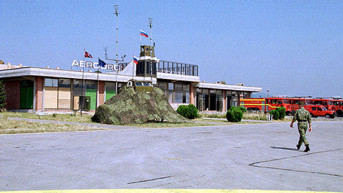
In Russia, it was a holiday, and few knew that the country was on the brink of military conflict with NATO countries. Russian and NATO troops were ready to shoot at each other... Now, the whole story can be reconstructed from the notes of the main participants in that drama. A combined battalion of Russian airborne forces, which was part of the international peacekeeping contingent in Bosnia and Herzegovina, carried out a forced march to Pristina on June 12, 1999, with the operation's goal being to seize the Slatina airport before the British NATO peacekeeping contingent.
These events took place in June 1999 when Russian paratroopers were secretly transferred to the Pristina airport, the capital of Kosovo. On both sides were generals who were not afraid of war.
Russian President Boris Yeltsin reveals that he made the decision to seize the Slatina airport. Yeltsin states that on June 4th he had to decide whether to approve the military plan to transfer the airborne unit to the Pristina airport. He doubted whether it was necessary because all documents were signed, "what's the point in showing courage, swinging fists after the fight"? However, under the conditions of "complete non-acceptance of the Russian position by the European public opinion," he decided that Russia "must make a final gesture," even if it "had no military significance."
"It wasn't about concrete diplomatic victories or defeats. The matter was that we achieved the most important thing – Russia didn't lose morally. It didn't allow itself to be split. It didn't allow itself to be dragged into a war," Yeltsin concluded.
Lieutenant General Leonid Ivashov, who was then the head of the Main Directorate for International Military Cooperation at the Ministry of Defense, recalls:
"We worked on the possibility of an armed conflict with NATO in the decision-making phase about deploying to Kosovo. There was another option, a backup: to fly to Belgrade and, in case of a conflict with NATO, hold blitz negotiations about jointly opposing the threat to our peacekeepers.
We were well aware of the Serbian army's mood: they were ready to deploy troops in the southern direction and enter Kosovo. In this case, NATO would have faced the prospect of a ground operation, which they were terribly afraid of. Moreover, the Yugoslav Army would have gladly avenged the aggressors for the victims and the tarnished honor. Moreover, in a brotherly alliance with the Russians. This argument became decisive..."
"Sputnik" states that in May 1999, Major Yunus-Bek Yevkurov received a secret task from the highest military leadership of Russia - to secretly infiltrate Kosovo and Metohija as a group of 18 GRU special forces soldiers from the Russian General Staff, take control of the "Slatina" airport, and prepare for the arrival of the main forces of the Russian contingent.
NATO's Supreme Allied Commander in Europe, General Wesley Clark, perceived the secret military operation of the Russian paratroopers as a hostile act. Stubborn by nature, he was ready to use weapons to stop it:
"I tried to get in touch with NATO Secretary-General Javier Solana, but unsuccessfully, so I called the Vice Chairman of the Joint Chiefs of Staff General Joe Ralston in Washington with a suggestion:
- Shouldn't we at least consider a military response to this challenge?
General Ralston agreed with this proposal. General Mike Jackson reported to me that he had two British companies (about two hundred fifty people) and that the French offered their battalion (another three hundred fifty people)."
At that moment, the fate of the world was in the hands of the military. The political leadership had no idea what was happening.
In Moscow, Deputy U.S. Secretary of State Strobe Talbott was visiting, whose influence is explained not so much by the fact that he had spent his entire life studying our Russia as by his longstanding friendship with President Clinton.
"On Friday, June 11," Talbott recalls, "I arrived at the Kremlin for a meeting with Vladimir Putin, Secretary of the Security Council. Putin was reserved, avoided conflicts and publicity, and therefore remained on the periphery of our panorama of Russian politics."
Having met Putin, I was amazed at how subtly he conveyed a sense of self-control and confidence. Externally, he was quite different from the country's leadership—he was short, slim, and physically fit; the others were taller, and most looked overweight. Putin exuded managerial competence, an ability to achieve results without fuss and unnecessary friction.
If Yeltsin and Chernomyrdin were, according to one scholar's terminology, "hot," then Putin was probably the "coolest" Russian I had met. He listened with an attentiveness that seemed as calculated as it was polite. And to me, as to others, he clearly made it known that he had done his homework and read my dossier prepared by the intelligence services... On one hand, this feels flattering ("I know you"), on the other, it's disconcerting ("I know things about you").
Putin expressed satisfaction that the war in Kosovo had given way to peace. Almost in passing, he added that he was pleased to have made his small contribution by suggesting that Yeltsin appoint Chernomyrdin as special envoy, Talbot noted.
However, a rift then occurred in the ranks of Viktor Stepanovich's associates. Along with Chernomyrdin to the negotiations went employees from the Ministry of Defense and the MFA. General Leonid Ivashov, representing the Ministry of Defense at the negotiations, voiced opposition to Chernomyrdin.
Ivashov was the one who insisted that "the Ministry of Defense considers the NATO bombing of Yugoslavia a violation of UN principles, an aggression against a sovereign state, and would take all possible measures."
The general considered NATO members war criminals:
"I stood up and declared that I categorically disagree. I understood that I was burning all my bridges behind me, but I was not dishonest. That's why I stated that the proposed document was not an equal agreement but an ultimatum posed to Yugoslavia, because of which the military part of the delegation will not participate in its signing and will leave the meeting room..."
There was no delegation as such. Chernomyrdin conducted the negotiations in the role of the president's special representative. He himself brought the agreed proposals to Belgrade. He expected that Milosevic would object, argue, seek changes and amendments.
"Slobodan Milosevic added nothing!" said Chernomyrdin. "Not a single word!" Neither Milosevic nor his closest associates did what was expected of them: attempts to change the draft UN Security Council resolution so that it better reflected their interests. How much effort was spent, how much blood was spilled—for what? Just to now accept a document that could have been agreed upon earlier?"
Every time Milosevic dragged the country into war, he consolidated his power. He launched a military-police operation in Kosovo to rally the country's population against an internal enemy. A cynical and calculated politician, he knew that Kosovo could not be maintained. Apparently, his reasoning was as follows: if he immediately accepted the plan for the deployment of foreign troops, he would be called a weakling, a poor patriot, a traitor. But after he had killed so many people and destroyed half the country, his agreement with the peace plan was some sort of a statesmanlike act. Speaking on television, Milosevic spoke of Yugoslavia's victory...
"Bombing," wrote Bill Clinton in his autobiography, "finally broke Milosevic's will to resist. NATO and the Serbian military command agreed on June 9th on the withdrawal of Serbian troops from Kosovo and the deployment there of international security forces under NATO command.
The next day, Javier Solana ordered General Clark to stop the air strikes. And I announced to the American people that after seventy days of bombing, the bombing was over, Serbian troops were withdrawing from Kosovo, and a million men, women, and children who had been forced to flee could return to their homes.
NATO forces received a UN Security Council mandate to conduct a peacekeeping operation in Kosovo. Then a new conflict broke out—between Russia and NATO. The stumbling block was the issue of the role of the Russian military contingent and its special status. "The Russian side," said Viktor Chernomyrdin, "wanted to have its own sector, roughly the size of a paratrooper brigade. NATO did not want to assign a special sector to Russian troops. Our contingent must maintain some autonomy or be under UN command, but not subordinate to NATO. The American side, NATO members, told us that these forces should be united, i.e., under their command. Personally, I have always defended this point of view: Russia has its special interests in Yugoslavia. Since it is not a member of NATO, its contingent should not and will not be subordinate to the command of the North Atlantic bloc.
In the meantime, dissatisfaction with the concluded agreement in the Ministry of Defense was translated into a concrete decision. Kosovo was divided into five sectors—American, French, Italian, German, and British. People around the Minister of Defense, Marshal Igor Sergejev, decided that if Russian peacekeeping forces were not assigned their own sector in Kosovo, they must seize it themselves.
"During the meeting with Putin," said Deputy Secretary of State Talbot, "I received a note. General Ivashov had stated that if NATO entered Kosovo from the south, from Macedonia, without a final agreement on Russian participation, Russian forces would unilaterally enter Kosovo from the north, through Serbia. I conveyed to Putin the content of the note and added that it seemed we were facing a military confrontation.
"Who is this Ivashov?" asked Putin...
Sitting on the plane, I bet one of our generals ten dollars that Ivashov would be fired before sunset," predicted Talbot.
The deputy secretary of state, who is considered one of the best experts on Russia in America, was wrong. A huge scandal only flared up, involving high officials.
President of Russia Vladimir Putin said that during the events in Yugoslavia in 1999, when he was serving as Secretary of the Security Council of the Russian Federation, the then Chief of the General Staff, Anatoly Kvashnin, asked for his opinion on seizing the "Slatina" airport in Pristina, to which he replied: "If you think it's appropriate, do it."
In June 1999, Russian armed forces launched a forced march—suddenly appearing in Kosovo and taking control of the Slatina airport (the main military airport near Pristina), a few hours before NATO forces planned to seize it.
Putin shared his memories of these events in an interview for the film "Belgrade" on Russia 1 TV channel. "I was then Secretary of the Security Council, and the then Chief of the General Staff, General Kvashnin, came to me. He told me there was an idea to seize this airport," said the Russian president. According to Vladimir Putin, in response to the question "why is it necessary?", Kvashnin then answered: "It's clear that we'll have to leave one day, but it'll be something we can bargain with."
The President of Russia then said that he knew Kvashnin had not risked coordinating this action with high officials, primarily from the Ministry of Defense. "In any case, he discussed it with me and asked me for my opinion, to which I replied: 'If you think it's appropriate, do it'," concluded Putin.
"Leaving Macedonia," recalled then U.S. Secretary of State Madeleine Albright, "I dreamed of getting a good night's sleep on the way home. But as soon as the plane took off from the ground, we were informed that Russian troops had entered the territory of Kosovo, and the Serbs welcomed them in Pristina as heroes. Sandy Berger and I immediately spoke with Strobe Talbott, who was just on his way from Moscow. We advised him to fly back."
German Foreign Minister Joschka Fischer believed that the military in Moscow acted independently of the political leadership. Relying on Talbot's information, he noted that it was "strikingly shown that those days and nights in Moscow there was a situation on the brink of a rebellion by the highest representatives of the Russian military authorities against the political leadership." Fischer believed that "obviously the political part of the authorities either knew nothing or had only limited knowledge of what the inner circle of generals in the Russian General Staff planned with Russian troops stationed in Bosnia, which were on their way to Kosovo, what orders were issued, and what was agreed with Serbian generals in case Serbian security forces withdrew from Kosovo.
"I myself, in a conversation with Igor Ivanov, conducted during those hours, could not escape the strong impression that the political leadership in Moscow was no longer the sole master of the situation," Fischer reported.
Talbot's plane was already somewhere above Belarus when he was told that the Russian part of the peacekeeping contingent stationed in Bosnia had entered Serbian territory and was supposedly moving toward Kosovo. National Security Advisor Sandy Berger called Talbot. The perpetually disheveled Samuel Berger had known Clinton for 20 years. Strobe Talbot had known the president for 30 years and had sought the position of National Security Advisor, but Clinton had chosen Berger instead of him.
"Sandy told me to return to Moscow and 'make a fuss,'" Talbot recalled. "I went into the control room and talked to our pilot."
Talbot's return to Moscow compares to how Primakov, learning that the bombing of Yugoslavia was about to begin, turned his plane around from a trip to America and returned home. In fact, there is a huge difference between them. Primakov turned the plane around so as not to talk to the Americans. Talbot turned the plane around to negotiate.
"In Moscow," said Talbot, "at our embassy, we watched live CNN reports on the progress of the Russian armored column in southern Serbia. When we arrived at the Ministry of Foreign Affairs, Ivanov was on the phone with Madeleine Albright. They had a strange dialogue. The Secretary of State informed the Russian Foreign Minister that his country's troops had already entered Serbia and were approaching Kosovo, and he replied that this was not true.
Madeleine did not believe Ivanov: we had our own information about troop movements in the Balkans, and we trusted it more than the Russian Ministry of Defense. However, Madeleine doubted who was lying: Ivanov to her or the Russian military to Ivanov.
What really happened? Why did Russian paratroopers start a secret expedition to Kosovo? And how did it happen that other ministers, including the head of Russian diplomacy, Igor Sergeyevich Ivanov, knew nothing about this?
"We," recalled General Ivashov, "began to prepare a report from Defense Minister Sergeyev to President Yeltsin that they were trying to exclude us from the Balkan process, to avoid a series of measures. One of them could be the simultaneous deployment of our peacekeepers in Kosovo with NATO divisions.
The draft document was submitted to Foreign Minister Ivanov. He carefully read it, made several amendments, and signed it. Later, it was said that the minister allegedly did not know about it, that he was almost 'set up.' As we see, this is not the case. Ivanov may not have known the details, but he did not need them. Details are a matter for the military. The Minister of Defense signed it and went to report to Yeltsin. He returned from the Kremlin satisfied: the president had given permission for the deployment of the Russian contingent in Kosovo, synchronized with NATO."
The Russian airborne brigade was performing a peacekeeping mission in neighboring Bosnia. They decided to transfer one of its battalions to Kosovo and then send two more battalions from Russian territory by transport planes...
Lieutenant General Nikolai Staskov, who was then the Chief of Staff of the Airborne Troops, told journalists:
"The decision was made privately, even not at the level of the highest officials. I, as the Chief of Staff of the Airborne Forces, knew in advance. The Airborne Peacekeeping Brigade in the Balkans was commanded by Colonel Nikolai Ignatov. And he calls him:
- Prepare a group in advance.
Without anyone noticing, they formed a column at the old airport. When they received the command, they immediately rushed forward. There were doubts. Colonel Ignatov came to me and said he had not received any written orders, what should I do? I take responsibility, I say, just go ahead."
The convoy that headed to Kosovo consisted of fifteen armored personnel carriers and thirty-five personnel vehicles. The main concern of the Ministry of Defense was how to hide the transfer of Russian soldiers from NATO. Formally, they were subordinate to the commander of the American division and jointly carried out a combat mission.
It turned out that it was not difficult to deceive American soldiers.
General Ivashov:
"The brigade command, on instructions from Moscow, informed the commander of the American division that our battalion had received orders to move to the territory of the Federal Republic of Yugoslavia. The division commander asked if assistance was needed and wished success to the Russians.
Near Belgrade, the battalion was under the command of Lieutenant General Zavarzin. I officially informed Viktor Mikhailovich that the order to bring our contingent to Kosovo was given by Minister Sergeyev on the direct order of the President of Russia. Frankly speaking, the balance of power in Moscow did not guarantee that any of the officials from the General Staff, the Ministry of Foreign Affairs, or the Presidential Administration would not try to interfere in Zavarzin's actions and would not implement their own line.


comments