
FEUILLETON Rambouillet - ultimatum for the bombing (10): Hill and the origin of the Community of Serb-majority Municipalities
Writing for Kosovo Online: Dragan Bisenic
As Abramovitz announced, more ambitious attacks by the KLA followed shortly afterward. On June 25th, the Belacevac mine was taken over, but that wasn't enough for the KLA to be truly considered a respectable combat organization. A condition for that was to control at least one major city. Prior to that, they had only briefly gained control of a part of Decani.
The choice fell on Orahovac. There were several reasons for this, and one of the essential ones was that there were no military facilities or members of the former Yugoslav army in this city. Military units prior to this attack were deployed on the border with Albania and were exclusively engaged in protecting the state border.
KLA leaders were eager to declare a city "free". Seizing Orahovac would enable them much easier insertion of personnel and war material from Albania.
The attack on Orahovac was carried out from July 17th to 20th, 1998, and completely surprised the police forces present in it. During the first two days, July 17th and 18th, the KLA, operating with about 1,000 people, took over all significant objects in the city, established checkpoints at the entrances to the city, and blocked police forces in the police building and the Park Hotel. The hotel housed around 100 policemen from Pirot, and there were between 400 and 500 police officers in the city and its immediate surroundings. All telephone lines were cut off, and the transformer station was damaged, leaving the city "cut off" without phone lines and electricity.
On the morning of July 18th, a Combat Group of the army and special police units, commanded by then-Colonel, later General Bozidar Delic, was formed, which broke through the city's defense, and after two days of fighting, on July 19th, the city was unblocked and liberated.
This was the first operation involving army units, which later became a topic of controversy and an alleged additional pretext for NATO military action. The attack on Orahovac is considered a turning point in the subsequent conflicts in Kosovo and Metohija. Following it, there was a strong offensive by Serbian security forces and the Yugoslav Army towards all KLA strongholds. Shortly after this attack, Malisevo, where the KLA Headquarters was located until then, was also seized.
This "summer offensive" was noticed by Madeleine Albright, who described it as a "disaster".
"In July 1998, the KLA launched a 'summer offensive'. It was a disaster. The Serbian counter-offensive was overwhelming and persistent. Their strategy was to cut off the guerrillas' supply lines by taking control of areas along the province's border with Albania and then drive the rebel forces out of literally every village. The result was a campaign of intimidation that drove hundreds of thousands of civilians along with KLA fighters into the mountains and forests. Milosevic thought this was his opportunity to destroy the guerrillas while terrorizing Kosovars committed to independence into abandoning their dreams".
She, for example, doesn't even mention here what actually happened, the temporary occupation of Orahovac.
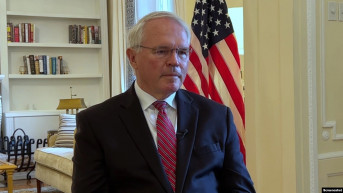
Albright asked one of her closest advisers, James O'Brien, the architect of the Dayton Agreement, to join Ambassador Christopher Hill in leading the negotiations. The two of them proposed a creative solution whereby Kosovo would remain within Yugoslavia while creating new civilian police forces and other self-government institutions.
"Without closing the door to eventual independence, the proposal called for a temporary period of at least three years before this explosive issue was resolved," Albright wrote.
She stated that Serbs privately told her that Milosevic was "open to a deal, but we wondered on what terms".
"We needed to test him, but first we had to persuade the Albanians to unify their negotiating team and agree on a series of achievable goals. This proved to be difficult. The KLA was gaining strength again, along with a reluctance to compromise. Different Albanian leaders spoke of each other with disdain, sometimes threatening each other with violence, and couldn't agree on the negotiation agenda. Precious weeks passed because, to our frustration, they refused to even meet. As the winter passed, my fears grew," Madeleine Albright admitted.
Since the Albanians were in disarray, she stated, Milosevic cannot be blamed for not negotiating.
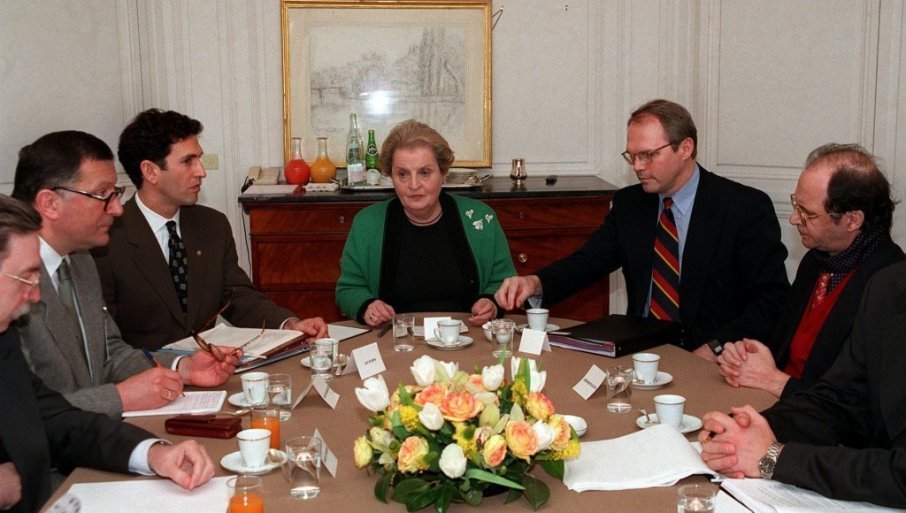
"Since the KLA was on the move, our allies were not willing to blame, let alone bomb, the Serbs. Since Milosevic could not be trusted, it was impossible to convince the KLA to rely on a small, unarmed team of OSCE observers for Kosovo's protection. The result was that negotiations were getting nowhere while violence was spreading," she drew gloomy conclusions.
Unlike Madeline Albright's clarity about the bombing, Hill spoke in mild formulations, using the phrase "NATO involvement".
At all times, demands for negotiations from the EU and its members, the Contact Group, and the Security Council were focused on the "future status" of Kosovo. However, as it turned out, the actual agenda promoted by Ambassador Hill through shuttle diplomacy between Belgrade and Pristina took a different turn.
After the Contact Group presented various options for a solution to the parties, it was clear that an agreement on the actual status of Kosovo would be impossible. FR Yugoslavia/Serbia was unwilling to budge, and the Kosovo leadership could not abandon its stance on independence, given the dramatic events of that summer.
Instead, Ambassador Hill informed the OSCE that an informal understanding had been reached on three years of stabilization and normalization to allow for the re-establishment of democratic institutions, after which a new approach could be envisaged. He emphasized the crucial importance of international presence in Kosovo during the implementation period and the significant role the OSCE would have to play in that area. Although a series of draft solutions seemed to originate from Ambassador Hill and another Dayton veteran, the rather brilliant legal advisor Jim O'Brien, the Contact Group as a whole retained significant influence over the content of these documents. Additionally, the draft prepared by the Venice Commission of the Council of Europe for Democracy through Law also proved influential — so much so that the equally gifted and resourceful director of the Venice Commission Secretariat was later instructed to support EU envoy Wolfgang Petritsch in talks at Rambouillet.
After further research during late summer, the first formal and Hill’s comprehensive draft was presented to the parties on October 1, 1998. It represented a genuine attempt to balance the different interests of the parties. Specifically, it completely avoided the question of Kosovo's status and instead focused on pragmatically allocating powers to various levels of administration. For FR Yugoslavia/Serbia, this approach was painful as it avoided explicit confirmation of the continuation of territorial integrity and sovereignty of FR Yugoslavia or even Serbia itself. Kosovo also hesitated. Although the draft did not directly prejudge its status, by sidestepping this issue, it still had a very significant drawback.
With this agreement, Hill prejudiced the form that is now the biggest stumbling block – the Community of Serb-majority Municipalities.
Marc Weller states that the "source of public power" would not be located in Kosovo's institutions but in individual municipalities or local districts. This meant that Kosovo as an entity would not enjoy any significant element of legal subjectivity - a fact that could seriously impede its quest for improved legal status in the future.
"In deference to Serbia, the draft also contained very detailed provisions that, as feared, would subject Kosovo to a policy of ethnic division. The actual allocation of public powers envisaged by the draft was quite complex. Remaining authority over all matters not regulated elsewhere would be held by the communes, which were also granted significant powers of direct self-government. This included the authority to organize local police forces representative of the commune's ethnic composition. Moreover, communes could unite to form 'self-governing regions consisting of multiple communes'. While the majority of municipalities in Kosovo had ethnic Albanian majorities, several had Serb majorities. Therefore, this provision seemed to allow for the formation of an ethnic Serbian entity in Kosovo based on a set of municipalities. Such division has not proven fruitful in the past, considering the establishment of the Republika Srpska in Bosnia and Herzegovina.
To be continued tomorrow: Racak – crime and punishment

0 comments