
Gvozdenovic: We need Chinese patience when it comes to Kosovo
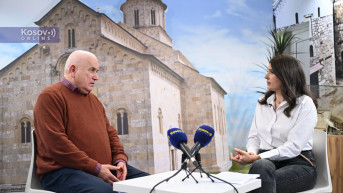
The connection between Serbs in Romania and Kosovo is deep and ancestral. Many of us trace our roots to Kosovo, not only on the left bank of the Danube but further into Romania as well. Every place where Serbs live in Romania is older than the Battle of Kosovo and Saint Sava, who founded three monasteries here – Bazjas, Zlatica, and Kusic. He could not have founded them where there were no Serbs, but among his own people. Everything that binds us to Kosovo and Metohija is found in my book “How Much Kosovo Is in Me.” It is a beautiful story in verse about Serbs from ancient times up to the present day. The publisher is the National and University Library “Ivo Andric” from Pristina, temporarily based in Belgrade. I hope the book manages to capture at least a part of what connects us to Kosovo, said Dr. Slavomir Gvozdenovic, poet, professor, translator, and honorary president of the Union of Serbs in Romania, speaking on the podcast KOntekst.
He presented the book to visitors of this year’s Belgrade Book Fair at the stand of the Office for Kosovo and Metohija. He lives and works in Timisoara and was born in the village of Belobreska, on the Romanian–Serbian border, where most of the population is Serbian.
“Serbs are the same everywhere, with all the virtues and flaws we have. What matters most is that we are aware of who we belong to and that we are conscious of our language and culture,” Gvozdenovic emphasized.
He said that the efforts to preserve the cultural identity of Serbs in Romania can be compared to those of Serbs striving to maintain their identity in Kosovo.
“It is the same for all of us, you cannot tell where it is harder – on your doorstep or when you move farther away. But it is our sacred duty not to forget who we are and what we stand for. We Serbs in Romania, in addition to our work in parliament, have published the book “When You Step Out on the Frozen Shores,” an anthology of Serbian poets from Kosovo. It reached people throughout Romania who respect and appreciate us. Every Serb, especially those of us who write and translate, is obliged to do more for Kosovo and help more. Above all, in that political struggle to which we Serbs from Romania are committed in body and soul. We must show that we are one nation no matter where we live and learn something from those who acted more wisely – I mean the Jews and the Armenians. When they look at each other, they know who they belong to, and we must learn that too, to understand that political affiliations do not matter. There is something above everything else, and that is Kosovo and Metohija,” the KOntekst guest said.
He is preparing an anthology titled “Timisoara on the Ibar,” which symbolically connects a city and a river, bringing together Serbian writers from Romania.
“My wish was for us to gather at the Ibar, which means so much to Serbs in Kosovo. The anthology will include all Serbian writers from Romania, so we could even read it on a bridge, for both sides to hear,” Gvozdenovic said.
The writer from Timisoara also spoke about how present Kosovo is as a theme among contemporary authors.
“This has been going on endlessly, and we must have Chinese patience. People write about Kosovo, but also about broader social themes. When we touch on a painful subject, our sensitivity comes alive,” Gvozdenovic said.
He is the founder and now honorary president of the Union of Serbs in Romania. He is proud that Serbs, as one of twenty national minorities in Romania, are far ahead of others when it comes to cultural heritage, social, and humanitarian activities. He served several terms in the Romanian parliament and often raised the topic of Kosovo.
“The Romanian public and the state have understanding for the Kosovo issue, but we must know that they protect their own interests that way because they have a problem with their largest national minority. If this precedent remains, the same could happen to them,” Gvozdenovic warned.
He recalled 1990, when, as president of the Union of Serbs in Romania, he organized a collective trip to Gazimestan for the anniversary of the Battle of Kosovo.
“We could not have dreamed we would get there. We were welcomed by Bishop Atanasije Jevtic. He couldn’t speak, it was the first time I saw such a great man lost for words. We brought the largest wreath ever to Gazimestan, as long as a bus, with the message ‘Grateful descendants to heroic ancestors.’ Most of us are originally from Kosovo, and when we were welcomed in Gračanica, we met families who celebrated the same patron saints as we do. It felt as if we were reunited as one family,” Gvozdenovic recalled.
His work has been recognized by many, including former Yugoslav president Dobrica Cosic. Gvozdenovic once said that perhaps Cosic’s idea of dividing Kosovo and demarcating with the Albanians should have been accepted. In KOntekst, he elaborated on that statement.
“It is a delicate issue. It is easy for us to give advice from Timisoara. But if we stop and think about it, knowing this suffering will never end, something must be done. What is Serbian must be preserved, and a special status must be ensured for the Serbian Orthodox Church in Kosovo. Only after that can we think about some kind of division. But I want to make it clear, if Serbia decides on something like that, for us it is sacred,” Gvozdenovic concluded.
You can watch the full interview in the video clip.
0 comments