
The New World Order and the Balkan Perspective: Serbia between Moscow, Beijing, and Washington

Written by Zeljko Sajn for Kosovo Online
The development of international relations after the Cold War and the fall of the Berlin Wall opened up a new global perspective. Although borders were redrawn in the wake of wars, the centers of power remained the same—Moscow, Beijing, and Washington. In this geopolitical map, Belgrade has in recent years become increasingly visible, while Brussels, London, Paris, and Berlin are more often left on the margins of major processes, without a clear vision or political influence.
Despite instability, the prospect of final agreements based on balanced relations and diplomatic compromise remains open. The foundation for this is provided by the Charter of the United Nations, a document marking its 80th anniversary this year. At such a moment, the question is clearly posed: on what principles will the new global architecture rest, and what role can small states, like Serbia, have within it?
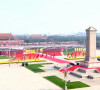
Answers to this question are, at least partially, offered through the political messages of military parades. Washington marked the 250th anniversary of the U.S. Army; Moscow emphasized the continuity of the Red Army’s tradition and its victory over Nazism; Beijing recalled the allied struggle against Japanese militarism; while Belgrade sent the message that the Balkans must no longer be the detonator of other people’s interests.
Parades, however, are not just displays of military power. They are a sophisticated form of political language. Every uniform and every unit on the central square becomes a message—to allies, rivals, and domestic citizens alike. The United States celebrates continuity and strength, Russia relies on historical memory, China reminds of past alliances, while Serbia demonstrates its readiness to act as a factor of stability.
It is well known that Russia, China, and the United States today possess nuclear arsenals so destructive that their use would mean the annihilation of humanity. The quality of modern weaponry surpasses imagination, but the true value lies in the ability to translate military strength into diplomatic capital. This confirms that diplomacy is not a sign of weakness, but the only mechanism for preserving stability.
Pope Francis, even before the outbreak of the war in Ukraine, warned that the world had entered a “fragmented Third World War.” The Holy See’s Secretary of State, Cardinal Pietro Parolin, reiterated this thought in Politika, stressing that a series of local conflicts is turning into a global one. In this context, the meeting between Vladimir Putin and Donald Trump in Alaska was a moment of halting total confrontation.
Under these circumstances, Serbia is increasingly positioning itself as an actor that turns military neutrality and diplomatic flexibility into an advantage. This is precisely why Brussels has been sending mounting criticism and pressure toward Belgrade, which, unlike some European capitals, retains maneuvering space both in the East and the West. On the occasion of the 80th anniversary of victory in the Second World War, Moscow and Beijing welcomed Serbian President Aleksandar Vucic with high honors, thereby confirming that Serbia upholds the legacy of a country that mounted strong resistance against the Axis powers and made a major contribution to defeating Nazism and fascism.
Yet today’s international relations show that “the arguments of force” are more often applied toward Belgrade than “the force of arguments.” In this context, it is worth recalling Einstein’s thought: “Powerful states do not need ambassadors—their strength speaks for itself. For small states, however, the way they express themselves is of decisive importance.” Through its parade and political messages, Serbia emphasized that it poses no threat to anyone, but is prepared to defend itself. In doing so, it has opened up space for a diplomatic game in which compromise becomes the key instrument.
At this very moment, a new world order is being shaped. Leaders such as Putin, Trump, and Xi, through their meetings and statements, confirm that compromise is not a sign of weakness but the only way to ensure lasting stability.
On the sidelines of the Shanghai Cooperation Organization summit, Chinese President Xi Jinping recalled the five principles of China’s peace platform: mutual respect for territorial integrity and sovereignty, mutual non-aggression, non-interference in internal affairs, equality and mutual benefit, and peaceful coexistence. These five points, formulated in the 1950s, are taking on renewed significance today. They offer a global framework for cooperation based on balance and serve as a counterweight to hegemonistic approaches. Serbia recognizes in them a platform that allows it to turn its status as a small state into an active diplomatic role.
The Balkans are no longer a passive periphery but are becoming part of the process in which a new security architecture is being created. Serbia, with a strengthened army and active diplomacy, affirms itself as an indispensable actor in the region. At the same time, the role of the United States in Eurasian processes demonstrates that no side can be completely excluded.
By contrast, Berlin, Paris, and London are increasingly on the sidelines. Their policy, based on sanctions and war rhetoric, has proven insufficiently effective. Meanwhile, Belgrade is strengthening cooperation with all relevant actors. Serbia, already recognized as a significant player in the emerging world order, is becoming of interest to the United States as well—evidenced by the U.S. Secretary of State’s invitation to meet President Vucic on the margins of the 80th anniversary of the United Nations in New York.
It is clear that the new world order is not being shaped in Brussels. It is emerging along the Moscow–Beijing–Washington axis. Thanks to its historical legacy and contemporary political choices, Serbia has entered the club of states with diplomatic significance in shaping this order.
In the coming years, the key question will be whether the world avoids total conflict and finds balance. The five principles of China’s peace platform offer a universal framework, while Serbia demonstrates that the Balkans can be a place of stability rather than a detonator of others’ interests. Belgrade is not only the heir of the antifascist tradition but also an actor in the new multipolar order that knows how to combine military strength with diplomatic wisdom.

0 comments