
The Serbs from Kosovo and John Grisham
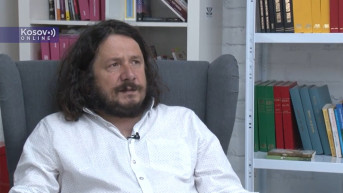
Writing for Kosovo Online: Muharem Bazdulj
Prominent newspaper "Financial Times," writes these days about an interesting literary experiment where 36 writers are collectively writing a novel titled "Fourteen Days". In that group, special emphasis has been placed on Margaret Atwood, Dave Eggers, and John Grisham. What caught my attention was the focus on Grisham. Because both Margaret Atwood and Dave Eggers are known as artistically accomplished top writers, while Grisham is usually seen exclusively as a "genre-savvy craftsman". In this sense, this can be interpreted either as a compliment to Grisham or as an "elevation" of the commercial potential of the entire project.
Grisham is a favorite of Hollywood producers. There are dozens of adaptations of his novels. In the first half of the nineties, these were "The Firm," "The Pelican Brief," and "The Client," but it seems to me that the peak of his fame is marked by the film "A time to kill" from 1996. Directed by Joel Schumacher, starring Matthew McConaughey, Sandra Bullock, Samuel L. Jackson, and Kevin Spacey.
At the heart of the story is an incredibly cruel and brutal crime of the rape of an African-American girl by two disgusting middle-aged white men. The girl's father kills them in the courtroom. That's just the beginning of the movie. The essence of this courtroom thriller is the trial of the father for the murder of the criminals. Jackson plays the father, and McConaughey plays his lawyer. It is he, in his closing statement, who delivers an unforgettable monologue, at the end of which is the powerful message of the whole film. After listing all the unimaginable things the criminals did to the girl, he says after a theatrical pause, "And imagine if the girl had been white." After that, the jury acquits the girl's father.
Recently, I was browsing through, after a long time, the excellent study by Croatian ethnologist Ivo Zanic titled "Deceived History." In it, he, among other things, deals with the murder of Branka Djukic, its consequences, and public reactions. Let's remind ourselves, in early September 1975, two shepherds, Albanians, saw the student Branka Djukic from the village of Meteh on Mount Cakor waiting for a bus to Pec. Expecting her to return the same way later, they ambushed her, intending to rape her. However, the girl resisted and fought back, so they killed her. The next day, her father Rade found her body. The killers were quickly arrested. Before the final verdict was pronounced, Branka's father, Rade Djukic, approached them and, with a pistol, executed the immediate perpetrator of his daughter's murder.
Rade Djukic was then tried, but his lawyer, it seems, was not as eloquent, or perhaps that wasn't the actual problem. Yugoslav public opinion was on his side. Tens of thousands of citizens signed a petition for his release, but he was still sentenced to eight years in prison.
After the secession of Kosovo, the killer of the innocent girl was proclaimed there as a "victim of Serbian terror." Between 1912 and 1999, excluding shorter intervals during the First and Second World Wars, when Kosovo was under the control of Serbia and Yugoslavia, the attitude towards Albanians was not always identical. Even if there are periods that could be described as "terror," the second half of the 1970s was by no means such a period. However, in today's Pristina "mainstream," these are nuances and subtleties for which they have no patience.
One of the most important contemporary writers globally, Nobel Prize laureate Peter Handke, has attempted in several of his works to be the "voice of the Kosovo Serbs." However, as much as Handke is artistically esteemed and relevant, he cannot be compared in terms of circulation and mass media influence with John Grisham. The visibility of Kosovo Albanians in global media is much louder, if not more sensational. They have celebrities even stronger than John Grisham.
If Kosovo Albanians today proclaim notorious criminals, whom they would have been ashamed of in normal times, as "victims of Serbian terror," they should at least have a little more understanding of the current Serbian position in Kosovo. On the other hand, certain historical periods in the twentieth century when the Albanians in Kosovo were indeed discriminated against should not be disregarded by the Serbs. However, history is one thing, and the present is something entirely different. In the present, it is clear to everyone who holds real power and authority in Kosovo, and who can only be a victim to that power and authority.
If all the wrongdoings committed against the Serbs in Kosovo over the past quarter of a century were listed, if all of that were specifically and documentedly presented, and if we paraphrase the mentioned scene from the famous Grisham novel, what strong, unambiguous, and concrete reaction would follow, only if the victims were not – Serbs?

comments