
“Shota” in Kosovo as a result of the agreement with Albania and Croatia – What comes next?
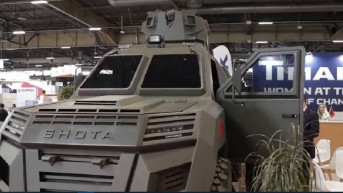
The announcement of the launch of production in Kosovo of the armored combat vehicle “Shota,” designed in Albania—a NATO member state—is viewed by security experts as a step toward strengthening the Kosovo Security Force (KSF), bringing Kosovo closer to the Alliance, but also as part of an arms race in the region. The agreement under which this vehicle will also be produced in Kosovo is the result of a trilateral military cooperation agreement between Kosovo, Albania, and Croatia signed last year, some of whose objectives include improving defense capabilities and advocating Kosovo’s status within the Partnership for Peace.
Written by: Dusica Radeka Djordjevic
As part of the implementation of the joint declaration from March last year, a trilateral meeting was held today at the level of directors for defense policy and armaments. According to the Kosovo Ministry of Defense, the meeting included an exchange of views on opportunities to enhance joint cooperation in the field of defense capacities, cooperation between defense industries, and further steps for implementing the declaration.
Cooperation between defense industries has already been discussed in previous months, resulting in an agreement for the “Shota” vehicle to be produced in Kosovo. According to announcements by Ejup Macedonci, acting Minister of Defense, talks with Albania on the development of this armored vehicle are expected to be expanded to include Croatia as well.
“Shota,” he specified, would be intended for the needs of the armed forces of all three parties, as well as for export.
This combat vehicle, whose prototype was presented in 2024 at the international arms and military equipment fair Eurosatory in Paris, is considered by Albania to be a major achievement of its defense industry.
Albanian Defense Minister Piro Vengu said last week that Croatia, Albania, and Kosovo have begun cooperation based on the March 2025 agreement in the military, training, academic and educational fields, as well as in military production.
Official Belgrade expressed concern over this agreement as soon as it was signed, describing it as a provocative initiative aimed at destabilizing the region.
Vengu, however, claims that it is not directed against anyone and that he was the first to invite Serbia to join the initiative if it considers regional stability and the Euro-Atlantic future of the countries in the region to be important—an invitation to which, he added, he received no response.
The U.S. Protects Its “Vineyards”
Journalist and analyst from Tirana, Dritan Laci, told Kosovo Online that the decision for Kosovo to produce the “Shota” is a way to build military capabilities in Kosovo, since it is not a NATO member and cannot enjoy the same level of cooperation within the Alliance as Albania and Croatia.
Agreements on the production of weapons and ammunition in these countries, Laci believes, are in fact concluded in the interests of the great powers—primarily the United States or major European countries—whose goal is to reduce costs, which is why they support the expansion of capacities in these states.
“This is undoubtedly also linked to the security situation in the Balkans, which has been described as a powder keg ever since the time of the Congress of Berlin. It is therefore a hotspot that can explode at any moment. There are several reasons why this triangle has emerged between Kosovo, Albania, and Croatia. First, because of the good relations Albanians have with Croats and because Albania and Croatia are members of NATO. Also because Albanians and Croats were together ‘in the trenches’ during the wars in the former Yugoslavia,” the analyst notes.
The Balkans, Laci says, have always been part of the interests of the great powers, and in this case the United States is trying to create a status quo to prevent conflicts between actors with differing interests.
“All these countries are interested in an arms race. So when a superpower like the United States sees that Russia has interests in the Balkans and is trying to arm a country like Serbia, it views the arming of other countries as an alternative, because in the end it will protect its own interests—it will protect its ‘vineyards’,” he assesses.
No Operational Steps Yet
The announcement of the production of “Shota” in Kosovo, according to Nikola Vujinovic, a security studies researcher from Belgrade, indicates the strengthening of the KSF and a desire to turn it into a genuine armed force, which, he points out, is contrary to all agreements reached so far.
At the same time, he notes, it represents the operationalization of the “trilateral pact” between Albania, Kosovo, and Croatia reached last year, aimed at strengthening armed forces.
Vujinovic adds, however, that everything is still based on announcements, just as there have been announcements about drone and ammunition factories that are supposed to be built in Kosovo.
“Operational steps are probably not being implemented due to political instability in Kosovo. Mr. Macedonci pointed out that Croatia is one of the potential buyers of ‘Shota,’ and we will see whether that actually happens,” Vujinovic told Kosovo Online.
In his view, Kosovo may also be expected to produce some additional equipment—possibly infantry weapons or artillery ammunition—as a result of the defense cooperation agreement between Kosovo, Albania, and Croatia.
“This raises the question of the purpose of this agreement, which we still do not fully understand. They are trying to present it as a multilateral agreement which, although NATO is already present, is needed for Kosovo to become substantively and indirectly a NATO member and thus to enhance its security. It is not to be expected that complex combat systems will be produced in Kosovo, as under Albin Kurti’s government it has been completely deindustrialized,” Vujinovic emphasizes, noting that power outages occur daily, electricity prices are high, and the demographic crisis is becoming increasingly evident.
Strengthening KSF Capacities
Security expert from Pristina, Burim Ramadani, says it is very important that Kosovo will be able to produce the “Shota,” as this will contribute to strengthening the capacities of the KSF and the security sector as a whole.
“This is also very important in terms of budget expenditures. The budget will decrease in terms of costs for armored vehicles, while at the same time there could be much more room for training and greater investment in other aspects of the KSF,” Ramadani told Kosovo Online.
When it comes to the trilateral military cooperation agreement between Kosovo, Albania, and Croatia, Ramadani says he has so far not been optimistic about achieving its operational aspects.
“This smart defense concept is a good idea for countries to work together, train together, and have the same techniques and the same operational methodology. It is also very important to invite other Balkan countries in order to achieve much broader cooperation,” he believes.
Similar to “Miloš”
Explaining what kind of vehicle the “Shota” is, Vujinovic says it is an armored combat vehicle similar to the “Miloš” used by the Serbian Army, the “Despot” in The Republic of Srpska, or the “Humvee” used by the United States.
“According to the projections I have seen, ‘Shota’ is stronger than both the ‘Despot’ and the ‘Miloš.’ Compared to the ‘Despot,’ it has stronger armor, and compared to the ‘Miloš,’ it has more powerful armament. The prototype of ‘Shota’ was presented by the Albanian company Timak in Paris in 2024, and since then we have had no information on whether operational testing has begun, let alone its introduction into the Albanian armed forces,” Vujinovic says.
Far from Respectability
On the Global Firepower ranking, a portal that annually ranks military forces worldwide, Kosovo placed 138th out of 145 countries in the latest list.
According to Vujinovic, once production of the “Shota” begins, it may or may not significantly improve Kosovo’s ranking.
“That list is compiled based on 60 individual indicators, from oil production and electricity consumption to weaponry. So it may have some impact, but not a major one, because Kosovo faces enormous social, economic, and industrial problems that affect that list far more significantly than military power alone. Australia, for example, is ranked 17th, even though its army is essentially one of the weaker ones. Serbia is ranked 63rd, Croatia 73rd, Albania 77th—so Kosovo is still far from any kind of respectability on that global firepower index,” he notes.
The Declaration on Cooperation in the Field of Defense and Security between Croatia, Albania, and Kosovo was signed on 18 March last year by Croatian Defense Minister Ivan Anušic, Albanian Defense Minister Piro Vengu, and Kosovo Defense Minister Ejup Maqedonci.
The declaration identifies four areas of cooperation: improving defense capabilities and industrial cooperation; enhancing interoperability through education, training, and exercises; combating hybrid threats and strengthening resilience; and providing support for Euro-Atlantic integration.



0 comments