
Trump’s path to the Baku–Yerevan Agreement (1)
Written by: Habib al Hadi for Kosovo Online
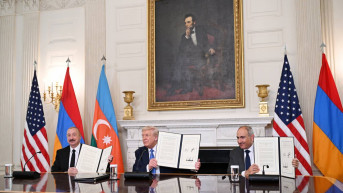
“Thirty-five years of hostility and war have lasted too long—now they are friends and will remain friends for a long time,” said Donald Trump at the signing ceremony in the White House, where he was flanked by Azerbaijani President Ilham Aliyev and Armenian Prime Minister Nikol Pashinyan. Trump stated that the two countries had committed to ending hostilities, establishing diplomatic relations, and respecting each other’s territorial integrity.
Armenia and Azerbaijan have been in conflict since the late 1980s, when Nagorno-Karabakh—a mountainous Azerbaijani region predominantly populated by ethnic Armenians—seceded from Azerbaijan with Armenia’s support. Azerbaijan regained full control of the region through a military operation in 2023, which forced almost all of its 100,000 ethnic Armenian residents to flee to Armenia.
The agreement grants the United States exclusive rights to develop a strategic transit corridor through the South Caucasus, which the White House said will facilitate greater energy exports and the transport of other resources. The U.S. also signed separate agreements with each country to expand cooperation in energy, trade, and technology—including artificial intelligence—though no other details were made public. Restrictions on U.S.–Azerbaijan defense cooperation were also lifted, a move likely to raise concerns in Moscow.
This partially unexpected peace agreement between Yerevan and Baku could undermine—or at least complicate—previous plans by Western strategists to integrate Armenia into Euro-Atlantic structures under their “security umbrella.” It comes at a time of worsening relations between Moscow and Baku, fueled by suspicions that Azerbaijan is being used to facilitate Ukrainian military operations against Russia—such as the recent major drone attack on an airfield deep inside Russian territory. Since then, Baku has openly aligned itself with Kyiv. The positions of Baku and Yerevan are also significant for the evolving confrontation in the Middle East: Tel Aviv counts on Azerbaijan’s alliance in its conflict with Iran, given that Israel provided decisive military support to Baku during its 2023 offensive on Nagorno-Karabakh. To this, one must add Turkey’s interests as Baku’s unwavering partner. The consequences of the agreement will thus be felt across the Caucasus, the Middle East, Europe, and Russia.
At present, it is Yerevan making the most visible concessions. Armenia has strategically worsened its position in the region, finding itself more dependent on Turkey and Azerbaijan, while Washington has assumed no written obligations in return.
The declaration signed in Washington is non-binding; even the act of initialing it carries no legal force. Legally speaking, this is not yet a peace treaty but rather a protocol of intent—a kind of “memorandum” that the two presidents have merely initialed. However, the provisions it contains are set to form the basis of the final version of the document, which will most likely be concluded and come into force in 2026. The most important of its 17 provisions are:
·
Baku and Yerevan renounce territorial claims and the use of force against each other.
·
No third-country forces will be stationed on the Azerbaijan–Armenia border.
·
Azerbaijan and Armenia will delimit their border on the basis of a separate agreement.
·
In their bilateral relations, both parties will be guided by international law and this Agreement; neither party may invoke domestic legislation as grounds for non-compliance.
·
Both countries undertake not to interfere in each other’s internal politics and to establish diplomatic relations.
·
Within one month of the Agreement’s entry into force, both sides will withdraw all mutual and international claims, complaints, and disputes relating to past issues.
·
The parties will determine the fate of the missing, exchange information, return remains, and conduct investigations.
·
To monitor implementation, a bilateral commission will be formed to resolve disputes; if unresolved within six months, the parties will seek other peaceful solutions.
One factor intended to normalize inter-state and societal relations between Armenia and Azerbaijan is found in Article 8, in which both sides commit to “combat intolerance, racial hatred and discrimination, separatism, violent extremism, and terrorism in all their manifestations.”
The provision on third-country forces specifies that they should not be present on the shared border, but this does not exclude, for example, the construction of third-country military bases deep within national territory or near a third-country border—such as in Azerbaijan, bordering Russia or Iran. In this way, the agreement impacts neighboring states and alters the geopolitical configuration of Central Asia at a sensitive moment.
Practically, this provision means that EU “observers,” whose mission—deployed in recent years despite objections from Moscow and Baku during a period of closer Yerevan–Brussels ties—will now have to leave Armenia’s border regions.
On June 14, 2023, in response to a question about the opening of three EU observation mission operational centers in Armenia, Russian Foreign Ministry spokesperson Maria Zakharova stated:
“The deployment of the EU presence in Armenia was forced under serious pressure from Brussels. The EU essentially imposed its presence. The mission, purportedly aimed at helping normalize relations between Baku and Yerevan, was launched unilaterally, without consensus, without the consent of the Azerbaijani side or other regional actors, and without proper reporting.”
She added:
“This only confirms the real background of the EU’s policy in the region, whose main goal is to push Russia out of the South Caucasus, turning it into an arena of geopolitical confrontation to the detriment of the fundamental interests of the people living there. The EU mission’s lack of accountability to the international community—especially to Azerbaijan and Armenia—raises further doubts about its hidden agenda ‘on the ground’ and the ‘double bottom’ of its mandate under the guise of its so-called ‘civilian’ nature.”
Nevertheless, in September of last year, during the visit of outgoing French Foreign Minister Stéphane Séjourné to Yerevan, the question of EU observers resurfaced with renewed urgency. “The presence of observers is very important for reducing risks and increasing transparency,” Séjourné said in Yerevan, much to the obvious dissatisfaction of Moscow and Baku, which regarded the EU border mission near Azerbaijan as “military–police” in nature.
Overall, if one looks only at this draft document, it appears—like many such agreements—to be “good for all and against all that is bad.” The problem is that the “bad” is simply not written into such documents; it either emerges later in supplementary agreements, which are kept from public view as much as possible. Even with an agreement on a peace treaty, both sides will face new problems and obstacles before it is signed.
It is clear to all that Baku will agree to a peace treaty only after Yerevan amends its Constitution to remove all references to Nagorno-Karabakh (Artsakh). Under Armenian constitutional provisions, this can be done only by a national referendum—realistically possible only alongside parliamentary elections in 2026. Yerevan is prepared to meet Baku’s demands to delete references to Karabakh from the Constitution and to remove the clause on “the reunification of Armenia with Nagorno-Karabakh” from its preamble. But the outcome of such a vote is unpredictable. It cannot be ruled out that the Armenian authorities may consider alternative methods of amending the Constitution via parliament, given that constitutional change is unlikely to win public approval. Taking this route would almost certainly spark street protests, which could lead to a change of government. In short, there is still a long road from signing this “Letter of Intent” to concluding an actual peace treaty.



comments