
Trump’s Route to the Baku–Yerevan Agreement (Part 2)
Written by: Habib al Hadi for Kosovo Online
The peace agreement between Azerbaijan and Armenia is expected to be concluded as soon as the Armenian constitution is amended to remove all references to the formerly disputed territory of Nagorno-Karabakh. Now entirely under Azerbaijani control, with nearly all ethnic Armenians having left the region, every vestige of its Armenian character will soon disappear. The two sides intend to petition the OSCE Secretary-General to dissolve the Minsk Group, under whose auspices negotiations over the Karabakh conflict had been held for decades. A joint appeal to the OSCE to close the Minsk process signals that the parties have reached their goal and are determined to end the conflict.
The drafting of the peace declaration signed in the United States began under the previous administration of Joe Biden, but Baku ultimately refused to sign it in its final stage.
As for “other means of peaceful dispute settlement,” one might recall Donald Trump’s remark at the signing ceremony: “If there’s a problem, just call.” In other words, the question of an arbiter already appeared to have been settled.
The so-called “Zangezur Corridor” is absent from the declaration — it has been renamed “Trump’s Route.” On one hand, details had already been discussed, including the number of American private military companies to operate the route and oversee the southern part of Armenia’s Syunik region. On the other, this remains the subject of a separate agreement, which could be concluded even without a formal peace and friendship treaty between Baku and Yerevan.
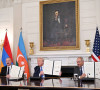
Russia has assessed positively the mediation efforts of the United States in normalizing relations between Baku and Yerevan. This was stated on 9 August by Russian Foreign Ministry Spokeswoman Maria Zakharova, commenting on the joint declaration on peaceful relations signed the previous day in Washington by Prime Minister Pashinyan and President Aliyev, with the direct participation of the White House and Donald Trump.
Moscow also called on extra-regional actors “not to create new difficulties” in order to “avoid the sad experience of Western assistance in resolving conflicts in the Middle East.” Zakharova specifically recalled that the current stage of Armenian–Azerbaijani normalization began with Russia’s “central role” in 2020–2022.
The Baku–Yerevan declaration foresees the future signing and ratification of a peace treaty, already initialled by the Armenian and Azerbaijani foreign ministers.
Where Does the “Trump Corridor” Lead?
The declaration highlights the importance of reopening transport links in the region, blocked since the early 1990s. A special provision calls for the creation of the “Trump Route for International Peace and Prosperity” (TRIPP), a transport corridor connecting Azerbaijan’s western regions with its Nakhchivan exclave via Armenian territory along the Armenia–Iran border.
This issue was addressed during bilateral talks between Trump and Pashinyan, in which the Armenian Prime Minister agreed to grant the United States exclusive rights to develop the so-called Zangezur Corridor for a period of 99 years.
American media, citing administration sources, had earlier reported that Washington planned to sub-lease the route to a consortium tasked with its infrastructure and management. TRIPP would operate under Armenian law.
Commenting on this provision, Zakharova recalled Armenia’s continued membership in the Eurasian Economic Union, which regulates the organization of transit freight transport. She also urged the Armenian leadership to take into account the presence of Russian border guards on the Armenia–Iran frontier, noting that “in this area, the trilateral agreements of November 2020 with Russia’s participation remain in force” and that no party has withdrawn from them.
The potential presence of Americans on Armenian territory has caused concern in Iran. While Tehran welcomed the agreement on the text of the peace treaty between Armenia and Azerbaijan, its Foreign Ministry warned of the possible negative consequences of “any external interference” in the region. Ali Akbar Velayati, adviser to Iran’s Supreme Leader, told Tasnim News Agency that the cross-border route in Armenia would be turned “not into a Trump-owned corridor, but into a graveyard for his mercenaries.” He claimed the route could alter the region’s geopolitical balance and was designed to “break Armenia.” Velayati expressed confidence that Moscow was “strategically opposed to the corridor,” but said Iran intended to “protect the security of the South Caucasus” without Russian involvement.
Legal and operational questions over TRIPP will likely be addressed in a bilateral Armenia–U.S. format, taking into account Baku’s interests. As for Iran, it seems the issue of Armenia’s sovereignty concerns them more than it does Yerevan itself — but Tehran is unlikely to intervene openly.
Iran’s statements appear to be largely informational and propagandistic in nature, aimed at pressuring Yerevan and preventing the route’s opening. At the same time, the construction of the “Trump Corridor” could involve an American construction company together with Turkish subcontractors, likely the usual Bechtel–Enka partnership. In addition to a 42-kilometre railway segment in southern Armenia, the project would require a highway, power line, fibre-optic cable, and gas pipeline. Baku plans to use the route to supply the West with its own and Central Asian energy resources.
U.S. involvement in such a critical segment of a transport route — one that would form part of the Middle Corridor, the Trans-Caspian International Transport Corridor from Europe to China bypassing Russia — could eventually transform the entire regional security architecture. The perceived need for a Russian military presence in Armenia could diminish over time.
In practice, implementing the signed document means Armenia would lose sovereignty over part of its territory, albeit without formal legal arrangements. The greatest risk in this context is that Azerbaijan might view the “Trump Corridor” as extraterritorial and demand the removal of Armenian presence there, under threat of renewed war.
This agreement is also part of Trump’s broader strategy to present himself as a global peacemaker in the early months of his second term, as promised during his election campaign. The White House is also credited with brokering ceasefires between Cambodia and Thailand, peace agreements between Rwanda and the Democratic Republic of the Congo, and between Pakistan and India.
The Armenia–Azerbaijan deal clearly signals Trump’s expectations ahead of his upcoming meeting with President Putin in Alaska in a few days. Trump has already declared that within “the first two minutes” he will determine whether a “very rapid ceasefire” can be agreed upon.
Both leaders have praised Trump’s role in ending the conflict and said they will nominate him for the Nobel Peace Prize — for which he now needs only Putin’s “blessing” this Friday in Alaska.


comments