
Victory Day in Moscow: A ceremony of national remembrance and moral mobilization
Written by: Zeljko Sajn, special correspondent of Kosovo Online from Moscow
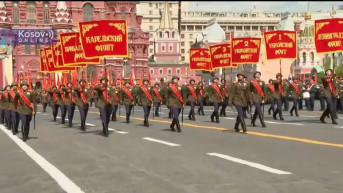
An unusual, almost historic silence reigned on Red Square in Moscow this year. Unlike previous parades, there was no powerful rumble of tank engines and armored columns that for decades had symbolized the military might of the Soviet Union and later Russia. Yet the absence of heavy equipment did not diminish the impression of strength. On the contrary, this time the soldier’s boot came to the forefront — a symbol of the soldier who, eight decades ago, brought freedom to Europe and the world, crushed Nazism, and bore the greatest sacrifice in the history of the Second World War.
The Russian flag flew over Moscow, heir to the great state tradition of the Soviet Union, while the entire parade carried a strong message of historical continuity. In the Russian state narrative, the victory of 1945 is not merely a historical event, but the foundation of modern Russian identity. Precisely for that reason, this year’s parade seemed more like a ceremony of national remembrance and moral mobilization than a demonstration of raw military force.
Before Russian pride rose over the Moscow sky, in an atmosphere of dignified silence and peace, Russian President Vladimir Putin addressed those gathered, congratulating them on Victory Day — a holiday that in Russia holds an almost sacred status. His speech was a carefully constructed statesmanlike, military, and diplomatic address, intended simultaneously for the Russian people, the armed forces, allies, and the West.
In terms of state policy, Putin’s speech was an attempt to preserve the historical unity of Russian society. The central idea was that Russia remains the heir of the victorious generation that saved humanity from Nazism. For years, the Kremlin has been building political and identity-based continuity between the Soviet Union and contemporary Russia, and this year’s speech further reinforced that line. Putin emphasized historical duty, defense of the fatherland, and national unity, sending the message that the state has entered a period of prolonged historical confrontation in which every segment of society has a role to play.
The military aspect of the speech was particularly significant. Although there was no excessively harsh rhetoric, Putin clearly linked the feat of the Red Army with today’s, as the Russians call it, Special Military Operation in Ukraine. This is precisely where the essence of the entire address lies — the current conflict was presented as a continuation of the historical struggle against forces Moscow describes as successors to old threats to Russian statehood. It is especially important that the Russian president paid tribute not only to soldiers, but also to engineers, scientists, defense-industry workers, doctors, and volunteers. This shows that the Kremlin no longer views the war as a limited operation, but as a broad national mobilization in which the entire state system participates.
Diplomatically, the speech was very cautious and skillfully balanced. Unlike some earlier appearances, this time there was no explosive anti-Western rhetoric or direct threats. Putin avoided the tone of political hysteria and spoke the language of historical mission, moral strength, and the right of peoples to defend their own sovereignty. Such an approach is intended to present Russia as a stable power that does not react impulsively, but acts as a state aware of its historical role.
At the same time, the messages were also clearly directed at an international audience. The West was sent the message that Russia does not intend to retreat and is prepared for a long confrontation, while countries in Asia, Africa, and Latin America were presented with an image of Russia as an anti-fascist and anti-colonial force fighting against Western global dominance.
Still, despite Putin’s message that Russia is ready for a prolonged struggle until the causes and consequences of the conflict are removed, another nuance could also be observed behind this year’s address — a tone of confidence and control. On the other hand, the increasingly pronounced dependence of Ukrainian President Volodymyr Zelenskyy on Western political and military support creates the impression of limited room for maneuver for Kyiv in future negotiations. It is precisely in this relationship between Moscow’s confidence and the pressure under which the Ukrainian leadership finds itself that some analysts see the possibility of a gradual movement toward peace.
In that context, the possible mediating role of U.S. President Donald Trump is also being mentioned increasingly often, as he openly speaks about the need to stop the war and reach an agreement.
Although the road to peace remains uncertain and difficult, this year’s parade and Putin’s speech left the impression that Moscow wants to show it has the strength to continue the conflict, but also enough self-confidence to accept, at some point, a political solution under conditions it considers acceptable. That is why, in the shadow of military steps and major geopolitical conflicts, the first outlines of future negotiations and possible peace are slowly beginning to emerge.
0 comments