
What does the West gain by conceding to the unilateral actions of Kurti's government, and where does it stand to lose?

Albin Kurti's relationship with the most significant Western allies of the Albanians increasingly appears very damaging to the reputation and credibility of the USA and EU. Is the impact he achieves on the ground sufficient compensation, that results in turning a blind eye to his actions?
Edited by: Milos Garic
The policy by which Albin Kurti has brought forth and implemented unilateral decisions over the past few years, directly harming the Serbs in Kosovo and violating their basic rights, operates on a very apparent model, wherein significant roles are played not only by the authorities in Pristina but also by intermediaries from the USA, Great Britain, and EU countries.
It roughly goes like this: Kurti's government makes a "sudden" extreme decision - naturally, this causes shock and new tension among the Serbs - after appeals and protests from Belgrade and the Serbs in Kosovo themselves, verbal attempts from the West follow "pleading" with Kurti to postpone the implementation of his move - sometimes there might be a threat, mostly from Washington - but ultimately, following some minor apparent concessions from Pristina and some delays, the matter on the ground is established as an obligation and a fait accompli.
Much has passed in this manner during 2022 and 2023, and Albin Kurti, despite the damage he causes to the normalization of relations, currently sees no need to change anything significant in his behavior. After the ban on the dinar in Kosovo, which came into effect on February 1 and which, as everyone claims, Kurti did not consult with Western allies about, perhaps the biggest "storm" followed. However, even after more than a month, that decision remains valid and brings increasingly severe consequences for the Serbs.
The fact that there is no concrete change in the approach of the majority of the Western political spectrum in addressing the very serious crisis and total deadlock in the dialogue was also demonstrated by yesterday's visit of EU mediator Miroslav Lajcak to Pristina. The messages he conveyed after the meeting with Kurti's assistant Bislimi directly endorse the current policies of the Kosovo authorities.
In a bizarre way, a startling atmosphere is created where even high-ranking representatives of the US administration show helplessness and lack of authority in communicating with Kurti's cabinet and with him personally. The recent case of the dinar ban is just one of many in the past year. Therefore, the question arises of how the State Department accepts this kind of damage to its own credibility and influence in international circles, and whether the work Kurti is accomplishing on the ground is sufficient compensation for US policy towards the common goals long projected in the West regarding Kosovo.
The Germans "bet on" Kurti
Historian and political analyst Srdjan Graovac tells Kosovo Online that the West's concessions to Kurti's arbitrariness have their own logic.
"An independent Kosovo is an irreversible process for the political West, led by the USA, and the only dilemma is which country with the strongest influence will dominate in that fake state. Therefore, the concession to Pristina, or turning a blind eye to Kurti's terror against Kosovo Serbs, should not surprise us. Neither the Germans nor the current US administration, which is somewhat more attentive to Berlin's interests than Trump's, have nothing to lose by doing this," Graovac says.
He emphasizes that the role of Germany is particularly significant.
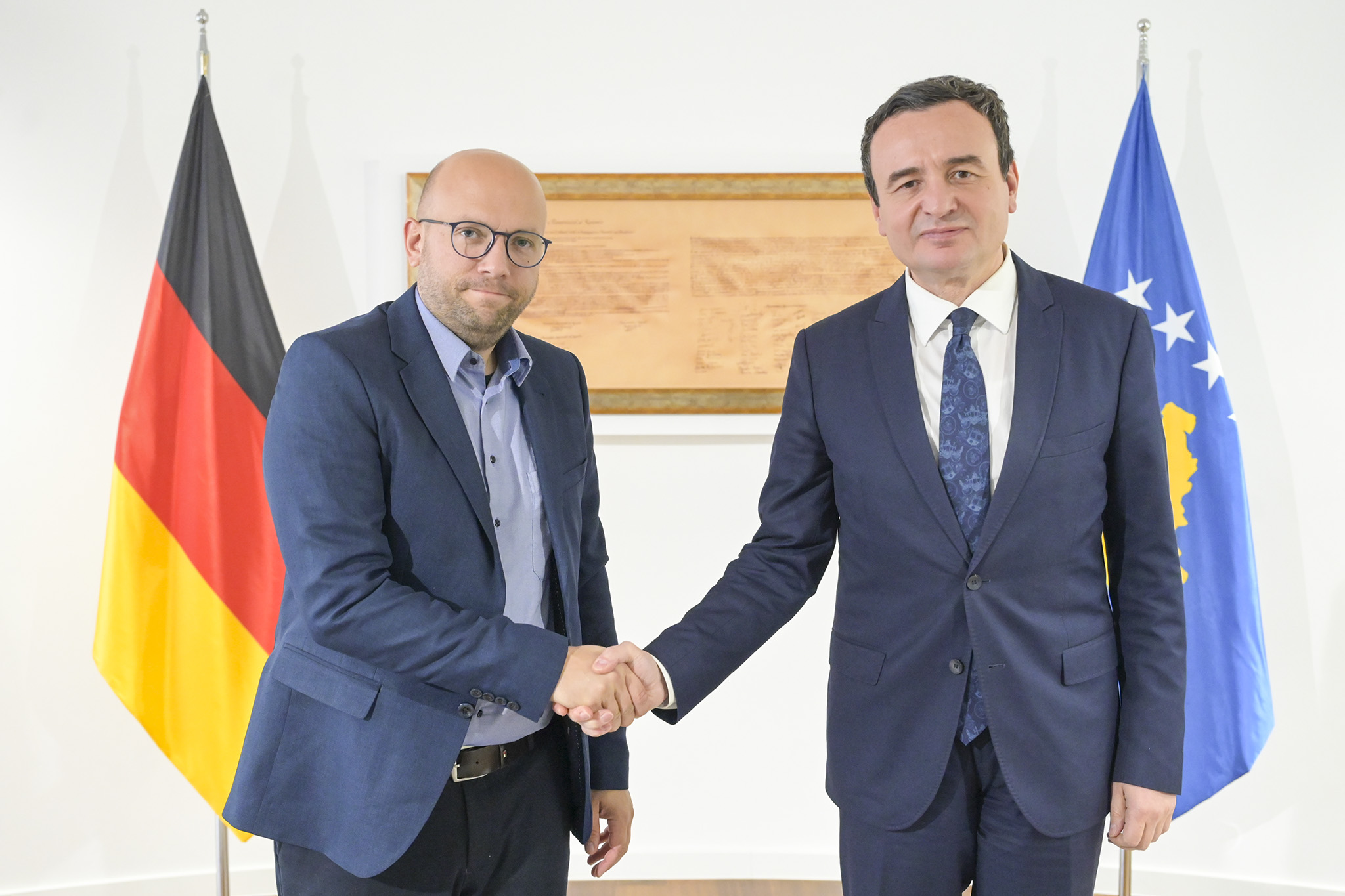
"The Germans believe that through Kurti, they have a dominant position in Kosovo, and by turning a blind eye to his actions, they calculate that they strengthen his, and consequently their own, position. The Americans allow the Germans to live in this illusion because they are aware that without their endorsement, Berlin, even with Paris's assistance, cannot achieve anything regarding the Kosovo issue. Adding to that, both parties see everything Kurti achieves in weakening Serbian influence in the southern province as a plus for their strategic interests. This makes it clear how they approach the current situation in Kosovo and Metohija," Graovac explains.
Dragisa Mijacic, the Coordinator of the National Convention on the EU, points out to Kosovo Online that the dialogue is "a very complex and multidimensional process."
"The dialogue encompasses many different segments. Hence, perhaps the West has shown some degree of leniency towards the Kosovo authorities. But we should not forget that punitive measures were imposed on Kosovo as early as June last year, and these punitive measures are still in place, so we cannot say that the West has no mechanism of pressure in line with its principles. I am more inclined to believe that the way the West tries to persuade the Kosovo Government to relent in the dialogue process through pressure mechanisms is not yielding results, and this is due to various factors. Primarily, it's because of the rather stubborn stance of the Kosovo Government on issues directly related to the dialogue, which has a certain degree of inflexibility. Kosovo certainly pays and will continue to pay the price for this inflexibility, but in such circumstances, it is very difficult to persuade the Kosovo Government to change something through punitive measures. On the other hand, the West itself is not ready for some actions, nor does it have instruments for more concrete forms of pressure, or stronger measures than what we have had the opportunity to see," Mijacic notes.
Credibility and trust are spent
Albin Kurti's relationship with the most significant Albanian allies in the West increasingly appears very damaging to the reputation and credibility of the USA and EU. It seems incredible how easily Kurti handles the warnings and admonitions sent to him by high-ranking representatives of the State Department, James O'Brien and Gabriel Escobar. Germany is much more restrained in this regard, so it is much less "uncomfortable" for Berlin when Kurti does not comply with them on something, such as returning land to the Decani Monastery.
Aleksandar Mitic, a research fellow at the Institute for International Politics and Economics, warns that everything happening in Kosovo is the result of a strategic goal of the West, called the legalization of the illegal declaration of independence.
"Given the consequences that this illegal independence has had on a broader scale in recent years, it is clear that this is something of broader significance to the West. Through biased moderation by the very biased European Union, we have today's situation and a whole series of unfulfilled obligations, on the one hand from the EU, and on the other hand from Pristina. A very perfidious policy has intensified in the past two years under the coordination of Quint and Albin Kurti. Germany holds the conductor's baton, but it is a trio, along with Great Britain and the United States," Mitic explains for Kosovo Online.
According to him, much of it is a show for the public and manipulation.
"You can see that from the results. We can talk about some slaps on the wrist for Kurti, but those are not sanctions if one day they didn't hold military exercises, and the next day they did. Or if a small amount is blocked. Those are not sanctions. A much bigger incentive for Kurti is pressure on Belgrade and support for Kosovo in international organizations, support in the EU, the Council of Europe, and visa liberalization... In such a game, it's clear that the West has gained a lot from the recent events in Kosovo and Pristina's unilateral moves," Mitic believes.
However, he also points out the damage that the West suffers in the current situation.
"However, on the other hand, it is a fact that the West has lost the trust of the Serbs as a whole and the Serbian state. This distrust has been growing before, and now, after all the events, it is rooted. The government in Serbia has to maintain certain relationships and swallow some things. However, the West has irreversibly lost the trust of the Serbs, who are a key security, political, and economic factor in the Western Balkans. This opens up space for other actors, whom the West complains have a malign influence, but who show understanding and provide diplomatic and political support to the Serbs. Here, the West has a significant minus in the current situation in Kosovo," Mitic concludes.


comments