
Who’s Who – James Rubin: From Madeleine Albright’s right hand to key defense witness in the case against former KLA leaders

James Rubin returned to political life in 2022 and to the Western Balkans, and has now testified for three days before the Kosovo Specialist Chambers. His testimony in Kosovo was greeted with enthusiasm, although Rubin largely repeated what he had stated in previous years and decades. Passages from his earlier interviews were cited, and it appeared that he was eager to conclude his testimony—at one point even complaining to the judge that he would have to extend his hotel stay because of the proceedings.
In The Hague, Rubin reiterated that the United States initially condemned KLA terrorist actions directed primarily against Serbian civilians. On several occasions, he emphasized that Hashim Thaçi had not been in a position to make decisions independently. He spoke of Adem Demaçi as the ideologue of the KLA and someone who had “greater power than Thaçi,” while also expressing frustration with the position of Christopher Hill.
In earlier interviews, Rubin highlighted that U.S. policy toward the KLA evolved over the years:
“In the early days, the U.S. condemned the terrorist activities carried out by Albanian groups, but as the peace process evolved, the KLA became the center of that process.”
“The KLA played a decisive role in the agreements signed by its leaders and in fulfilling the promise of demilitarization. I have fond memories of working with their leaders. That does not mean that everything that happened during the war was something I would support,” he added.
Former Diplomat and Journalist
Rubin is a former American diplomat and journalist, best known to the public as Assistant Secretary of State for Public Affairs in President Bill Clinton’s administration from 1997 to 2000. He also served as the State Department’s chief spokesman and was regarded as the right hand of Secretary Madeleine Albright.
Move to London and Work with Wesley Clark
After Clinton left office, Rubin moved to London, where he was a visiting professor of international relations at the London School of Economics. Upon returning to New York, he re-engaged in politics, serving as chief foreign policy spokesman for General Wesley Clark’s presidential campaign until Clark withdrew. He later worked as a senior national security advisor to Democratic candidate John Kerry in 2004.
Role with Hillary Clinton and International Engagements
Rubin was also part of Hillary Clinton’s 2008 presidential campaign team. Afterwards, he joined Bloomberg News before relocating to Paris, where he became diplomatic advisor to the newly elected Secretary-General of the Organization for Economic Cooperation and Development (OECD).
He made a significant return to the State Department on November 16, 2022, when Secretary of State Antony Blinken appointed him Special Envoy and Coordinator of the Global Engagement Center.
Honored in Kosovo
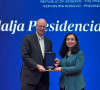
Rubin is well known in Kosovo. In 2013, then-President Atifete Jahjaga awarded him a medal of merit for his “extraordinary contribution to Kosovo during the wartime period, which helped establish peace, freedom, and development for all citizens, and later for building the state of Kosovo and its international consolidation.”
Five years later, he strongly opposed any change of borders between Belgrade and Pristina and sharply criticized Russia’s role in Kosovo. As reported by Albanian media, when asked in 2018 whether Russia would approve Kosovo’s UN membership if Serbia recognized independence, Rubin replied that he would “never trust Serbia.”
“That does not mean I would not believe them if I had full guarantees that Russia would recognize Kosovo’s independence. Still, I would not act based on speculation,” he said.
Return to the Balkans under Blinken
With his 2022 appointment, Rubin returned to the region, which remains burdened by unresolved disputes. During a visit two years ago, he stated that the purpose of his trip to the Western Balkans was also to counter foreign information manipulation, stressing that the United States sought to create partnerships with Montenegro, North Macedonia, and Kosovo, even though the latter is not a NATO member.
“By working together with willing partners in the Western Balkans, we can reduce the impact of disinformation coming from Serbia, often reflecting Russian and Chinese perspectives, and it is important to expose this. For example, although RT and Sputnik no longer broadcast in the EU and U.S., they continue to spread lies in Serbia and thus throughout the region. The goal of my recent trip was to visit two new NATO partners that are striving to fulfill their responsibilities as members, in countering foreign information manipulation and domestic disinformation—both their own and in the region,” Rubin explained.
“The Long-Term Goal of Normalization is Recognition”
In 2024, Rubin reiterated that the long-term goal of normalization means recognition, and that this remains U.S. policy:
“It is difficult to imagine normalized relations between Kosovo and Serbia without recognition, and the fact that some EU member states do not recognize Kosovo is not relevant,” he said.
He underlined that Kosovo and Serbia face a problem that must be resolved and emphasized that they must normalize relations.
“These are EU standards. As an American, I do not tell the EU what to do. What matters is our policy—that normalization should include mutual recognition between the two countries.”
“Kosovo a Friend of the United States”
Rubin once stated:
“Kosovo has become a democratic, independent country with democratic values, a friend of the United States, and a close partner—all achieved with minimal American lives put at risk.”
Personal Life
Born in New York in 1960, Rubin was married to CNN’s chief international correspondent and anchor Christiane Amanpour, with whom he has a son. The couple divorced in 2018.
0 comments