
Albania and the Iranian anti-government group MEK: Intersecting ties with the US and Israel
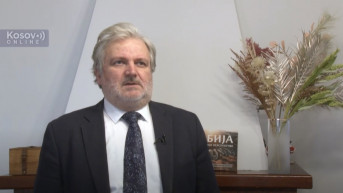
Writing for Kosovo Online: Dragan Bisenic, journalist
Last week's search, which the Albanian police carried out in the camp of the Iranian anti-government group "Mujahedin e Khalq" (MEK), represents a significant step in Albania's relations with this group, because of which it broke diplomatic relations with Iran last year and through which Albania crossed its close relations with US and Israel. The attitude of the Albanian authorities and the position of the US represent a major change for the organization that was considered to be the main force in opposing the official Tehran.
It may be a sign of new winds blowing in Washington in relation to Iran and a signal that the return of the US to the Comprehensive Agreement on Iran's nuclear program may be on the horizon.
From the negotiations in Vienna, which are conducted in the "P5+1" format, the signing of the agreement was announced several times, but it never happened.
Iranian Ministry of Foreign Affairs spokesman Nasser Kanaani welcomed the news, saying the MEK would always pose a threat to the security of the host country due to its "terrorist nature."
Interestingly, the US government has responded by distancing itself from the MEK, a group that has been vocally supported by many senior US officials for years.
Washington said Albania had assured the administration that the raid had been conducted in accordance with the law and that it had serious concerns about the MEK, including allegations of abuses against its members. The American ambassador in Tirana said that it depended on the Albanian government whether it would continue to host this Iranian anti-government group. It can, of course, mean "yes".
As the raid came a day after France blocked the MEK from holding a July 1 rally in Paris - where they have gathered many times before - social media linked the two incidents, with the National Council of Resistance of Iran, the MEK's umbrella group, accusing France that it bowed to the "pressures" of the Iranian government.
These theories were only further reinforced by the fact that last week Iranian President Ebrahim Raisi had a long telephone conversation with his French counterpart, Emmanuel Macron. Although neither side officially mentioned the MEK, there is no doubt that it was an important topic for both sides.
The culmination occurred a little less than a year ago, in September 2022, when Albania severed diplomatic relations with Iran and when it was disclosed to the whole world that about 3,000 members of this group were in a camp not far from Tirana, which until then had been quite discreet stored information.
The immediate reason for this move was the publication of data from the Albanian security sector that was attributed to Iranian activities. Thus, in September 2022, the files of the former Director General of the State Police of Albania (Policia e Shtetit), Gladis Nano, and his family were published. Less than a month later, on October 3, the same group of cyber actors published another voluminous document, which exposed the identities of 300 persons suspected of criminal offenses in Albania. The peak was in December, when the identities and personal data of 600 Albanian intelligence officers, including their names, emails, and phone numbers, were disclosed.
A month after breaking off diplomatic relations with Iran, the Albanian Prime Minister, Edi Rama, paid a three-day visit to Israel, where he met with the then Israeli Prime Minister, Yair Lapid, the President, Isaac Herzog, the Speaker of the Knesset, Mickey Levy, the Minister of Finance, Avigdor Lieberman, and the head Israel's National Cyber Directorate, Gaby Portnoy. They discussed improving cooperation in security matters, especially in the cyber sphere, and plans to organize a summit of Balkan leaders in Israel.
For its move, Albania won praise in Israel, as Israelis have often expressed their frustration with the reluctance of European governments to stand up to Iran.
"Iran represents a common threat to Israel and Albania. We saw this in the recent Iranian cyber attacks on Albania. Israel will help in any way it can in the effort against Iran. We see it as a national interest and a historical responsibility," Lapid said.
Washington also supported Tirana's decision to cut ties with Tehran and sanctioned Iran's intelligence ministry for its alleged role in cyber attacks.
Tehran rejected accusations that it was behind the cyber attack and accused Albania of complicity in the US-Israeli campaign against Iran. Iranian Foreign Ministry spokesman Nasser Kanaani welcomed the news, saying the MEK would always pose a threat to the security of the host country due to its "terrorist nature."
The "Mujahedin e Khalq" organization has somewhere between 5,000 and 10,000 members worldwide, according to the State Department. Their name means "People's Mojahedin of Iran," but it has nothing in common with radical religious fanaticism.
The MEK was founded on September 5, 1965, by leftist Iranian students affiliated with the Freedom Movement of Iran to oppose Shah Pahlavi. The leaders of the group are husband and wife Maryam and Massoud Rajavi. Maryam Rajavi claims that she wants to become the president of Iran.
Many analysts have characterized the MEK as a cult, citing the group's allegiance to the Rajavis. The group nurtures the life of "professional revolutionaries" for whom there are no private goals or private pleasures. Former members of the group testified that romantic relationships and sexual thoughts were forbidden, contact with family was very limited, and friendships were discouraged. The group cultivates "rituals of self-criticism," in which members would confess to their commanders any sexual or other disloyal thoughts they had.
The group found itself in Albania thanks to the unusual partnership of the former president and then Prime Minister of Albania, Sali Berisha, who in 2012 accepted the proposal of the Secretary of State, Hillary Clinton, and agreed to receive the first 200 MEK members who would be transferred from the Liberty camp in Iraq to Albania, and previously the US undertook to provide financial aid to Albania.
After that, on March 17, 2013, a meeting was held between Sali Berisha and the US Deputy Assistant Secretary of State, Barbara Leaf, when it was agreed that MEK members still in Iraq would be transferred to Albania within 6 months. In the same year, the transfer of MEK members to Albania began.
Then Senator John McCain, then the leader of the Republicans in the House of Representatives, met with MEK leaders on April 28, 2015, in Tirana. US Secretary of State John Kerry stated on September 12, 2016, that the US, with the help of Germany, Norway, Italy, Great Britain, Finland, and Albania, had successfully transferred all MEK members to Albania.
The Albanian government first announced that it would only accept members of the MEK temporarily, but the US increased its aid, and Albania became the host and ally of the MEK.
The Minister of Foreign Affairs between 2013 and 2019, Ditmir Bushati, in an interview with Voice of America on March 24, 2017, admitted for the first time that Albania hosted MEK members. That same year, many Albanian politicians, including Pandeli Majko, Fatmir Mediu, and Deputy Foreign Minister Elona Gjebrea, joined the MEK during a large ceremony celebrating Nowruz, the Persian New Year.
It was only in 2017 that Albania decided to open an embassy in Tehran, which was announced by Foreign Minister Ditimir Bushati during his visit to Tehran in June 2017, where he was invited by his Iranian counterpart, Mohammad Javad Zarif. Both sides showed great enthusiasm for the further development of relations between the two countries. Minister Zarif did not fail to refer to "the rise of extremism in European and Balkan countries" and said that Iran was "ready to cooperate with Albania in the fight against extremism and terrorism." But already at the end of December 2018, the head of state, Michael Pompeo, praised the Albanian government for expelling Iranian diplomats "in response to an Iranian-sponsored plot to carry out a terrorist attack in Albania."
But why was Albania chosen? Simply put, it is not that difficult for a global superpower to exert its influence in a small and often overlooked country that was isolated on the world stage until the 1990s, and which is now eager to make up for the lost time by trying to be at the service of American needs in every way since the US rarely forgets such favors. Albania is probably America's most loyal ally in the world.
For illustrations of that zeal, one needs to look no further than George W. Bush Street in Tirana, the statue of George W. Bush in the village of Fushe-Kruje, or the statue of Hillary Clinton in Sarande. The city of Kamez has a boulevard named after US President Donald Trump, who was also declared an honorary citizen. The late Israeli president Shimon Peres also has his own monument in Tirana.
Albania also assisted the US in the wars in Afghanistan and Iraq, as well as various US schemes. Because of this, it was often described as a "dumping ground" for various groups that the American authorities did not know what to do with. The Egyptian "Returnees from Albania" as well as the group called "The Golden Chain" and also those who were released from Guantanamo found shelter in Albania.
"Albanian returnees" are a group of members of the Egyptian Jihad, among whom was the recently liquidated leader of Al Qaeda, Ayman al-Zawahiri, who was tried in a grand trial in 1999, and "The Golden Chain" is the name for elite donors of Al Qaeda, whose names were found in 2002, the investigation of Saudi foundations in Bosnia and Herzegovina. Additionally, Albania was on the list of countries hosting CIA secret prisons as a transit point for CIA secret prisons in Romania and Lithuania.
The American magazine "Foreign Policy" concluded that in this way Albania had hoped to strengthen its role in the region and improve its diplomatic relations with the United States and Israel. Back in 2011, then-Prime Minister Sali Berisha declared Iran a "Nazi state" and supported Israel at the United Nations against the Palestinian bid for statehood. Foreign Policy stated that "then, as now" Rama's idea had been to "get access to the United States through Israel'. The magazine claims that the person who organized Rama's visit to Israel is Alexander Mackevich, a billionaire businessman and chairman of Eurasian Resources Group, one of the world's largest producers of essential metals and minerals, which employs about 80,000 people. Mashkevitch is an Israeli citizen and a good friend of Rama's,” "Foreign Policy" stated.
Why is MEK even important for the West? Of course, primarily because they are opponents of the regime and thus serve as a constant threat of possible overthrow or illegal activities in Iran. MEK, however, is the creator of the "nuclear issue" of Iran. It was MEK who carried out the propaganda coup in 2002 when it revealed the existence of Iran's main nuclear facilities. With the help of its network of supporters inside Iran, the MEK is said to have exposed the Iranian regime's secret nuclear program for the first time by revealing the existence of two undeclared nuclear facilities in Natanz and Arak. The revelations by the Iranian opposition triggered international efforts to curb the Iranian regime's nuclear ambitions and prevent Tehran from obtaining atomic bombs, although Iran has always claimed that the use of atomic energy is for peaceful purposes. This led to a long conflict between the Islamic Republic and the West, which continues today with varying intensity.
The MEK believes that Iran's nuclear program and its uranium enrichment facilities should be completely dismantled, and have remained a relevant source for the US on Tehran's covert activities and have continued to reveal covert aspects of Iran's nuclear activities.
The MEK had a special place during the time of President Donald Trump and his policy of "maximum pressure" on Iran when the US withdrew from the Comprehensive Agreement on Iran's nuclear program. The group's staunchest allies were Trump's national security adviser, John Bolton, and Trump's personal lawyer and former New York City mayor, Rudolph Giuliani. Addressing MEK members at a rally in Paris, Bolton said the Trump administration should embrace their goal of immediate regime change in Iran and recognize their group as a "viable" alternative.
The current attitude of Albania and the US indicates that Trump's policy on this issue, too, seems to have come to an end.

0 comments