
Half a century since a novel “The Rise and Fall of Comrade Zylo” was first published
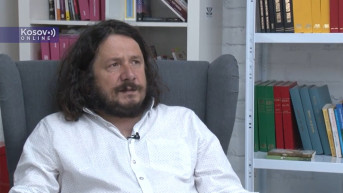
Writing for Kosovo Online: Muharem Bazdulj, writer and journalist
Hardly any European literature in Serbia is less present in translations than Albanian. Even if there is no ambivalence about the status of Kosovo and Metohija, even if there is no significant Albanian minority in Serbia and outside Kosovo and Metohija, Albania is Serbia's neighbor and it is certainly wrong not to be informed about the social and cultural developments there. Apart from a few books by Ismail Kadare, absolutely nothing is known about Albanian literature here. Even Kadare himself is rather poorly known and recognized on the Serbian scene.
If there is an important prose book of Albanian literature in the second half of the twentieth century, which was not written by Ismail Kadare, it is first and foremost "The Rise and Fall of Comrade Zylo", a novel published in 1973, exactly half a century ago. That book is a well-known work for fans of German-translated literature. The translation also exists in Italy, as well as in France (where it was published by the legendary publisher "Gallimard"), however, for example, there is no English translation.
"The Rise and Fall of Comrade Zylo” was written by a writer named Dritero Agolli. He was born in 1931 and died in 2017. He published his masterpiece in his early forties. Somewhat typically, before he turned to prose, he was a poet, and this novel is an exception in his oeuvre since he mostly wrote about the Albanian partisan struggle. Even their titles are indicative: "Commissioner Memo" or "The Man with the Cannon".
The book was written during Enver Hoxha's dictatorship and deals with the era of Enver Hoxha's dictatorship. Similar to other examples of critical fictional literature, within the totalitarian paradigm, the question of humor plays an important role in the whole context. Tvrtko Kulenovic noted that Ilf and Petrov had been popular in the Soviet Union almost like pop stars and that they had had virtually no political problems, although it seems to their readers today that they were brutally critical of the then regime. Unlike them, numerous writers who were not focused on the humorous side of human life, either poets or novelists, knew all the horrors of Siberia and the GULAG.
In the book, Agolli is clearly ironic towards the communist bureaucracy. His critical humor is not as fierce as that of Ilf and Petrov, but it is still completely obvious. The narrator of the novel is a writer named Demka, once a recognized writer who showed great promise, but who at one point practically gives up literature and starts writing speeches for politicians. And among the politicians he cooperates with, Comrade Zylo Kamberi stands out the most.
This politician is a typical bureaucrat who is dedicated to the cultural sector in the state hierarchy. Although he is quite high-ranking, he is actually trying to impress his superiors all the time. Comrade Zylo's goal is to enter diplomacy, that is, to become the ambassador of Albania in a Western European country. His goal is the Netherlands, and he does not want to be an ambassador, for example, in Algeria.
Agolli's novel was not banned in Albania, but it began to be translated only after Enver Hoxha's death. In the countries where it appeared, it achieved decent success, especially in Germany. They compared it with Gogol's works, as well as with Kundera's "Joke". Although totalitarianism in Albania was much more "total" than in practically all other European socialist countries, there is something universal in this novel when it comes to the depiction of the relationship between artists and the government, not only the socialist one. If we bear in mind some details from Agolli's biography, among other things, the fact that he was the head of the Writers' Association of Albania for a long time, it seems that both Demka and Zylo are largely autobiographically inspired characters. Maybe that's why both of them are so believable as characters.
In addition to the mentioned Western European languages, "The Rise and Fall of Comrade Zylo" was also translated into Greek and Chinese. Half a century since it was first published, it could be an anniversary that will serve as a good reason for this novel to appear in Serbian. Interesting parallels could be made with some local writers and works. Various foundations allocate money to support cooperation between the Balkan countries, and this would be a great example of a book that could really find an interested audience in Serbia, and not be just another in a series of stillborn bindings of "project literature".



0 comments