
26 years since the bombing of FRY: The day international law collapsed
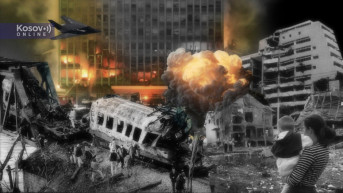
The NATO airstrikes on the Federal Republic of Yugoslavia began on this day 26 years ago. Air raid sirens sounded around 7:45 PM, and the first missiles struck the Communications Center building in the Prokuplje barracks, killing soldier Boban Nedeljkovic. In Kosovo, military targets in Pristina were the first to be hit.
The order for the military campaign was given by Javier Solana, then NATO Secretary General, to the commander of Allied forces, US General Wesley Clark, despite the fact that this intervention had no approval from the United Nations Security Council. For this reason, it is often said that international law died with the first bomb dropped.
NATO justified the launch of Operation "Allied Force" by citing the need to stop the "humanitarian catastrophe unfolding in Kosovo" and as a consequence of unsuccessful international efforts to resolve the conflict diplomatically.
NATO's readiness to launch strikes against the FRY had been announced as early as January 1999, prior to the Rambouillet Conference, where representatives of the then Serbian government and Kosovo Albanians, alongside international officials, unsuccessfully negotiated for 17 days in February.
The then US administration, led by President Bill Clinton, believed that the bombing would last only a few days and that FRY President Slobodan Milosevic would soon accept the proposed Rambouillet Agreement, which was particularly contentious for Belgrade due to the clause on NATO's military presence in Kosovo. However, the Alliance, which at the time had 19 member states, continued its attacks for 78 days.
A total of 2,500 civilians were killed, including 89 children, as well as 1,031 members of the military and police forces. Around 6,000 civilians were injured, including 2,700 children, as well as 5,173 soldiers and police officers, while 25 people remain missing.
During the 78 days of airstrikes, NATO carried out more than 38,000 flights – 10,484 of which involved combat actions.
It is estimated that around 15 tons of depleted uranium were used during the attacks. Economic facilities, schools, healthcare institutions, infrastructure, media houses, and cultural monuments were severely damaged. NATO also used graphite bombs for the first time to disable the electrical power system.
In Kosovo, the targets included Gracanica, Leposavic, Kosovska Mitrovica, Kosovska Vitina, Pec, Podujevo, Gnjilane, Prizren, Urosevac, and other locations. The last missiles fell near the village of Kololec, close to Kosovska Kamenica.
On May 1, NATO bombed the bridge in Luzane near Podujevo while a Nis Express bus was crossing, killing 44 people. A "Djakovica Transport" bus was hit on May 3 near Savina Voda on the Pec-Kula-Rozaje road, resulting in 20 deaths and 43 injuries. On May 14, a column of people near the village of Korisa, not far from Prizren, was bombed, killing 87 and wounding 70. The Dubrava prison in Istok was hit on May 21, killing at least 20 inmates.
The aggression ended with the signing of the Military-Technical Agreement in Kumanovo on June 9, 1999, which outlined the withdrawal of Yugoslav Army forces from Kosovo and the deployment of international military troops. This was followed by the adoption of United Nations Security Council Resolution 1244.
On June 10, 1999, NATO's Secretary General issued an order to halt the bombing. The first KFOR troops entered Kosovo on June 12.

0 comments