
Blakaj: Humanitarian Law Center has no information that Kosovo is preparing a lawsuit against Serbia for genocide
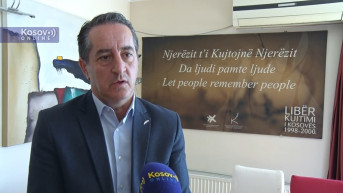
Executive Director of the Humanitarian Law Center, Bekim Blakaj, says that this organization does not have any information that evidence is being collected for a lawsuit against Serbia for genocide and that this topic is increasingly being used for daily political purposes and as a bargaining chip.
"We have no knowledge that anything is being done to gather material, information, and evidence for such a lawsuit, but lately it has been mentioned much more intensively by not only Kurti but also other officials and representatives of the government," Blakaj said for Kosovo Online.
He assessed that the issue of war crimes, as well as genocide, is being used for daily political purposes.
"It seems to me that this topic has always been used for daily political gain. It has always been mentioned more intensively before elections. It seems to me that it is used a little more as a bargaining chip," Blakaj said.
He added that the talk of a lawsuit against Serbia had been frequently mentioned so far, but that Albin Kurti was not the first politician in power who had emphasized this, recalling that Hashim Thaci and Kadri Veseli had done so before him.
When asked to comment on claims by some Pristina analysts who stated that Kurti's statements indicate that there is no evidence against Serbia, he believes that such claims should also be interpreted with a political prefix.
"I disagree with those who criticize him; it is probably politically motivated criticism. Nobody can conclude whether there is evidence or not until such a case is formed," Blakaj specified.
According to him, the Humanitarian Law Center of Kosovo has repeatedly pointed out that all previous processes of genocide lawsuits between regional countries have ended in failure.
"Like the lawsuit of Bosnia and Herzegovina against Serbia, the lawsuit of Croatia against Serbia, and the counterclaim of Serbia against Croatia. All three were unsuccessful. We have always said that it is much more important to gather data, to prosecute individuals responsible for committing war crimes, and if there are many such processes, then it can be concluded that there is enough evidence for genocide, then it should be done. Rather than constantly mentioning it, and we don't see anything being done about it," Blakaj emphasized.
He assessed that accession to the Council of Europe had no impact on the question of a lawsuit against Serbia because, according to him, these were two separate processes.
"I do not believe that membership in the Council of Europe can in any way help or hinder. I see that as two independent processes. Membership in the Council of Europe is very important because it guarantees citizens to realize their civil rights. They could appeal to the European Court of Human Rights in Strasbourg if they believe that their rights have been violated in Kosovo. And that is very important for all citizens," he emphasized.
When asked to comment on the statement of Kosovo Prime Minister Albin Kurti that work is being accelerated on a lawsuit for war crimes against Serbia, Blakaj says that Kurti probably meant a lawsuit for genocide.
"I believe he meant the same thing because a lawsuit for genocide is one thing, and war crimes are another. The only address for that is the International Court of Justice, and a country can be sued there. If it is about war crimes, then it is a criminal complaint against individuals who participated in war crimes or against those who issued orders, and those are criminal courts. Those are two different things," Blakaj said.
He explains that in the case of war crimes, it is about criminal responsibility for which a state cannot be held accountable.
"Only individual persons can be held accountable, and the state cannot be criminally responsible for crimes in any way."
He adds that for these crimes, the International Criminal Tribunal for the former Yugoslavia used to be competent.
"Now there is a permanent International Criminal Court, but it is not competent to prosecute war crimes committed before 2000 since the Rome Statute was signed only then. So, that is not the address either. Only domestic courts and the Kosovo Specialist Chambers remain. Those are courts where war crimes committed in Kosovo can be prosecuted," Blakaj emphasizes.


0 comments