
Brnabic: All EU officials supported the establishment of the CSM; Rama's request for sanctions is not neighborly
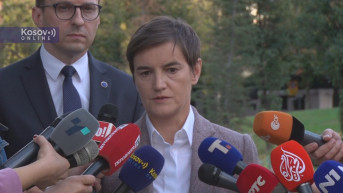
Serbian Prime Minister Ana Brnabic stated today in Tirana that during the Berlin Process Summit, the issue of the Community of Serb-majority Municipalities in Kosovo had been clearly communicated to Albin Kurti, and all European officials had supported the establishment of the CSM.
Brnabic also stated that she had not met with Kurti.
"I haven't met him, and as for the CSM, it was clearly communicated in front of them, and he heard it from each individual representative of EU member states present here, as well as the EU Commission and the Council, and all the others, discussing the necessity of establishing the CSM, something that is not only envisaged in the Brussels Agreement but also the Ohrid Agreement. Because the first article of the Ohrid Agreement implies the implementation of all previous agreements. So, no matter how you look at it - the Brussels Agreement and the CSM are on the agenda," Brnabic told reporters in Tirana.
She also emphasized that Albanian Prime Minister Edi Rama's request to impose sanctions on Serbia after the conflict in Banjska was not in line with good neighborly relations or with what was being done within the "Open Balkan" Initiative, and that was why she had been official during their meeting today.
She expressed her belief that she would discuss this issue with the Albanian Prime Minister and emphasized that Serbia wanted to nurture friendly relations with all countries in the region, including Albania.
"I can't greet warmly a man who called for sanctions against Serbia. I hope we will talk about it today, and we talked a little about clarifying it. We want the best possible relations with Albania, as well as with everyone in the region. You are not just a politician; sometimes you are a human being. That's how I feel. I'm not happy; I don't know why he did that; it doesn't make any sense, it's not in line with good neighborly relations or what we are doing within the Open Balkan Initiative," Brnabic said.
She said that Rama's reaction had hurt her because Serbia had not done anything wrong, but it was always open to discussions and further cooperation.
When asked if there had been any pressure regarding the events in Banjska, she said there had been no pressure, but they had talked about it and the situation in Kosovo.
She added that they had also discussed the dialogue and what came next, as well as the Brussels Agreement and the Community of Serb-majority Municipalities and the Berlin Process summit last year when Kurti had said in the middle of Berlin that the Brussels Agreement did not exist for him, and pointed out that there had been no reaction to that at the time.
"There was no pressure, but of course, we talked about the situation in Kosovo and Metohija and the events of September 24 in Banjska, the dialogue, what comes next, the Brussels Agreement, the CSM, and the Berlin Process Summit last year when Albin Kurti clearly said in the middle of Berlin that the Brussels Agreement does not exist for him. I reminded them of that and said there was no reaction at the time," Brnabic said.
She added that she had explained that the events in Banjska had been a reaction to everything that had been happening to the Serbs in Kosovo, emphasizing that the Serbs and non-Albanians in those areas had no rights.
"For the Serbs and non-Albanians in Kosovo and Metohija, there are not even basic conditions for a normal life. So, I asked that we stop talking about it as a political issue. It's a humanitarian issue; it's a matter of respecting basic human rights. It's the most critical issue for the Serbs in Kosovo and Metohija - whether someone can count on not being shot, and if someone does get shot, will they end up in prison? If they can count on the rule of law in the sense that they won't be arrested arbitrarily, beaten, or tortured in custody, and that these detentions won't last an average of nearly two years," Brnabic stressed.
She assessed that the Berlin Process was an excellent initiative for our region and that thanks to it, there was now a Regional Office for Youth Cooperation, which, as she said, should build new bridges for better cooperation and understanding among young people throughout the region.
"I'm glad that today we will sign another agreement, and it's all in line with our priorities and what Serbia believes in, which is better regional cooperation, connections, and people," she concluded.
As for the President of the European Commission, Ursula von der Leyen, and the plan for the economic development of the Western Balkans, the Prime Minister emphasizes that Serbia has already prepared projects and that EU investments will be very significant for the country.
Brnabic also commented on media reports that she was not in the joint photo at the Summit in Tirana, stating that these were "blatant lies".
"I deny it, but these are no longer disinformation; these are blatant lies that I am not in that photo. I am in the photo, and whether I came out earlier or later doesn't matter. The fact is that no one from the Berlin Process Summit said that someone avoided the photo," Brnabic said.
She pointed out that today, on the sidelines of the Summit, she had meetings with representatives of Hungary, and Great Britain, as well as discussions with the Prime Ministers of Spain and the Netherlands.
Also, as she adds, she had a short meeting with the President of the European Commission, Ursula von der Leyen, about all current issues.
"We expect the President of the European Commission to visit Belgrade. I hope it will go well, and we will have the opportunity to announce some more good news related to projects in Serbia and cooperation between Serbia and the EU," she said.
She once again commented on the situation in Kosovo, emphasizing that Serbia is for dialogue and that everything should be done to de-escalate.
"As you saw in Granada, President Vucic wanted to meet with anyone necessary to de-escalate, to reduce tensions, again to have a dialogue where we would ultimately discuss how we can influence that the Serbs and other non-Albanians in Kosovo and Metohija have basic human rights," she reiterated.
She also mentioned the upcoming elections in Serbia and emphasized that she, within her duties in the Serbian Progressive Party in Belgrade, met and talked to citizens about their needs all the time, and she did not think about the campaign and elections.
"I don't think about it; I am the Vice President of the Serbian Progressive Party and the Commissioner for the City of Belgrade. I try to use every free moment, after state obligations, to talk to people, members, and supporters, as well as people who are not in the Serbian Progressive Party, about the only things we are involved in politics for, which are results and concrete plans for the future. Everything else is not so important to me," Brnabic concluded.


0 comments