
Odalovic from Tirana: The process of finding missing persons is stuck in Brussels; politics must be set aside
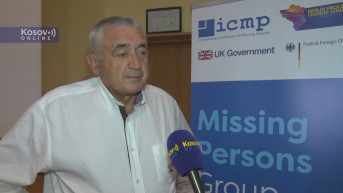
President of the Commission for Missing Persons of the Government of Serbia, Veljko Odalovic, stated for Kosovo Online that there was a willingness to resolve the issue of missing persons in the former Yugoslavia but that politics must be set aside.
The Missing Persons Group has adopted a report for the past year, which will be presented at the Berlin Process meeting in Tirana tomorrow.
"For five years now, we have been working together, having conversations, and today, we have adopted certain reports that we will present on a panel that is very important before tomorrow's summit. It seems to me that there is a willingness for what we are doing, it's a humanitarian and civilizational issue. However, first and foremost, we must try to separate ourselves from politics as much as possible, and then there will be results," Odalovic said from Tirana.
Odalovic called for the implementation of the Declaration on Missing Persons, which was agreed upon in May of this year. According to him, the process of finding missing persons is stuck in Brussels.
"If we become slaves to politics and the current or less current events, or I don't know what will happen in the future, we will then imprison this process because it is stuck in Brussels. That's the worst thing, and our appeal is to put the Declaration on Missing Persons into action and start simply searching on both sides. Today, we wanted more participants from the International Commission on Missing Persons to be with us at all those locations. I think it's good for the process. How they will respond to our extended hand and open offer is up to them, but in any case, I think it's good that we meet to discuss these difficult issues," Odalovic concluded.
Andreas Kleiser, Director of Policy and Cooperation at the International Commission on Missing Persons, told Kosovo Online that out of 12,000 missing persons since the Center had begun its work, 1,000 missing persons had been found, which was a significant number.
He emphasized that all bilateral problems must be overcome, and the commissions must continue their work.
"Locations of mass and individual graves of the missing are increasingly difficult to find. There are also mistaken identifications that need to be processed, which is really a long-lasting and long-term process that takes time. There are also individuals who have disappeared but have not been reported. Regarding the bilateral problems that have arisen, I think it's important to overcome them, and people are ready to work on it. More and faster work is needed. Today we discussed the Action Plan of the Missing Persons Group to achieve just that. I am satisfied with today's meeting and the work of the Missing Persons Group so far," Kleiser said.
The Framework Plan is an obligation provided for in the Declaration signed in July 2018 in London by the Chairman of the Council of Ministers of Bosnia and Herzegovina and the Prime Ministers of Kosovo, Montenegro, Serbia, Albania, Croatia, Germany, the United Kingdom, Austria, Bulgaria, France, Italy, Slovenia, and Poland, confirming their commitment to supporting efforts to find and identify the 12,000 people still missing in the conflicts in the former Yugoslavia.
The Missing Persons Group has an important supervisory role stemming from the Framework Plan for Addressing the Issue of Persons Missing as a Result of the Conflicts in the Former Yugoslavia, signed in November 2018 at the ICMP headquarters in The Hague. The second phase of implementing the Framework Plan is supported by the Government of the United Kingdom and the Government of the Federal Republic of Germany.

0 comments