
Brnabic: March 2004 will forever be the month and year of the pogrom in the minds of Serbs

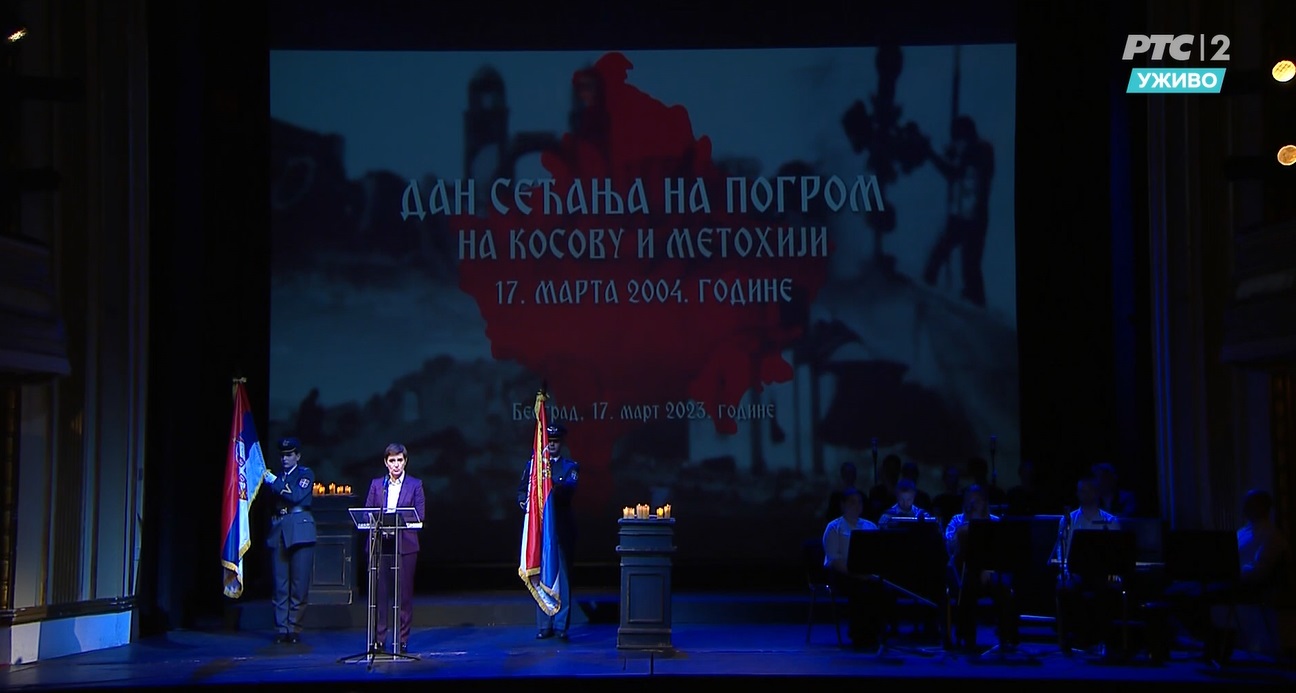
The Commemorative Academy in the National Theater in Belgrade marked the Day of Remembrance of the pogrom in Kosovo on March 17, 2004, and the Prime Minister of Serbia, Ana Brnabic, said that March 2004 would forever remain in the consciousness and memory of the Serbian people as the month and year of the pogrom, as well as that today Serbia wants to end the history of suffering and lay the foundations for a different future through responsible politics.
"The pogrom in which more than 4,000 Serbs, as well as members of the Roma people and other non-Albanians, were driven from their homes, from centuries-old hearths. In which 930 houses and buildings were burned and destroyed so that they would never return. In which 35 churches were destroyed and desecrated, dozens and hundreds of monastery collections, icons, crosses, paintings, bells, of inestimable importance," said Brnabic.
She reminded that the religious and cultural heritage of the Serbs was destroyed, as well as cultural treasures of world importance, such as the Cathedral Holy Virgin of Ljevis, under the protection of UNESCO, Devic Monastery, Visoki Decani, the Monastery of the Holy Archangels, the Temple of Christ the Savior, the Church of the Holy Week, but also that Serbian cemeteries and monuments suffered once again.
"The pogrom in which Jana Tucev and Borivoje Spasojevic from Kosovska Mitrovica, father and son, Dobrivoje and Borko Stolic from Strpce, Dragan Nedeljkovic from Prizren, Boban Peric and Slavoljub Dabic from Gnjilan and Nenad Vasic from Lipljan were killed," emphasized Brnabic, recalling the killed people.
She pointed out that with the expulsion of the Serbs, the ethnic composition of the population in certain areas was completely changed, and numerous towns, municipalities and villages were ethnically cleansed of Serbs.
"The image of a frantic and hate-ridden man breaking the cross at the Church of St. Andrew in Podujevo will, even when we are gone, stand in the album of our national suffering, next to the murdered Macva peasants, Kozarac children, refugees from Krajina, the train in the Grdelica Gorge and all other unimaginable sufferings of the Serbian people," emphasized Brnabic.
As she said, even when descendants looked at those symbols of suffering, it would remain a reminder that history often repeats itself, as evidenced by the Church of St. Andrew, built after the First World War, shelled in the Second World War by the Albanian organization Bali Kombetar, and then rebuilt in 1971 by the Serbs, and then attacked again in 1999, 2004, and then, after another reconstruction, in 2006.
"And so the circle, history repeats itself. But today, we, as a responsible and courageous state politician led by Aleksandar Vucic, are fighting to bring that cycle of misfortune and the history of suffering and uncertainty to an end somehow, without forgetting the past, we are laying the foundations for a different future," she said.
She pointed out that it is a future in which children can peacefully enjoy their childhood, and their parents know that they can create something that will not be destroyed already in the next generation, in which peace, not weapons and barbed wire, will protect churches and monuments, in which the dead will also have dignity, because cemeteries will not be desecrated again.
"The future in which Kosovo and Metohija remain ours, but which we must, if we want to realize that dream, build together with the Albanians," said Brnabic.
According to her, such a future cannot be built by a Serbia that agrees to everything and is ready to be humiliated, but by a Serbia that is stronger, stronger than it has ever been, proud, responsible, brave and independent, that conducts politics in accordance with its own interests.
Brnabic also stated that it took a lot of time and effort for Serbia to become such a country, to start winning, to believe in itself.
That, she said, is primarily the merit of President Vucic, but also of all citizens, all together, who believed in such a policy.
"It is a Serbia that is strong and independent enough to call things by their real name, not to use euphemisms to call the crimes committed against it. Pogroms will never be riots, nor aggression - intervention. Only such a Serbia has the strength to protect national interests and preserve its past in glory and sorrow and pave the way for a better future," said Brnabic.
Only in 2013, she reminded, the series of defeats ended, and only then, nine years after the pogrom, at the insistence of Vucic, was the first memorial plaque erected in North Mitrovica, in memory of the victims of the March pogrom.
She also reminded that the Brussels Agreement was signed at that time, guaranteeing the Community of Serb-majority Municipalities, which is still being fought over today, because it safeguards the interests of the Serbs in Kosovo.
"Only since then have we begun to commemorate our misfortunes and call things by their true names," said Brnabic.
At the same time, she says, Serbia's economic progress has been initiated, saying that it is clear to everyone in Serbia and the world today that there will be no "Oluja (engl. Storm) operations" and pogroms of the Serbian people and that today, in a Serbia like this, such crimes would be impossible.
"Those times are over. Serbia is no longer weak and humiliated, it does not bury its head in the sand, because it cannot do more than that. We must never allow Serbia to be so powerless again," said the Prime Minister.
Today, Serbia is self-confident, but not arrogant, and its demands and expectations are rational, and the national interest is peace and stability, of all with whom it shares this region.
"We do not want the main feature of Serbian-Albanian relations to be the anticipation of a new conflict, because neither the Serbs nor the Albanians can progress in the shadow of constant threats, violence, and an atmosphere of constant hatred and resentment. It is important that we try to close that page of history, in order to open the pages of the future, in which we will be directed to each other, guided by common interests. It doesn't seem like an easily achievable goal, but there is no alternative," stated Brnabic.
The Prime Minister said that Serbia's red lines are clear.
"Our readiness for dialogue and peaceful resolution of disagreements is an expression of strength and responsibility, towards ourselves and others, not hesitation and weakness. Serbia will never be able to agree to some things, but it will continue to do everything to make it better for itself and for everyone in the region. Glory be to the victims of the pogrom, may they rest in peace, and their descendants and our nation may hear clearly - never again," concluded Brnabic.
After Brnabic's address, an artistic program followed, followed by pictures and videos of the suffering of the Serbs in March 2004.




0 comments