
Dacic: No one can prevent the Serbs from resisting if Kurti brings the Albanian police to the north of Kosovo
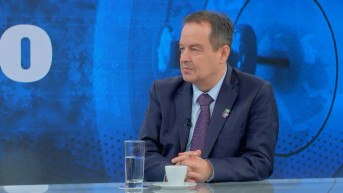
First Deputy Prime Minister in charge of foreign policy and security and Minister of Foreign Affairs of Serbia Ivica Dacic pointed out that there have never been Albanian policemen in the north of Kosovo, and if that happens, the Serbs will resist, and no one can stop them.
"If Albin Kurti sends the police to the North, there may be armed conflicts and everyone knows that," Dacic told Euronews Serbia.
He stated that the price for imposing sanctions on Russia would be the loss of support for Kosovo.
"It is up to us to make a decision, either we are going to give up the fight for Kosovo or we are going to have consequences regarding our geostrategic position. I think we have come to the point where everyone needs to make things clear. What we are doing is dribbling on a small field and that's why I think it's the right policy. Whoever knows how to dribble will survive," said Dacic.
Referring to the Franco-German proposal for solving the Kosovo problem, he said that it was unacceptable that it was unanimously evaluated at the session of the National Security Council, because its very essence is that Serbia directly or indirectly recognizes Kosovo. “This is unacceptable,” he added.
The starting point of the proposal is that Kosovo declared independence, he said.
"We believe that it was done unilaterally, which is internationally unacceptable. It started from the fact that Pristina and some countries that recognized it believe that the issue should not be raised again. We believe that, based on Resolution 1244, there must be a dialogue about it. They want a unilaterally imposed solution to be accepted on our side," Dacic said.
The intention, he added, is to move on as if nothing had happened, and what happened is that the Brussels agreement is a dead letter.
"Brussels has failed to guarantee the implementation of the agreement, first of all, regarding the CSM. Without the CSM, the essence is lost, and for nine years you refuse to form it, while the Serbs participate in the institutions, and the question arises as to how long this will last. It is paradoxical that we are calling for the Brussels agreement, while those who should guarantee its implementation are silent," Dacic reminded.
He stated that Kurti's calculation is “that within his megalomania the global relations are such that Serbia is now on the wrong side" and that he wants to put some Western countries in a such situation to see how they will behave.
Dacic stated that even the West is not enthusiastic about Kurti's moves, such as the application for the Council of Europe, because the decision on this has never been made by voting, which would inevitably happen in the case of Pristina. This, he added, is tolerated and the West fails to condemn it.
"Western countries often behave like the Tibetan council of sages - they stand for peace, instead of directing criticism towards those who undermine it. They say that it is a wrong move by the Serbs to leave the institutions. Well, wait, the Serbs entered the institutions because of the agreement, but they were deceived," Dacic pointed out.
When asked if he feels cheated considering that he is a signatory of the agreement, he answers that he and the current president of Serbia, Aleksandar Vucic, had good cooperation with the former high representative of the EU for foreign policy, Catherine Ashton, who was the guarantor of the implementation of the agreement, but after her leaving office, everything "started to decline".
When asked if he sees a point in the future where Serbs and Albanians could live together, he answers that we live in an era of mixed principles.
"In principle, we all talk about living together regardless of nationality, about civil rights and freedoms, but these principles are violated in every country and there are always national problems," said Dacic.
He announced that Serbia will continue working on the recognition of Kosovo's independence, but he did not want to name the countries that have done so, so far, in order not to be exposed to pressure from Pristina.

comments