
Djuric: The authorities in Pristina are not constructive; Significant stagnation in the dialogue
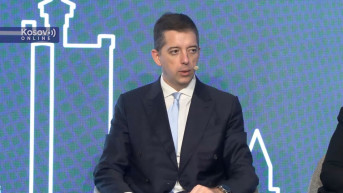
Serbia’s Minister of Foreign Affairs Marko Djuric stated today that opening Cluster 3 in negotiations with the European Union—either now or in the coming months—would serve as a strong incentive for Serbia as a whole to focus on the process of European integration in the year ahead. Djuric praised the Berlin Process and, speaking about relations between Belgrade and Pristina, emphasized that there has been a notable decline in minority rights in Kosovo and a major stagnation in the dialogue, due to the lack of constructiveness on the part of the authorities in Pristina.
“I wish to begin with sincere praise for the Berlin Process. Throughout this period, it has provided us with a stable platform for regional cooperation that does not depend on the internal dynamics among the countries in our region. Since becoming Minister, I have witnessed some very productive meetings in Berlin, but also in the United Kingdom and Northern Ireland. This has allowed us to maintain a platform for further advancement in dialogue between states,” Djuric said on the panel titled “A Decade of Dialogue: Has the Berlin Process Brought Progress?” at the “Beltalks” Forum organized by GLOBSEC.
Regarding the Belgrade–Pristina dialogue, the Minister underlined that there has been significant stagnation, as well as a decline in the political, cultural, economic, ethnic, and other rights of minorities in Kosovo.
“This is the important ‘elephant in the room.’ The authorities in Pristina are not as constructive and cooperative as we would wish,” Djuric noted.
He referred to the issue of university diplomas, pointing to the paradox that a diploma from the University of Pristina, headquartered in North Mitrovica, allows its holder to work in Berlin, yet the same diploma cannot be used in Pristina without additional procedures.
“More than a decade ago, we signed an agreement that we would mutually recognize university diplomas, but what we see in practice is that the question of statehood continues to be misused in relation to basic rights, such as the recognition of academic degrees,” Djuric said.
Importance of Good Neighbourly Relations
Djuric stressed that good neighbourly relations are of paramount importance to Serbia.
“I often like to emphasize that, given Serbia has eight direct neighbours, this makes us—after Germany and together with Austria—the European country with the largest number of neighbouring states. I repeat this because I want to highlight how crucial we are to regional stability. This type of platform is extraordinarily important for progress. We have already achieved progress in the Common Regional Market, but I want to underline that for us, regional cooperation is a national interest and an important step toward European integration. One cannot go without the other,” the Serbian Foreign Minister stated.
He added that the Berlin Process is not an alternative to the EU integration process. However, regional cooperation—both in this format and in others—is being influenced by a broader European pessimism.
“This is something that concerns me. If you look at public opinion surveys such as Eurobarometer, you will see that both in our region and in some EU member states, there is considerable scepticism regarding EU enlargement. I believe that in 2026 we must seize the opportunity to push the region more firmly toward the EU—not just Serbia. It must be a political decision, in the same way it was for countries that joined the EU more than a decade ago. I do not believe that our economy or institutions—with their strengths and weaknesses—are significantly different from those of countries admitted a little over ten years ago,” Djuric stated.
He expressed confidence that Serbia can contribute to a stronger Europe.
“We are a country that has doubled its economy in just over a decade. Part of President Aleksandar Vucić’s vision was a shift away from the narrative that dominated our politics for more than a decade, toward GDP growth, infrastructure development, and a focus on the future. That is a profound transformation in Serbian politics. This is a fact, whether or not one agrees with this Government’s policies,” the Minister said.
A Difficult Year for the EU and Serbia
He emphasized that when assessing the entire year—especially regarding integration—one must recognize that it has been a very difficult year for all countries in the region, as well as for the European Union.
“For Serbia, this has been a particularly challenging year, with considerable divisions and internal difficulties. However, in the past three months, we have succeeded in using the European integration process to overcome some of these issues and move toward more positive developments. European integration is not solely the responsibility of the government, but of society at large—including the opposition and civil sector,” Djuric said.
He recalled that the European Commission issued recommendations for Serbia to undertake several steps, which Serbia fulfilled by implementing key judicial reforms and adopting laws related to the electoral process.
In the field of energy, Djuric noted that Serbia had achieved major results in diversification of supply sources, opening markets, and connecting with the European energy market.
“These are clear results achieved over the past several months. We would like EU member states to acknowledge that the European Commission has, for the fifth time, recommended opening Cluster 3. I believe that opening this cluster now, or in the coming months, would motivate our society to focus on the EU integration process in 2026 and on everything related to enlargement. If, despite these results, we are unable to move forward, I must be honest—pessimism toward the EU, already present across Europe, will only intensify in our region,” Djuric warned.
He emphasized that reforms must continue and accelerate, regardless of circumstances, in order to build a society capable of retaining young people and inspiring them to build their future at home.
“We therefore need to roll up our sleeves and work on strengthening our institutions, our economy, social mobility, and also regional reconciliation,” the Minister stressed.
He recalled that this year marked several difficult anniversaries—the 30th anniversary of the Dayton Agreement, the 30th anniversary of Srebrenica, and the 30th anniversary of Operation Storm.
“These were politically sensitive anniversaries, sometimes misused. I heard someone use the term ‘tribalization of pain’—in the Balkans, this must stop. We must accept that we all suffer, perhaps not to the same degree, and extend our hands in a spirit of cooperation with all our neighbours,” Djuric said.
He added that during recent meetings with the German Foreign Minister, Serbia offered to host future Berlin Process meetings, either independently or jointly with another country.
“We seek success on the path toward the EU. Serbia deserves to be part of the next round of EU enlargement, and we will certainly try to use 2026 to make up for any lost time in which we may not have been fully focused,” Djuric concluded.

0 comments