
Djuric: I reminded of the fact that the CSM has not been established, that obligation was signed here in Brussels
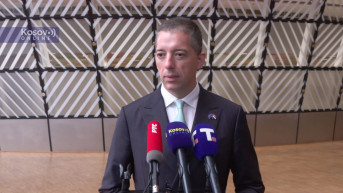
Serbian Foreign Minister Marko Djuric, following the informal meeting between EU High Representative for Foreign Affairs and Security Policy Kaja Kallas and Western Balkan ministers, stressed that Serbia wants the Schengen area to be opened to the entire region as soon as possible. Regarding the dialogue with Pristina, Djuric emphasized that during the meeting, he reminded participants that the Community of Serb Municipalities has still not been established.
Djuric stressed that Serbia’s key message at the meeting was that Europe has no time to lose.
“We must accelerate the integration process and adapt to global circumstances that are truly unprecedented,” Djuric said.
As he added, rapid changes require the EU to admit into its ranks, without delay, the countries that are not yet members but are on the European continent.
“Among those countries, Serbia stands out in terms of economic, demographic and geopolitical characteristics, as the country with the fastest economic growth over the past decade,” Djuric added.
Besides the broader picture, Djuric said that specific details and concrete issues were also discussed in Brussels today, including, as he noted, difficult details regarding the situation in Bosnia and Herzegovina, where he added that he tried to protect Serbian interests.
“Serbia has always stood on the side of stability, Serbia has always been and remains committed to the Dayton Agreement, but Serbia also firmly believes that the peoples of Bosnia and Herzegovina should be the ones deciding the fate of that country, not anyone from the outside. Of course, assistance from all of us is always welcome, but the core work must be carried out among political actors in Bosnia and Herzegovina, and Serbia has shown how much it contributes to the normalization of relations,” he stated.
As he pointed out, there were also discussions about other issues in the region, as well as the Belgrade-Pristina dialogue.
“I reminded them of the fact that the CSM has not been established for more than a decade, even though that obligation was signed and agreed upon here, and I myself witnessed it on April 19, 2013. Representatives of Pristina tried to blame Serbia for various regional problems and portray it as a source of instability in the region. However, the general observation is that Europe today, faced with numerous challenges, is working to accelerate the enlargement process,” Djuric added.
Serbia wants the Schengen area opened to the entire region this summer already
In that regard, Djuric stressed that Serbia’s message is that it wants to see the Schengen area opened to the entire region as quickly as possible.
“It is frustrating that we have hard borders every 150 to 200 kilometers interrupting the bloodstream of people’s lives, families and economies, and there is no reason why Europe should not already this summer unlock the full potential of integrating our region into Schengen, because that would directly generate 50 billion euros in new economic activity and would not reduce the security of the EU and the continent. On the contrary, it would lower tensions in our region and would be very beneficial, just as we support the rapid integration of our region into the common economic area,” Djuric stated.
Djuric added that some of the ministers reacted positively and supported these views.
“The overall tone of the discussion was courteous and respectful toward our country, and I hope that our European integration process will continue to advance despite all ideological and sometimes politically motivated pressures to which our country is often exposed from certain centers,” he said.
Reacting to Marta Kos’s statement regarding Growth Plan funds intended for Serbia, Djuric said it seems to him that there is a bit of, as he put it, political gamesmanship in public communication around the issue of European funds, with the aim of exerting political pressure or influence on internal relations in Serbia.
“The fact is that there is no decision by the European Union denying Serbia economic or development support from the EU. It is also a fact that Serbia is working hard and diligently to implement reforms and all other organizational, technical and political steps necessary for us to receive full support. Even when that does not happen, it is very often the result of political assessments, but let us be very clear: Serbia has not deserved to be treated as a black sheep through its actions. It is certainly a country leading in the adoption of various legal, organizational and other steps in the field of European integration. We have our internal specificities and our internal political situation, like every country, but claiming that Serbia is not receiving assistance from EU development funds because some decision has been made is simply political manipulation and does not correspond to the truth,” Djuric concluded.
He believes that accepting the proposal of Serbian President Aleksandar Vucic for the entire Western Balkans to be admitted immediately, without delay, into the EU would be the best possible step both for Europe and the Balkans.
“It would calm tensions and unlock the full potential. I mentioned that from the moment the region entered Schengen, 50 billion euros in new economic value would be unlocked in that same year. Just imagine how much lower tensions in our region would be if all Serbs, all Albanians and all Bosniaks could move completely freely, without borders, while respecting sovereignty, statehood and laws, but without bureaucratic obstacles. The borders of the Schengen area would shrink by 20 percent. And only 19 international entry points, namely 19 airports and ports, would require additional enhanced supervision. This is something that would reduce EU costs for maintaining all those border services and everything else, while at the same time not increasing migrant inflows by even a fraction. Because physically, it is practically impossible to enter Europe through the Balkans without first passing through or alongside other European countries. Therefore, we need to think carefully, we need to press the accelerator on integrating our region into Europe, and I believe that what President Vucic has done, both individually and in cooperation with some other leaders from the region, is a serious impulse and an outstretched hand that I hope the member states will accept as soon as possible,” Djuric stated.
0 comments