
Due: Rising tensions and legacy of past conflicts require continued focus on Kosovo
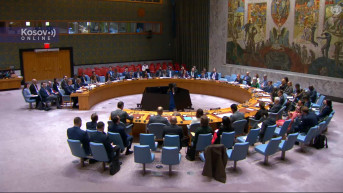
The recent rise in tensions and the legacy of past conflicts in the Western Balkans underscore the need to maintain a focus on Kosovo despite challenges elsewhere, UNMIK chief Peter Due said while presenting the mission’s semi-annual report to the UN Security Council.
He said that progress in the EU-facilitated Belgrade-Pristina dialogue remained essential to the normalization of relations and called for the implementation of agreements already reached, particularly the establishment of the Community of Serb Municipalities.
Due said that genuine commitment from both sides was necessary to achieve tangible progress.
“I recognize the EU’s continued efforts and welcome the separate high-level meetings it held with Aleksandar Vucic and Albin Kurti here in New York in September. I call on both sides to engage constructively and implement the agreements already reached, including the establishment of the CSM, as well as to take steps that contribute to confidence-building and the reduction of tensions,” Due stressed.
He noted that EU Special Representative for the Belgrade-Pristina Dialogue Peter Sorensen had continued his intensive efforts, including on the issue of missing persons and the inclusion of the voices of women and young people, and recalled that the fate of 1,577 people remained unresolved.
“Recent excavations and the identification of human remains have brought a measure of solace to families, but at the same time serve as a reminder of the enduring suffering of those who are still waiting for answers. I call on all sides to ensure that the approach to the issue of missing persons remains humanitarian, victim-centered and free from politicization. I also encourage both sides to take steps to facilitate access to relevant archives, including by appointing contact persons. UNMIK remains committed to supporting these efforts, including through the Working Group on Missing Persons,” Due added.
He recalled that three elections had been held within a period of 16 months, resulting in political uncertainty and heightened rhetoric.
He also assessed that tensions in Kosovo and the region had increased over the past six months, noting that tensions in northern Kosovo and elsewhere had risen over property-related issues, including demolitions and evictions.
“These developments have raised questions concerning property rights, due process and the potential socioeconomic consequences for local communities and businesses. Concerns also remain regarding the stalled reintegration of Kosovo Serb judges and prosecutors, as well as restrictions on freedom of expression, including the use of signs, symbols and language associated with non-majority communities. There have also been concerns regarding law enforcement actions, including during the Vidovdan commemoration at Gazimestan on June 28. There are allegations of mistreatment of Kosovo Serbs by Kosovo police officers. The Kosovo Police Inspectorate has opened investigations into these matters,” Due explained.
He pointed out that healthcare and educational institutions administered by Belgrade, as well as the Serbian Orthodox Church, continued to face challenges arising from closures and decisions affecting access to religious and cultural sites and the conduct of pilgrimages.
“This reinforces perceptions of insecurity and unequal treatment among Kosovo Serbs, undermining trust and affecting Kosovo’s multiethnic character,” Due warned.
He noted that demonstrations had taken place in several Kosovo cities following the judgment against Hashim Thaci and three other former KLA leaders and criticized the fact that Kosovo Police had failed to brief UNMIK representatives on its operations.
He said that Kosovo Police had acted professionally in managing the demonstrations, while safeguarding the rights to assembly and expression.
However, he stressed that coordination with the United Nations had been inadequate, with other organizations having been informed while the UN had not.
“Kosovo Police informed other international organizations, but not the United Nations. Operational coordination among international actors on the ground was also less than optimal. I have raised these concerns with the authorities in Pristina and with our international partners,” Due said.
He strongly condemned attempts by the institutions in Pristina to restrict the jurisdiction of the Specialist Chambers in The Hague, noting that confronting the past was essential to the future of the region.
“I note the deep concern expressed by the EU regarding these amendments. The integrity and independence of the judicial process must be respected. Any legislative action must be fully consistent with Kosovo’s legal and international obligations,” Due said.
He welcomed the resolution of the institutional crisis through the election of the President of Kosovo, assessing the establishment of functioning institutions as an encouraging sign.
Due warned that the continuation of the dialogue was a key factor in achieving progress and called on both sides to fulfill the obligations arising from agreements reached to date, including the establishment of the Community of Serb Municipalities.
“Another 1,577 people remain missing. I encourage the parties to facilitate access to archives that could help clarify their fate,” Due said.
“UNMIK continues to promote dialogue, confidence-building and inclusion within and between communities. We continue to perform important so-called residual functions relating to Interpol, document certification and facilitating Kosovo’s participation in United Nations forums. Our shared responsibility is to work toward reconciliation and normalization so that all communities in Kosovo can participate fully and confidently in public life, with respect for the rule of law, human rights and Kosovo’s multiethnic character. The recent rise in tensions and the legacy of past conflicts in the Western Balkans indicate that this Council should maintain its focus on Kosovo despite challenges elsewhere,” Due concluded.
The meeting is being chaired by Greece’s Ambassador to the UN, as Greece assumed the rotating monthly presidency of the Security Council on October 1.
Djuric: Northern Kosovo has become a police protectorate for Serbs
Serbian Foreign Minister Marko Djuric told the UN Security Council this evening that northern Kosovo had become a police protectorate for Serbs, where intimidation and violence against civilians had become part of everyday life. Speaking about the war crimes judgment against the KLA leaders and the reactions among Albanians, he stressed that Serbia’s position was clear—justice for victims must never be sacrificed for political interests and must apply equally to everyone.
“The report describes the situation in northern Kosovo and Metohija as calm but fragile. A street may be calm because a family has decided that it is safer to stay indoors. A town may appear quiet because its young people have left. A community may slowly disappear without a single dramatic event occurring that would attract the world’s attention,” Djuric warned.
Djuric pointed to the problems facing Serbs in Kosovo, including the closure of institutions, property-related issues, allegations of police mistreatment and the lack of conditions for the return of displaced persons, stressing that the return of Serbian judges and prosecutors was important for restoring trust.
He reiterated that the Community of Serb Municipalities had still not been established 13 years after the agreement was reached and stressed that Serbia remained committed to dialogue, peace and the protection of the rights of Serbs.
“The victims have waited long enough to be heard. Those who are alive today should not have to wait another generation to feel protected. Serbs and Albanians deserve a future based on respect, cooperation and friendship—let us stand up for such a future! That is the responsibility before this Council and before all of us,” Minister Djuric concluded.
Konjufca: Report biased and one-sided
Kosovo Foreign Minister Glauk Konjufca assessed that UNMIK’s report on the situation in Kosovo was biased and one-sided, while maintaining that the Kosovo Government was committed to creating a safe environment and opportunities for progress for everyone.
According to him, the UNMIK report was based on “Serbian propaganda,” while the incidents listed in the document had been “groundlessly described as interethnic.”
Konjufca also said that UNMIK had “long overstayed its welcome,” arguing that the mission was unnecessary and that it was time for it to be terminated.
US calls for termination of UNMIK, China supports continuation of mission
US Deputy Representative to the United Nations Tammy Bruce said that UNMIK’s mandate was outdated and that the Security Council should terminate the mission.
“UNMIK no longer plays any role in Kosovo. KFOR, the EU mission and several other missions play a much greater role,” Bruce said.
On the other hand, China’s Deputy Permanent Representative to the UN Sun Lei stressed that dialogue was the only path toward resolving the Kosovo issue and that Serbia’s sovereignty and territorial integrity must be respected, while calling for continued support for UNMIK’s work.
“The Kosovo authorities must implement the Brussels Agreement and establish the CSM without delay, thereby removing obstacles to the dialogue,” Sun said.

0 comments