
Djuric: Regional cooperation is the backbone of Serbia's foreign policy
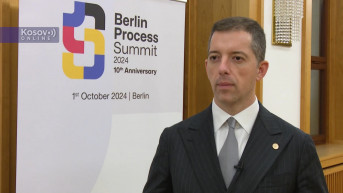
Serbia's Foreign Minister, Marko Djuric, emphasized that Serbia's participation in the Berlin Process once again confirmed that regional cooperation is the backbone of its foreign policy. He also stated that during separate meetings on the sidelines, he drew the attention of all his interlocutors to the very difficult situation of Serbs in Kosovo.
Today in Berlin, a summit was held to mark the 10th anniversary of the Berlin Process, with Serbia's delegation arriving directly from Washington.
"We sent a strong message that we will work closely with each of our neighbors in the coming period to improve our economic cooperation, enhance our transport connections, boost scientific and youth exchanges between our countries and peoples, and address past issues in a way that will not undermine the national interests of any of the involved parties," Djuric said.
He emphasized that today's forum discussions were not easy for Serbia, as there were several open and somewhat veiled or covert attacks on Serbia's political positions or certain aspects of its policies.
"I tried to represent Serbia's interests in a dignified manner, guided by the principle that it may not be most important to try to 'win' the debate, as if we were on TV, but to show that we want to contribute constructively to solving regional problems," Djuric added.
In addition to regional ministers, the Berlin Process summit was attended by the German minister, who hosted the event, as well as ministers from Austria, Greece, Slovenia, Croatia, and representatives from France, Italy, and Poland. Djuric stated that all these countries, which influence Serbia's EU accession, were able to directly witness Serbia's reasonable and rational approach to regional relations.
"Unlike others, we didn't throw any political barbs. We tried to present the situation as it truly is. Of course, in the bilateral talks I had with my fellow ministers, I also highlighted the very difficult situation of our people in Kosovo and Metohija, caused by the uncoordinated and unilateral actions of Kurti's regime, which has jeopardized some of the essential functions necessary for the survival of the Serbian community in Kosovo," Djuric said.
He specifically thanked the host, German Minister Annalena Baerbock, as Germany's Federal Ministry of Foreign Affairs, under her leadership, has shown a willingness not only to invest in the Berlin Process and regional cooperation in its many dimensions, but Baerbock herself demonstrated a readiness to listen to Serbia's arguments during their bilateral meeting.
During that meeting, there was a renewed mutual commitment to developing economic cooperation and collaboration in the fields of science and technology between Serbia and Germany.
"This is extremely important for us, and the dialogue on various political issues that bring our two countries closer also signifies a stronger anchoring of our country in the broader international environment. I believe that the citizens of Serbia understand the importance of this," said the head of Serbian diplomacy.
In addition to meeting with Baerbock, Djuric also held a bilateral meeting with Austria's Foreign Minister, Alexander Schallenberg, to discuss economic cooperation between Serbia and Austria.
As for political topics, Djuric said today's talks were another opportunity to explain Serbia's position on Kosovo and various other regional issues.
It was also an opportunity, as he added, for Serbia to once again gain support for the opening of the third cluster in its EU accession process.
Djuric also mentioned having an excellent conversation with his Hungarian friend and brother, Peter Szijjártó, and they agreed on several concrete meetings in the upcoming period to strengthen economic, political, and other forms of exchange.
Among the meetings he had today, he highlighted the one with the British Minister for Europe.
"I believe that there are vast opportunities for cooperation and overlapping interests between the UK, which is no longer in the European Union, and Serbia, which is not yet a member. It is essential to deepen political dialogue and understanding with Britain, a power historically and politically deeply rooted in our region. I think this was a step in the right direction. We would like to welcome both Mr. Lammy, the British Foreign Secretary, and my interlocutor today, the British Minister for European Affairs, to Serbia," Djuric said.
He concluded by stating that Serbia would continue its intensive diplomatic efforts and campaigns.
0 comments