
Djuric: The strategic partnership with France continues to advance; Barrot: We want Serbia to be in the EU
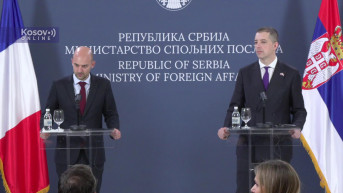
Serbia’s Minister of Foreign Affairs Marko Djuric stated that he had informed the French Minister for Europe and Foreign Affairs, Jean Noël Barrot, who is on an official visit to Serbia, about the problems faced by the Serbs in Kosovo. The French minister said today that Serbia belongs in a strong and robust European Union and that Paris supports Serbia’s aspirations to become an EU member, adding that, with regard to the Belgrade–Pristina dialogue, the parties must implement the obligations they have undertaken.
“We also discussed the situation in Kosovo and Metohija, and I briefed my French colleague on the problems our population faces in this area. I pointed to the intensification of pressure over the past year and informed him of the circumstances in which our people live,” Djuric said at a joint press conference.
He noted that it was an honor to host a representative of a country of immense importance to Serbia—politically, economically, culturally, and in all other fields—with which Serbia maintains a strategic partnership.
Djuric recalled that this year marks the 15th anniversary of the strategic partnership between Serbia and France, giving the visit a historic character.
“We discussed overall bilateral relations. I am pleased to say that these relations are characterized by steady progress, based on the very close relationship between the two presidents, Emmanuel Macron and Aleksandar Vucic. This has resulted in a genuine boom in economic cooperation in recent years. French investments have increased significantly, and together with French partners we are modernizing our infrastructure,” he explained.
Djuric emphasized that he and Barrot discussed ways to make the continuously advancing strategic partnership even more effective.
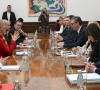
In this regard, he noted that during the visit to Belgrade, Barrot signed two documents, which he described as confirmation of the development of bilateral relations.
“We have an exceptionally developed high-level political dialogue. We reviewed all key issues related to European integration, where Serbia’s strategic priority is to become a member as soon as possible. We are grateful to President Macron and Minister Barrot for their vision of a large, strong, and united Europe that will consolidate its strength in order to jointly respond to the challenges facing the continent. The consequences of current developments affect all of us today more than ever, and it is more necessary than ever that we work together,” Djuric said.
He thanked France for its support for the opening of Cluster 3 and announced that Serbia would double its efforts in implementing the European agenda to enable faster accession.
Djuric added that he and Barrot also discussed joint action in the regional context.
He expressed gratitude to France for its participation in Expo 2027, stressing that Serbia expects the event to have a transformative role for Belgrade and the country as a whole.
“We are pleased that France will be represented at the Expo,” the head of Serbian diplomacy said.
Djuric announced that following the meeting he would lay wreaths at the Monument of Gratitude to France.
“I can say that there is deep historical friendship in the hearts of Serbia’s citizens and a strong memory of the alliances that existed in different eras, and we are determined to strengthen that alliance,” Djuric concluded.
Barrot: We Want and Support Serbia’s EU Membership
French Minister for Europe and Foreign Affairs Jean-Noël Barrot said that Serbia belongs in a strong and robust European Union and that Paris supports Serbia’s aspiration to become part of the EU, noting that, with respect to the Belgrade–Pristina dialogue, the parties should implement the commitments they have signed.
“I would like to convey a dual message. First, about the friendship between Serbia and France, embodied in cooperation between our citizens and economies. Second, to reaffirm that Serbia’s place is in Europe—in a strong and robust European Union that will enable both France and Serbia to confront challenges. We want the Western Balkans to be part of Europe,” Barrot said.
He underlined France’s support for Serbia’s EU aspirations, recalling that accession is merit-based and subject to specific criteria.
“France stands by your side,” Barrot stressed.
He added that remaining tasks related to the Regulatory Authority for Electronic Media (REM) and the European Commission’s recommendations on the judiciary must be completed, noting that the bar is high and the path to the EU long—hence France’s support for opening Cluster 3 in Serbia’s accession negotiations.
Regarding the Belgrade–Pristina dialogue, Barrot reiterated that the parties must implement the obligations they have undertaken.
Speaking about the strategic partnership, Barrot said the two countries cooperate in politics, the economy, transport infrastructure, sustainable development, wastewater treatment, and artificial intelligence, while also exploring new opportunities for cooperation in the civil nuclear field. He added that the French company Bull will deliver a “supercomputer” within the framework of the strategic partnership.
“This partnership has existed for 15 years, and we have agreed to develop a roadmap to make its implementation even more impactful. The French Development Agency, active in Serbia since 2019, has dedicated budget lines related to the ecological transition. We are ready to support Serbia’s energy independence,” Barrot said.
According to him, Serbia will be able to strengthen both its strategic and overall autonomy within the EU.
Responding to journalists’ questions, Barrot reiterated France’s support for opening Cluster 3.
“The President said in Bratislava in 2023 that the law of the stronger is beginning to prevail in the world and that we must be ready to respond as a strong Europe to such force. We cannot strengthen ourselves if we leave the Western Balkans aside,” Barrot said.
He added that France is accompanying Serbia on its EU path, noting that accession is complex—not only about economic progress, but also about citizens’ choices, constitutional rules, and democracy.
“It is a demanding path, and that is why we accompany Serbia, as well as other countries, in implementing reforms. We encourage Serbia and do not want the Serbian people to become discouraged or lose the desire to join the EU. The Union will be enriched by admitting Serbia, and it is essential that we keep this idea alive among citizens,” Barrot concluded.
On the European Parliament Delegation and Greenland
Asked about the upcoming visit of a European Parliament delegation, Djuric said it is no secret that Serbia believes some MEPs involved in reporting on Serbia lack an objective approach.
“The delegation will be received by Serbian officials and representatives of state institutions. The level of reception is our sovereign and discretionary decision,” he explained.
He added that perceptions are not helped by actions such as a prominent MEP posting a photograph with automatic weapons from the period of fighting against Serbs on the anniversary of Operation Storm, and similar incidents reflecting the views of certain individuals.
“These ideological differences should not cast a shadow over our cooperation with the European Parliament as a whole. I hope that at least some of those coming to Belgrade will be prepared to put themselves in our position and listen to our arguments,” Djuric emphasized.
On Greenland, Barrot recalled that France expressed support and solidarity with Denmark, noting that France expects similar solidarity from EU and NATO partners should it face a comparable situation.
“France’s participation in the Arctic Endurance exercises testifies to that support and solidarity,” Barrot added.
Djuric said Serbia welcomes discussions on the issue at the White House, stressing that respect for the UN Charter is crucial for international relations.
“In our discussions, we conveyed to our guest the sentiments of Serbia’s citizens and our particular sensitivity regarding respect for territorial integrity and sovereignty, given that since 2008 we have faced a specific situation concerning Kosovo and Metohija. In that sense, it is not within our scope to be actively involved in this issue, but Serbia consistently adheres to UN principles, without exception. Such matters can be resolved exclusively through dialogue,” Djuric concluded.

comments