
Djuric: The UN General Assembly is an opportunity for Serbia’s voice to be heard
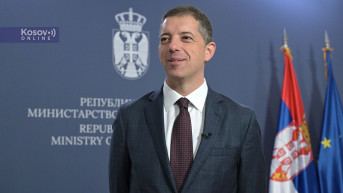
Foreign Minister Marko Djuric announced that next week he will travel to New York, together with the President of Serbia, for the session of the UN General Assembly. Speaking to Euronews Serbia, he said this will be an opportunity for the voice of a sovereign, independent, and free Serbia—a country of opportunities—to be heard.
Appearing on Euronews Serbia, Djuric recalled that this will be the fourteenth time he has attended the event.
“For me, my first association with the UN hall has already become the epic struggle the President waged last year to prevent a negative ‘genocide’ label from being attached to our country. On the most difficult topics—designed both to divide us internally along national, ideological, religious, and any other lines, and to portray us negatively in the international arena—Serbia showed what a network of friends it has in the international community,” the minister underlined.
He stressed that this year’s participation in the General Assembly will be a highly important opportunity to present the truth about the situation of Serbs in Kosovo and Metohija.
He also noted that visas with certain countries will be lifted and that agreements on economic cooperation will be signed.
“Follow this closely—there will be good news next week,” the minister said.
Djuric stated that relations with the new U.S. administration have visibly and tangibly improved, and he is confident this will be confirmed during the upcoming meeting between the President and the U.S. Secretary of State.
He said this will be an excellent opportunity to discuss the strategic dialogue between the two countries, as well as what can be done together in the region, on Kosovo and Metohija, and on other topics.
“As for the positions of certain European countries or Europe as a whole, there is no single view. If you ask Slovakia, Greece, Cyprus, Hungary, and so on, you will get one picture. If you ask some other countries, you will get a somewhat different one. Of course, Serbia has excellent relations with France. And, after all, Germany is a country that employs over one hundred thousand people here in companies under German ownership. Our duty is not to neglect any relationship and to improve them all. That is what we are doing. We will not draw divisions or ideological lines here, because our foreign policy is truly balanced. It reflects the aspirations of Serbia’s citizens to build a safe and friendly environment,” Djuric said.
He added that this also applies to Serbia’s immediate neighbors, as the country borders eight states.
“My job—whether it is popular or not—is to talk with representatives of those countries, to look for the lowest common denominator, and to advance cooperation,” Minister Djuric said.
“It is important for Serbs to turn out for the local elections in Kosovo and Metohija”
Speaking about the situation in Kosovo and the local elections on October 12, Marko Djuric said that
Albin Kurti wants to break the Serbs in Kosovo and keep them from voting.
“He and his regime fear the possibility that Serbs will once again take control of the municipalities and institutions in northern Kosovo and Metohija—something for which there is a clear, democratic, and legal opportunity in the local elections on October 12. It is our responsibility—and the responsibility of our people in Kosovo and Metohija; to be completely frank, they are the greatest guardians of our national interests in the province—to seize that opportunity,” he said.
He therefore believes it is important for Serbs to turn out in the largest possible numbers for the upcoming local elections.
“They are rallying around the Serbian List, and that is good. It is good because the Serbian List truly represents the backbone of our national struggle and the ties we maintain with our people in Kosovo and Metohija. That is the best antidote to the attempts of the authorities in Pristina to exclude and eliminate Serbs,” the minister emphasized.
Asked about the future of the Belgrade–Pristina dialogue, Djuric said it is necessary to move from words to deeds.
“We have needed that for a long time. The Brussels Agreement on the Association of Serb-majority Municipalities was signed in 2013 and confirmed in 2015 with additional arrangements. More than ten years have passed. Of course this affects the credibility of the dialogue process. It is also important that regular discussions and debates on the situation in Kosovo and Metohija continue before the UN Security Council. And it is important that in the past ten years, 28 countries have withdrawn recognition of the so-called independence—thanks to our diplomatic efforts—while only three new states have recognized it,” he said.
He said this shows that the international climate is changing, while emphasizing that Serbia is committed to protecting its national interests and to a constructive approach to the dialogue process.
“We are a rational and serious actor in all this. We want to achieve mutually beneficial solutions,” Djuric noted.
“We have preserved old friendships and are building new relationships”
Djuric said he is pleased to report that Serbia, even in these difficult circumstances, is making progress in relations with some of the world’s key countries.
“We have preserved all our key traditional partnerships, as seen in the President’s visit to China and talks with Russia’s leadership. But we are also building new relationships, and the opening of a strategic dialogue between Serbia and the United States represents a historic step forward in relations between Serbia and one of the most influential countries in the world—indeed, the most influential country of the Western world,” Djuric said.
At the same time, he added, Serbia continues its reform efforts under the European agenda so that no one can use this as a pretext to push Serbia away from the European decision-making table.
“Serbia is in no way worse than some countries that joined the EU fifteen years ago. We believe we deserve an equal place at that table and that we can achieve mutual benefit,” the minister said.
He added that Serbia is not always treated equally by all international actors. “But that does not mean we accept such a status or treatment for Serbia; on the contrary, we seek to change the views of those who are critical of us, to connect on the basis of shared interests, to win them over, and to explain our values—that we are not in the negative place where, unfortunately, some try to portray us,” he said.
Serbia is sincere in its efforts to join the EU
On Serbia’s European integration, Djuric said Serbia is very sincere in its efforts to become an EU member, with the desire to be equal with other members, to participate in the work, to create added value, and to help decide on issues such as foreign and security policy.
“We are a centrally positioned country in Southeast Europe; we can offer much, and we can gain much. Imagine, to our east we have a neighbor that has been an EU member for more than a decade and a half and has received over 90 billion euros in direct EU funds. We have received significantly, significantly less—almost twenty times less—yet our standard of living and the strength of our institutions are not inferior. Imagine what we as a society and a state could do if we had that kind of structural, institutional support from European funds and systems,” Djuric said.
However, he emphasized that Serbia has every right to conduct its own foreign and domestic policy in accordance with the interests and will of its citizens, and that it has no formal legal obligation to agree with and accept every decision made in Brussels, because Serbia is not an EU member.
He noted that Serbia cannot be addressed in the language of pressure, but that talks and agreements can be reached on rational, sound grounds and on the basis of mutual respect.
“That is what we are doing, and with all our interlocutors in Brussels we strive to deepen trust. You have seen that in the past year President von der Leyen, the EU’s most influential politician, has paid several visits here. Other officials come regularly. Of course, many EU member states have different positions from ours on some sensitive issues, from Kosovo and Metohija onward. Our skill in the coming period will be to safeguard our number-one interest and to secure our equal place at the table,” he said.
“We must strengthen our defense capacities as a means of preserving stability”
Regarding security alignments in the region, Djuric said he was among the first to sound the alarm when agreements were seen being made in the security sphere in a non-transparent way and without consultations.
“This region not only lived through the catastrophe of war and civil conflict thirty years ago, but there are also agreements that limit and control the amount of armaments, military equipment, and other means that some countries may possess. When agreements are made outside those frameworks, that naturally calls for a response. Our response is very clear,” the minister said.
He noted that Serbia’s reaction is, on one hand, political and diplomatic—talks with top European and international security officials, as well as with representatives of the countries concerned, with clear questions about what is going on and why there is no transparency.
“On the other hand—let us look to ourselves. We must strengthen our defense capacities as an instrument for preserving stability, peace, and security for all our people,” he said.
The minister added he looks forward to the upcoming parade, where the progress made in recent years in enhancing Serbia’s defense capabilities will be on display.
“I would like to congratulate in advance the members of the Serbian Armed Forces, the Ministry of Defense, and everyone involved in the preparations, because, from everything I hear, this will be the largest display of its kind in decades,” he said.
“Violence as a method of political struggle must be rejected”
Djuric said that the greatest responsibility for safeguarding national interests lies with society and with the institutions that are obliged to do their job—namely, to prevent violent scenarios for the seizure of power.
“Violence as a method of political struggle must be universally rejected—by both the authorities and the opposition and opposition-minded citizens. As for foreign actors, of course there are always countries less well-disposed to you and countries more well-disposed. As foreign minister, I strive to gain as many friends as possible,” Djuric said.
He added that some will use every opportunity to diminish Serbia’s economic strength, reputation, or overall influence.
He said there is no doubt that those ill-disposed to Serbia will exploit any internal narratives in which Serbs label one another or in which individuals describe their own country as an undemocratic despotism.
As foreign minister, he said, he considers it his responsibility not to export domestic political disputes abroad, but to send a positive message about Serbia, because there is much good to talk about.
“In a little over ten years we have more than doubled our GDP. We are the best investment destination in Southeast Europe. We are a country of almost seven million hardworking, talented, and diligent people, where in ten years IT, software, and new technologies have grown to 15 percent of our total output—surpassing even agriculture. We are modernizing at a rapid pace,” Djuric said.
Serbia, he added, is a land of opportunities because it has free-trade agreements with Europe, Russia, and China, as well as with countries in the Middle East and Africa.
“This is Serbia’s profile—a country that, in 2027, will host an exceptional exhibition, an event that for us is much more than an exhibition: Expo 2027,” he said, adding that this is an opportunity to change perceptions of Serbia and to accelerate infrastructure development, with benefits that will be felt by every citizen.
Marko Djuric said that many falsehoods about Serbia are propagated, both from outside and within.
“We have a serious responsibility to explain the situation—drawing a clear line between exporting our internal conflicts and explaining the facts and realities, on the one hand; and, on the other, recognizing there are countries inclined to use negative narratives and propaganda as a means of pressure, just as there are countries pragmatically oriented toward cooperation or friendly toward us,” the minister said.

0 comments