
Djuric: We informed Rubio about the challenges faced by Serbs in Kosovo
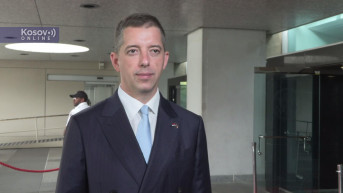
Serbian Foreign Minister Marko Djuric emphasized that he informed his American counterpart, Marco Rubio, about the pressures and problems faced by Serbs in Kosovo, stressing that the situation requires engagement from the international community in order to preserve stability. He also highlighted that his visit and meetings with top U.S. officials were extremely important for Serbia’s new positioning in Washington.
"Regarding Kosovo and Metohija, we managed to convey at least part of what the Serbs are facing—pressures, problems, the takeover of institutions, and the pressure on the Serbian Patriarch and the Serbian Orthodox Church. This is a situation that requires the engagement of the international community to maintain stability," Djuric explained to reporters.
He stated that he pointed out Serbs are being targeted by Albin Kurti and are suffering as a result of his unilateral moves.
Djuric recalled that Serbs in northern Kosovo renamed Lake Gazivode to Lake Trump in gratitude for what was done during his first term, and that Kurti's regime not only annulled the name but also reversed everything achieved under the Trump administration.
He said the meeting with Rubio took place in an exceptionally positive atmosphere.
“We even joked that this was a summit of the two Marks. This is the first time in many years that such an open space has been created for Serbia in the U.S. We talked about launching a strategic dialogue very soon, elevating our relations to a level we haven’t seen in generations. There is a strong mutual awareness that this is an excellent opportunity to raise relations—long marked by fluctuations—to a new level,” he said.
Serbia, he stressed, as an independent country that takes orders from no one, appears to be a natural partner for the Trump administration, which seeks new ways of cooperation with countries in our region.
Djuric stated that beyond political alignment, there is a strong desire to deepen economic cooperation in areas such as energy, infrastructure, new technologies, and more.
"This is an opportunity we must seize, because the administration led by Trump needs allies and friends, and historically, Serbia has been just that. I believe it can be again," Djuric emphasized.
He added that he requested support for issues important to Serbia.
“Understanding the difficulties we are facing, the judgments against RS officials, and the pressure on The Republic of Srpska—because the imposition of decisions by unelected representatives only adds fuel to the fire. Pressure from irresponsible politicians who seek to remove those elected by the people cannot lead to solutions. Solutions must be sought through dialogue,” Djuric underlined.
He noted that he had the opportunity to present his views on the situation in RS and Kosovo to Rubio, who, he said, went directly to the White House after their meeting.
“We positioned Serbia, which is committed to regional stability, as an anchor of stability in turbulent times—one that should be supported, as opposed to those who would drag the region into conflict,” Djuric said.
He emphasized that the treatment of Serbian representatives reflected high respect and the ambition of the U.S. government to build new relations with Serbia.
He said that this was the greatest honor of his life—to have had the opportunity, together with his team, to work on opening a strategic dialogue with the U.S.
“When we achieve that strategic dialogue, it will place us in a completely different category in the eyes of the American system—a different group of countries in terms of economic, security, and political approach. Will that solve all our problems and challenges? Of course not—not even close. But it is a serious step forward,” he stressed.
“It is especially important that this meeting happened during these turbulent times, given what is happening with RS and Kosovo. We need people who are receptive to the Serbian position. That is why this is quite significant,” Djuric said.
The Serbian Foreign Minister stressed again that his visit and talks with top U.S. officials were extremely significant for repositioning Serbia in Washington with the new administration, and that they actually represent a continuation of what President Vučić started with his conversation with Donald Trump during the early days of his presidency.
"This is a huge opportunity for Serbia, at the very beginning of the new administration’s term, to be the first country from the region to strategically engage with it. I believe that in the coming weeks and months, we will see more results and concrete steps," the Minister announced.
The very fact that he was the first from this part of the world, as Serbia’s foreign minister, to be in Washington is, according to Djuric, a sign of respect and a sincere desire for positive change.
"It is our responsibility to find a way to make this happen and not miss the opportunity to turn a new page in Serbia–U.S. relations," Minister Djuric concluded.
He told reporters that, in addition to Rubio, he also spoke with his deputy Christopher Landau and Brendan Hanrahan, whom he described as the key official for Europe, and that all meetings took place in an atmosphere aligned with Donald Trump’s stance and that of his administration—to improve relations with Serbia.
He added that he would also meet in Washington with the U.S. Special Presidential Envoy for Hostage Affairs to ask for help in securing the release of a Serbian national from Gaza, adding that he expects Serbia’s help to ensure the release of nine journalists from the NBC media network (who are not U.S. citizens) from Gaza in the coming hours.
When asked about tariffs, Djuric said the two countries’ teams would continue negotiations on the matter, expressing hope that growing high-quality political relations would positively affect this topic as well.
He reminded that U.S. tariffs impact all countries worldwide, adding that, for example, the President of Switzerland is currently in the U.S. and that Switzerland, despite investing hundreds of billions in the U.S., has been subjected to a 39% tariff.
“We will continue working to resolve this issue. It is very important for us that U.S. institutions continue visiting Serbia, that through strategic dialogue we resolve the issue of double taxation and other matters, and that cooperation between our two economies continues to flourish. On an annual basis, in IT and software alone, we have an exchange measured in billions of dollars,” Minister Djuric said.

0 comments