
Drecun: The meetings in Brussels indicate that no agreement has been reached
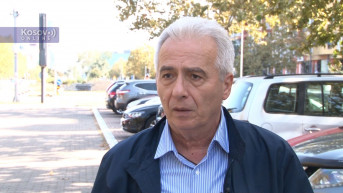
President of the Committee for Kosovo and Metohija of the Serbian Assembly, Milovan Drecun, stated that he didn't believe that any agreement had been reached in today's talks in Brussels.
"The separate meetings of European leaders with Serbian President Aleksandar Vucic and Prime Minister of the provisional institutions in Kosovo, Albin Kurti, indicate that no agreement has been reached and that a solution is being sought to bring the two sides closer, the possibility of achieving some progress. To agree on the continuation of the dialogue and the implementation of some agreement, but for us, it's just a proposal for an agreement," Drecun told Tanjug.
He emphasizes that Pristina's refusal to establish the Community of Serb-majority Municipalities prevents any progress and reaching an agreement and that a solution is sought in Brussels for the almost complete deadlock in the dialogue.
"They simply don't want an agreement. You have it in Kurti's statement, he only said that if Serbia was not sanctioned because of the events in Banjska, i.e., he pre-judges, and for him, the official Belgrade is responsible, there will be no successful crisis management, no continuation of dialogue, and they will forget about normalizing relations. Then Kurti probably just asked in this meeting to sanction Serbia, if he sticks to what he said, then there will be no dialogue," Drecun said.
He added that the EU was not naive to take measures against Belgrade without evidence, and, as he said, there would be no evidence because Serbia had nothing to do with the events in Banjska.
He reminds that the President of the Assembly of Kosovo, Glauk Konjufca, said that if it ever came to the agenda, Pristina would write the draft of the CSM, and there was nothing to negotiate about.
"They have accepted this innovative plan brought by the five countries as a framework for continuing talks and only with allies. They don't intend to hold any talks with Belgrade, only with allies," Drecun concluded.
He states that the EU spokesperson Peter Stano has said that the new plan offered by the five countries to continue the dialogue and implement the agreement on the path to normalizing relations and the Ohrid Annex is a modern European proposal.
Then he notes that the US Ambassador in Pristina unequivocally states that the CSM cannot be in conflict with the Constitution of Kosovo and the decision of the Constitutional Court of Kosovo and cannot have any executive powers.
"This means that they have completely rejected the Brussels Agreement from 2013 and 2015 regarding the CSM. This is not acceptable for our side. How do you think progress can be achieved? There is a continuous policy of Western countries and Pristina here. This can be seen from what I have said so far," Drecun emphasizes.
On the other hand, as he said, Serbia's position had been clear, confirmed by Prime Minister Ana Brnabic at the UN Security Council, where she stated two key things.
"The CSM, as far as Serbia and the Serbs in Kosovo and Metohija are concerned, must be in line with the Brussels Agreement and must have executive powers; otherwise, we will not accept it. That was her message. She did not say we would not accept any other concept, but she said it must be in line with the Brussels Agreement. This means we will not agree to anything else. And she said, as President Vucic also said, that we would not recognize the false state of Kosovo, neither de facto nor de jure," Drecun pointed out.
He added that if someone insisted that the agreement be adopted on those terms, he condemned it to failure in advance.
Therefore, as soon as he saw what the draft of the agreement looked like, he said it was a dead letter on paper because it had come out of the status-neutral framework, which was absolutely unacceptable for Serbia.
"The status-neutral framework allowed for negotiations and the previous Brussels Agreement to be reached. It was the framework in which Belgrade and Pristina negotiated, not two states. This proposal of the agreement departs from the status-neutral framework and treats Kosovo as a state, which from the outset makes reaching any agreement impossible," Drecun emphasizes.
He believes that leading Western countries are trying to force Belgrade, especially President Vucic, into accepting the proposal as an agreement through political pressure and fully implementing it, even though Serbia cannot accept it due to two points regarding the membership of the false state of Kosovo in international organizations and the establishment of relations with them based on territorial integrity and sovereignty.
"These are principles that exclusively apply in the relations of two internationally recognized states. Kosovo is not any internationally recognized state," Drecun concludes.

0 comments