
Escobar: The solution for the normalization of relations - the formation of the CSM
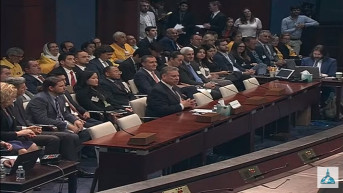
The US Special Envoy for the Western Balkans, Garbiel Escobar, pointed out today, in front of the Foreign Affairs Committee of the House of Representatives in Washington, that the solution to the normalization of relations between Kosovo and Serbia was the formation of the Community of Serbian Municipalities.
When asked by the congressman if there was any hope that the agreements from February and March of this year would be implemented by the end of this year, Escobar said that - he did not see the will on either side.
During the discussion, congressman Darrell Issa pointed out that the unilateral measures of Kosovo Prime Minister Albin Kurti were documented, and asked how the US could act on him, because he was not part of the solution.
Escobar replied that the EU and the US had announced clear demands, that Brussels had introduced measures, and Washington had taken actions, such as the exclusion of Kosovo from a large joint military exercise.
"We are concerned that Kurti is not coordinating with the Euro-Atlantic community. This includes the Quint, but also Kosovo's neighbors, Albania and North Macedonia. We are looking for ways to convince the government in Pristina to see the US as a major partner, because that would be beneficial," Escobar said.
He also emphasized that the USA was the main guarantor of security and stability through the contingent in KFOR.
Congressman Issa also asked why EU diplomats did not go to the north of Kosovo to talk with representatives of Serbs.
Escobar replied that he went to Mitrovica every time he visited Kosovo, and that the last time he was in the north was last fall, and that since then he talked with the leaders of Kosovo, including the Serbs, in other parts of the region and Kosovo.
"We talk regularly. Now, while we are talking here, a group of Kosovo Serbs, representatives of non-governmental organizations is in Washington", said Escobar, stating that the USA has significant contact with Kosovo Serbs.
When asked by Issa whether there was a constitutional solution to the problem in Kosovo, Escobar said that he believed that the solution was the CSM.
"I think the solution would be CSM. This would enable the Serbs to enjoy their rights. They are often dual citizens. We have European models that they could apply. It just takes the will," said Escobar.
Congressman Mike Lawler asked whether the Brussels Agreement, 10 years after its signing, was still important, to which Escobar replied that the Brussels Agreement was good, was is the basis for the Ohrid Agreement.
"It provides an opportunity for rapprochement and normalization of relations. Both sides should give up ethno-nationalism and look at the opportunity offered to them by joining a multi-ethnic community such as the EU," he added.
Escobar also stated that the CSM, whose formation was foreseen by the agreement, would not undermine the functionality of Kosovo.
"That Community would be an institution that would provide communal services in the Serbian language, to the Serbian population in Serbian majority municipalities, and nothing more," underlined Escobar.
He reminded that Albania even offered to draft a statute, and expressed the hope that Kosovo would understand that it had an obligation that it must fulfill, and that this obligation would be in accordance with European standards.
Asked what the State Department was doing to convince the five EU countries to recognize Kosovo, Escobar said that those countries did not recognize Kosovo, because they believed that this would lead to instability.
"But the Ohrid Agreement represents the greatest opportunity for progress. Those countries would like to see Kosovo's goodwill in the implementation of the agreement," he added.
Congressman Brad Schneider was interested in the European integration of the Western Balkans, and Escobar explained that it would be a mistake to look at the region as a whole.
"Three countries - Montenegro, North Macedonia and Albania have progressed on the European path. We count on those countries to help us stabilize the region. We still have three countries, Serbia, Kosovo and Bosnia and Herzegovina, which are lagging behind in European integration. All those three countries have a similar problem that they have not reached the required level, because domestic politics is marked by ethnic rivalry. We are working on finding a way for ethnic reconciliation," Escobar added.
He pointed out that integration into the EU would be of great benefit to the region, but also that these countries had enormous potential.
He said that the economic cooperation of the region was needed on this path, and that the USA supported economic integration precisely because of this.
When asked by Congressman Thomas Kean whether Kosovo sincerely approached de-escalation and the implementation of the agreement, Escobar said that the latest agreements, especially the Ohrid one, offered both sides the opportunity to normalize their relations.
He said that the agreement envisaged that Serbia recognized the documents of Kosovo and gave up the blocking of membership in international organizations.
On the other hand, he added, Kosovo was required to form the CSM.
"Both countries should implement the agreements as soon as possible, without delay. Everyone should implement their obligations, independently of the other party. They need to start implementing it as soon as possible and achieve progress", explained Escobar.
When asked by Congressman Kean what Kurti should do to lift the sanctions, Escobar replied that he would not talk about the sanctions, but about the consequences.
He reminded that there is a joint EU-US three-point plan, which envisages the withdrawal of special police from the north, the abolition of protests and the holding of elections, and then a return to dialogue.
"Those are the conditions. We received an assurance from Serbia that they will withdraw the demonstrators and that the Serbs will participate in the elections. We agree with Kosovo about democratic standards, and that all those who were violent should be punished. But we want greater harmonization of Kosovo with the international community," said Escobar.
He said that the USA recognized the legitimacy of the elections in the north, even though only three percent of the voters turned out, despite the opposition of Serbia, that Washington recognized the new mayors despite the opposition.
"However, we were against the violent installation of the mayor in a new position," he emphasized, adding that this did not diminish the legitimacy of the Kosovo government.
He pointed out that the US would work with the EU to implement a joint plan for de-escalating the situation in the north of Kosovo.
Congressman Bill Huizenga was interested in the fact that Serbia was buying weapons from Russia, but also from China, and asked if Serbia was warned that if it wanted to be a part of the EU, it must agree with European policy in that field.
"There are some technical complications, when we talk about Serbia there is influence from Russia, but also from China. We tell them at the meetings that if they want to be part of the EU, they must also be part of the European armament policy," said Escobar.
Huizengu asked Escobar if he ever received an answer from an official from Serbia that they would stop with that, to which Escobar replied in the negative.
Congressman Jim Costa reminded of the agreement and the annex to the agreement agreed in March of this year and stating what Serbia agreed to in that agreement, and noting that it was already July, asking if anything could be implemented before the end of this year.
Escobar honestly answered that he saw no goodwill from either side.
As he says, they invited both parties to return to dialogue and implement what was agreed upon, as well as to de-escalate the situation.
"Serbia should recognize Kosovo's national symbols, not oppose Kosovo's membership in international organizations, and Kosovo should form the Community of Serbian Municipalities. That was agreed, but for the last 60 days we have been working to calm tensions," Escobar said.
Congressman Costa also expressed concern about ethno-nationalism in the region, to which Escobar replied that reform processes were being worked on that would lead to greater protection of minorities.
In response to congressmen's concerns about the influence of China and Russia in the countries of the region, Escobar said that the US and the EU should increase economic investments, as well as work to reduce energy dependence on Russia.
As he says, many countries in the region have taken steps to reduce this dependence. He also points out that Russian influence manifests itself through misinformation and energy. He also states that Russia has lost influence in most countries in the region, but that work with governments must continue.
Congressman Keith Self said that there was no doubt that Serbian President Aleksandar Vucic initiated the boycott of the elections in the north of Kosovo, and that Serbia was not Ukraine, which was a country on the border of NATO, but a country surrounded by NATO, so the potential danger was greater, and asked why there were no sanctions against Serbia, when it was known that it imported weapons from Russia.
Escobar replied that he did not deal with sanctions related to weapons from Russia.
He pointed out that the USA had great opportunities to sanction those who undermined stability in the Balkans, and that they were using these opportunities.
He said that former congressman Eliot Engel's statement that the USA was pursuing a conciliatory policy towards Serbia was wrong.
He reminded that in the past 60 days, the USA had supported Kosovo in many ways.
"We recognized the legitimacy of elections in which the turnout was less than three percent, we sanctioned the head of the intelligence service of Serbia. The Kosovo authorities themselves say that the elections in the north are not the key to stability. Some members of the new government have only one vote, their own. That is not stability," said Escobar.


0 comments